Our Eccentric House

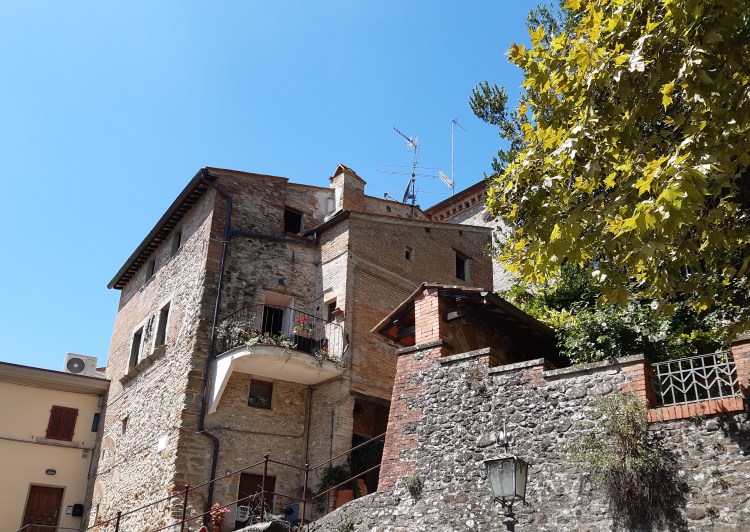
Our house in Anghiari is a tower, probably a watch tower originally as it overlooks the Tiber Valley. Living in a tower means living with stairs leading from one floor to the next, two sets of them in our case. Living in a tower built in the 1300’s means that it has undergone a number of renovations during its centuries of use. Terry and I wish we could see a time lapse video of all the changes made over its history. We know of the renovations that the previous owner made–moving the kitchen from the first (U S second) floor to the ground floor was a major shift in the way the house was used and one we fully appreciate. This post, however is about the real oddities of the house, the truly eccentric features that make our home unique.

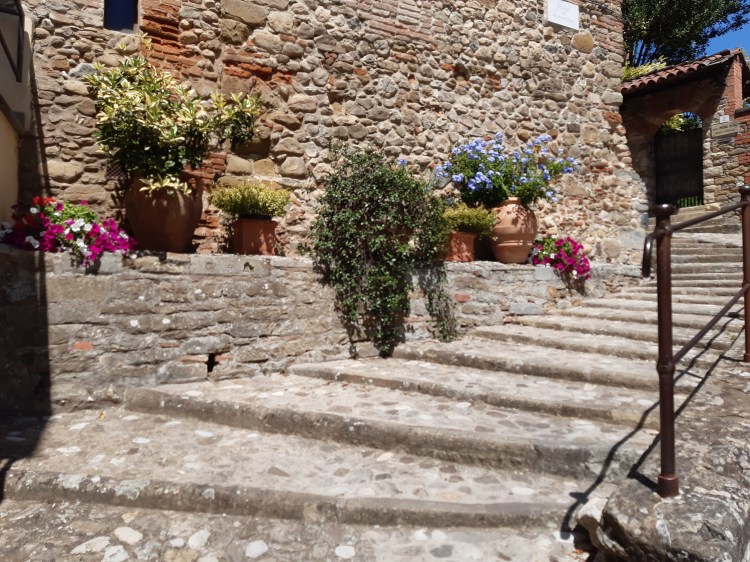
First, there are the steps just inside our entry door. The only term that can fairly describe them is Ugly. They look like they belong outside, perhaps leading to a tumble down shed on the back of a property but instead are one of the first things seen when entering our house. In addition, they are difficult stairs with risers much higher than on modern, built to code, steps.
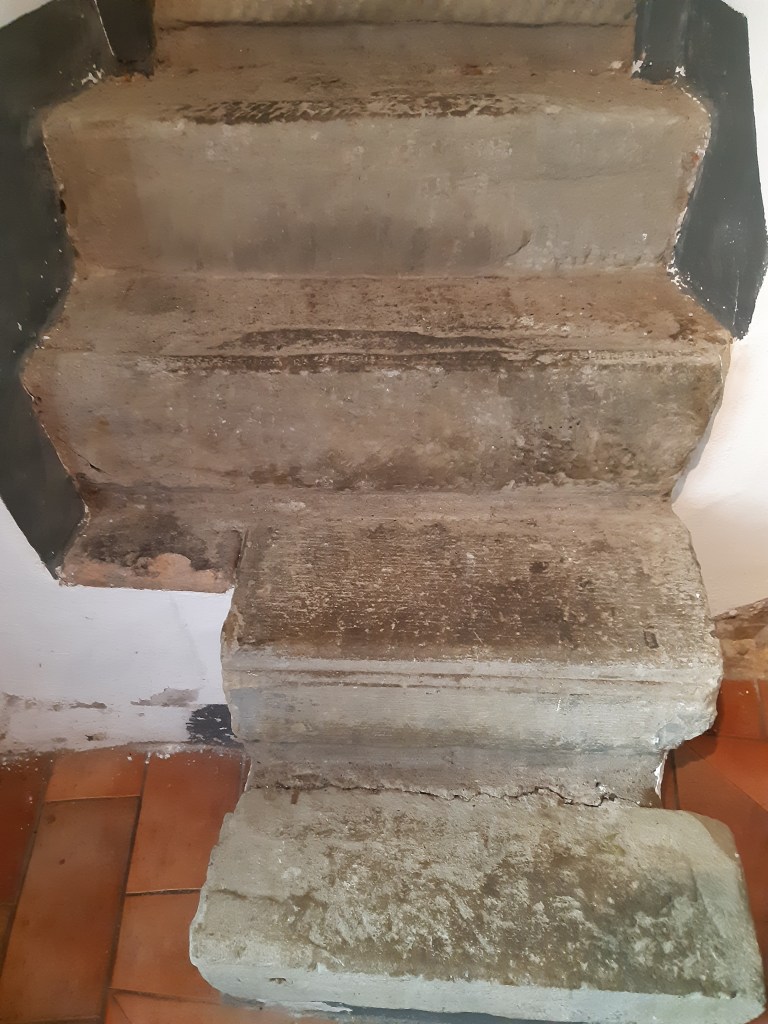
Steps leading to cloak room near entry door

As you can see, the lower steps are only about three quarters the width of the upper steps. Were the lower ones cut? In their current configuration, they leave room for the entry door to swing open, which couldn’t happen if they were the same width as the upper steps. Assuming they have been cut, then when?
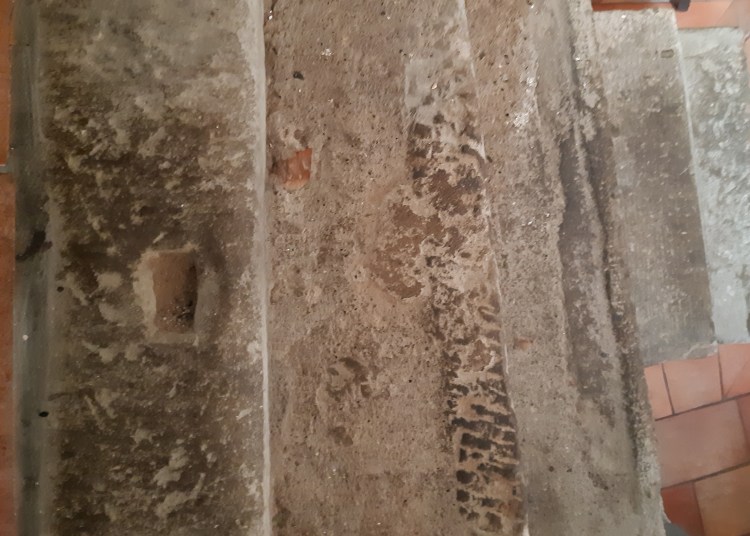
On the threshold leading into the cloakroom at the top of the stairs, there is a depression indicating the use of a pintle. I can only speculate about the kind of door original to this entry, but it may have been a single wooden panel, which pivoted on the pintle. Today the width of the doorway is very narrow because the existing walls of the cloakroom encroach into the space, but certainly the original opening had to be much wider.

Since I find these steps so unattractive, why not replace them? Well, because they are clearly very old, possibly as the old as the house itself and are part of its story. Many occupants of this house have climbed those stairs, maybe including the soldiers who fought in the Battle of Anghiari and I just wouldn’t like erasing that little bit of history.

Walking through the entry room into the kitchen, we see a door jamb that today is in the outer wall of our house. Where did it once lead? Who knows. It seems most likely that it was an outer door as there is no indication in the present structure that there was another room into which this door might lead. Now it simply frames shelves holding pans.
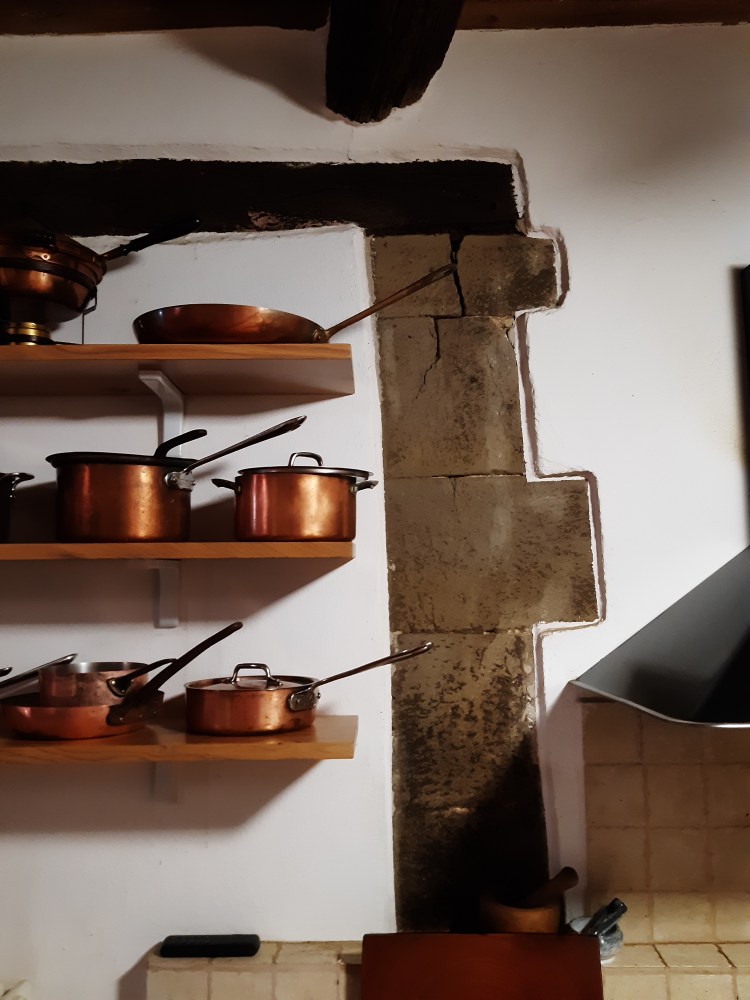
doorway to nowhere

Turning left from here takes you through another doorway into the dining room. On the right side door jamb there is a cross etched into the stone. While we were quite delighted to find this symbol in our house, it is apparently not unusual in older houses. Our friend Elga has three such crosses in her agriturisimo.
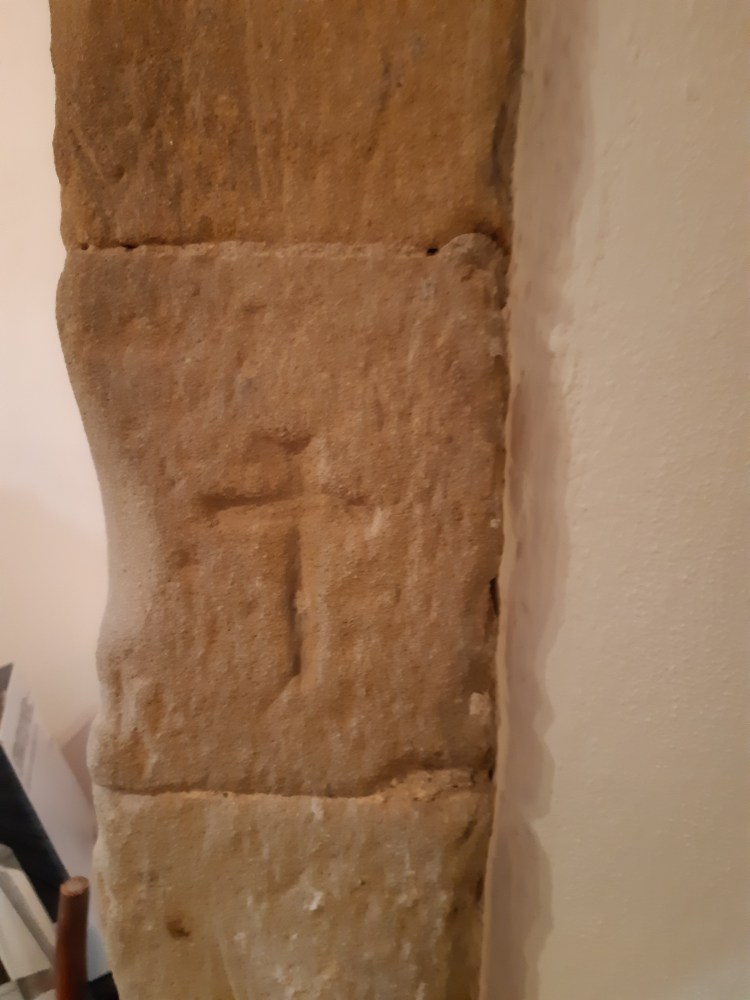
cross etched into the doorway to dining room

Next, on the outer wall of the dining room there is a window at floor level. In the recess for the window stands my Mexican turtle tureen, seeming to be guarding the opening.
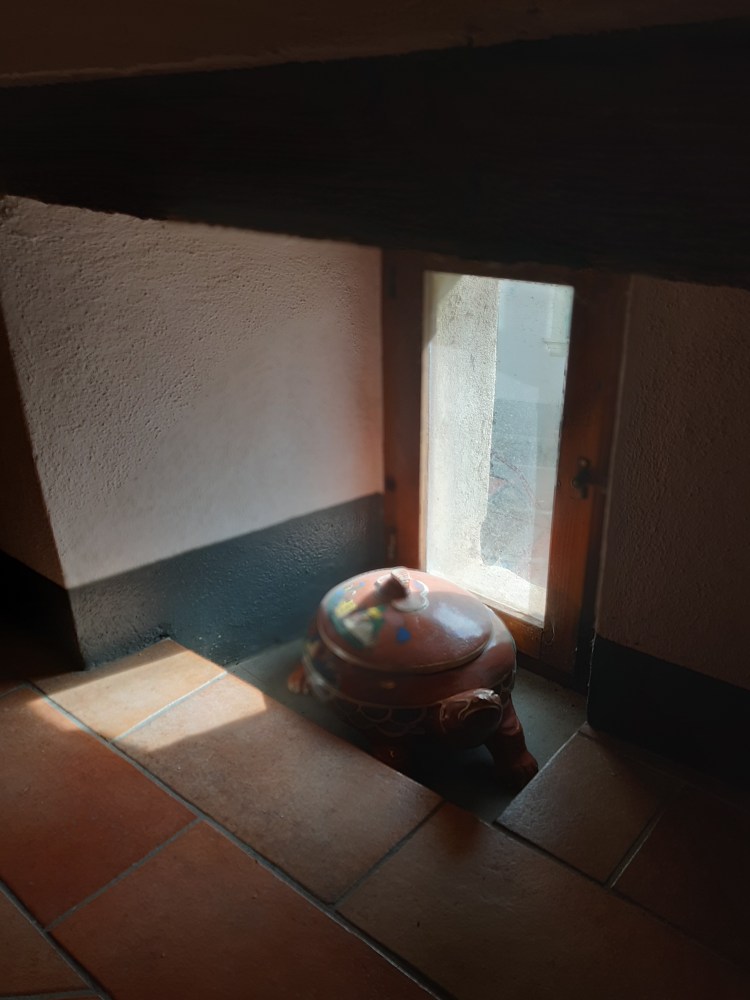
window at floor level

Viewed from the outside, some sense can be made of the window’s placement. A door to the exterior was at one time located here but it was filled in at some point in the tower’s history, and only the small window opening left. Since the window is at floor level in the current configuration, the base of the doorway had to have been on a yet lower floor, made possible by the slope of the land. Today that level contains our cantina, a store room filled with Terry’s paintings. The cantina does not extend as far as this doorway and was walled off at some point.

At the threshold of the lower door, where one would step outside, there is a low wall providing a walkway, perhaps used for monitoring activity, even threats from unwelcome visitors, or maybe simply leading to ground level. Today, that wall is used to hold plants that line the stairs to our entry door.
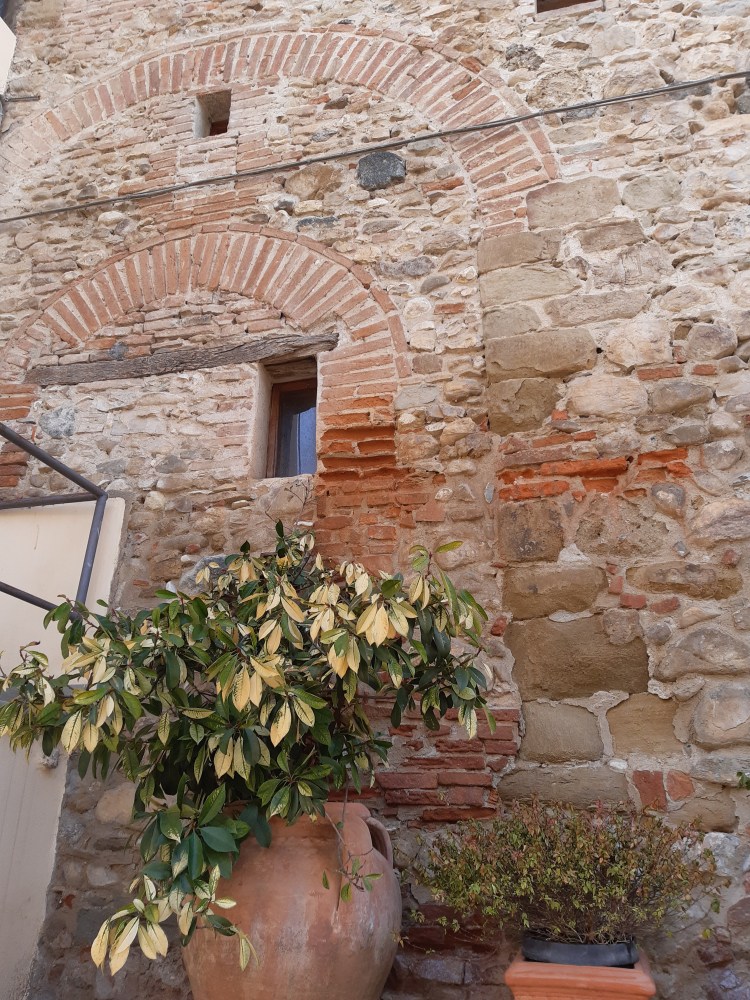
window on floor of dining room, seen from outside

Another window in the larger, upper doorway is high on our dining room wall and, if the brickwork is a good indicator, must have been larger at one point. Now it is just another oddly placed and rather small window. Perhaps someday further research or analysis by a practicing architectural historian will explain the sequence and purpose of the two doors, but for now that remains unknown.

Adjacent to the kitchen, a stairway, built in recent times, takes us upstairs to the first (US second) floor landing and hall, living room and bedroom. When sitting in the living room, it is obvious that the outer wall curves slightly and the curve continues through the adjacent wall of the hall at the top of the stairs. While this would not be evident in a photograph of the wall itself, the construction of the beams shows how the curve had to be accommodated.
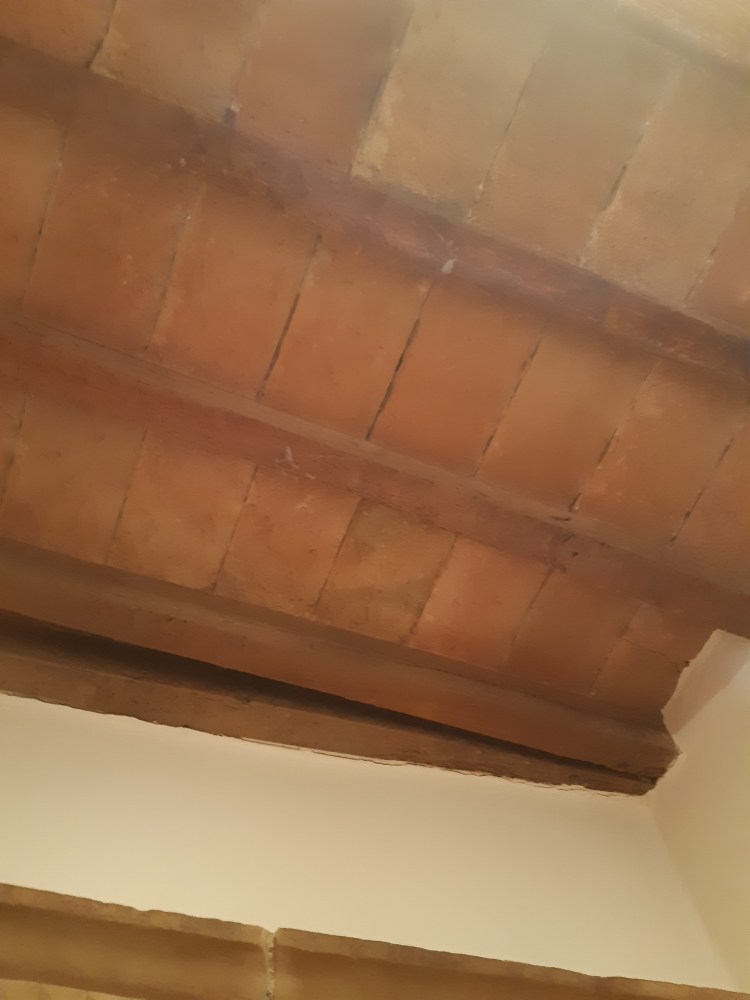
beams on the outer wall of living room

This method of adjusting the ceiling to the curve can be seen in the outer rooms of all three floors. The curve leads to speculation about the original form of the tower. From the outside it appears to be rectilinear, but was it, at one time, rounded? Rounded towers developed later than square ones and were somewhat more defensible since arrows were deflected more easily than when shot at a flat wall. However, the slight curve apparent today does not necessarily suggest a fully rounded structure. It is just another matter giving rise to speculation and puzzlement.

Along the curved outer wall of the living room, there is a non-operational fireplace. We don’t know when it was blocked and made unusable except that it would not have been done until improved heating systems were available. Today a small laundry room backs up to the fireplace wall, a renovation that eliminated the flue and chimney in favor of a more convenient laundry space. But the oddest thing about this fireplace is the result of a remodel that added a partial wall between the living room and hall landing.

right side of fireplace

You can see that the mantle of the fireplace finishes with a rounded end extending beyond the right side of the fireplace surround. Now look at the left side of the fireplace.

left side of fireplace

The left side of the fireplace abuts the living room wall and the mantle appears to be cut off. However, that is not the case, as you can see below.
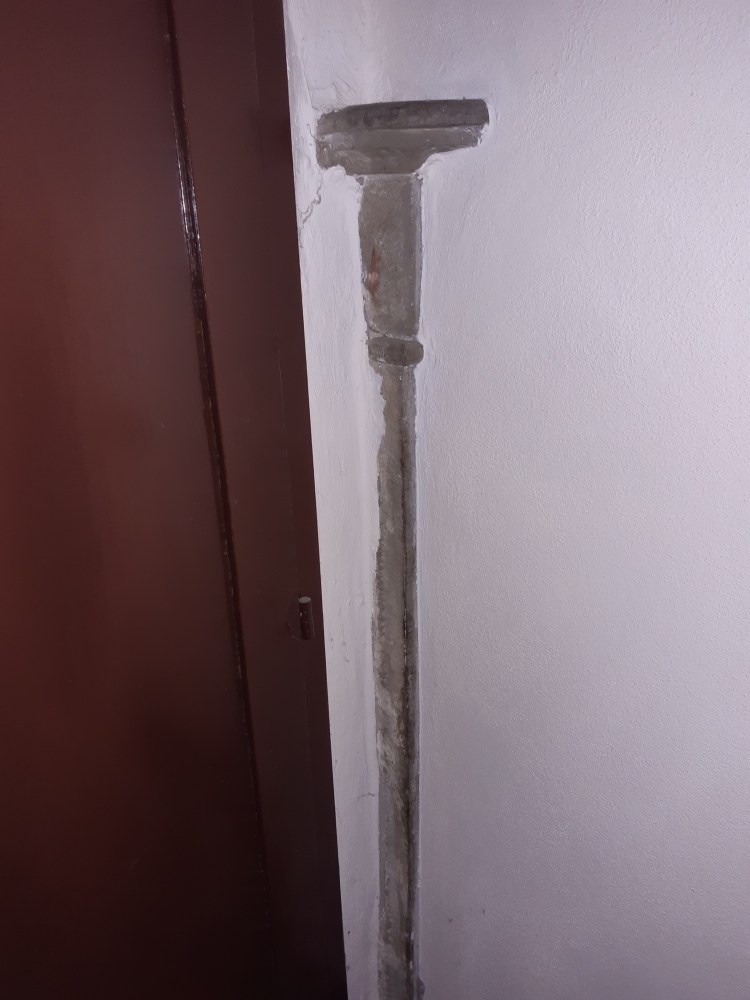
the rest of the fireplace seen in hall

Here you can see that the left side of the fireplace protrudes through the wall into the hall. Why wasn’t a more aesthetically pleasing option used? Simply building the wall a little further out would have been an obvious alternative or eliminating the partial wall altogether and creating a larger, more open room. However, on the left is the door that leads to the present laundry room and therein lies the problem. Even I at 5’4″ have to duck when going through this door because a slanting beam and stairs to the third level compromise clear passage. All decisions about construction were dictated by the wish to have a laundry room, which I have to admit I do appreciate.

The final oddity is in the en suite bath in our bedroom/dressing room area.
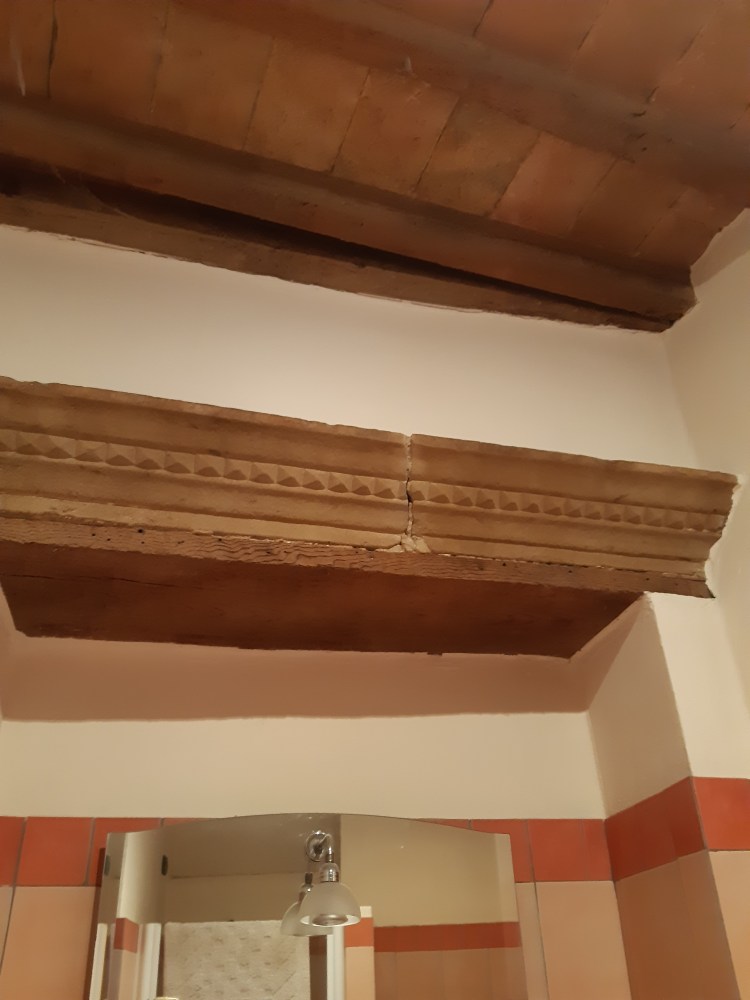
lintel in bathroom

The lintel and its supports shown above appear to be the remains of a doorway. If that was indeed the case, then its placement on what is now an outer wall on an upper floor is surprising, even more so because this has the appearance of an exterior element. Both Terry and I have interpreted the lintel as a late installation meant to provide an interesting feature, not part of the original structure. The lintel, with its tetrahedral design is hard to date with certainty, but clearly it is a rather ancient element curiously placed now in a modern bathroom. Above the lintel, you can also see the beams adjusting to the curve of this exterior wall.

Archaeology is the fascinating science we know because every object represents an activity, a process. All of the curious architectural features recounted above reflect a decision made by someone in the past who followed that decision with a subsequent action. It is left for us to wonder and speculate about who, why, when and how. And, yes, we love our tower house with all its eccentricities and will leave them for the next occupant to puzzle over.

Florence-Magic and a Little Mayhem

Post II

So following an interlude of re-nesting in Anghiari, we headed back to Florence, this time driving all the way so that we could make a quick visit to Montebeni where Terry had lived as a student. The tiny, two street hamlet sits atop a hill a short distance from Florence and remains today the quiet and intimate place Terry knew. But in the time since he was there, the village has attracted a new, wealthier population who live in upscale houses along the main street. Now there is a fine restaurant in what might be called the center, if there were actually a center, but on this day it was closed, denying us the opportunity to linger in Montebeni over lunch.

Driving across the hills to Fiesole, we planned to find a place to eat before driving to Florence. Fiesole is a popular destination for tourists and second home owners and I looked forward to exploring what I anticipated would be an exceptionally attractive small town. At mid-day, though, it was crowded with lunch goers and we found neither a parking spot nor a restaurant that wasn’t already filled. We circled the main piazza several times before giving up and decided to turn up a steep and very narrow street leading, we hoped, to better prospects. Instead, we met a car coming from the opposite direction and with no room for both cars, our only choice was to back down to the bottom of the hill. Terry put the car in reverse and edged slowly down, looking over his shoulder at the road and walls on each side. I grasped the door for security and monitored the wall sliding by my passenger side window, warning Terry whenever we got too close. Greatly relieved when we finally came to the end of the street, we decided we had seen enough of Fiesole.

As we drove toward Florence, I realized after a short time that we were actually in Florence. No obvious boundary or change in appearance separated the two–Fiesole simply morphed into Florence. Navigating the one way streets, we found a parking garage where we could leave the car for the remaining time we would be in Florence. We unloaded the extra baggage we had brought along, leashed the two dogs and headed back to our apartment on Piazza Santa Croce.

The piazza, even in September, filled daily with post summer tourists arriving by 8:00 a.m. to meet their guides. Along with seeing the sights, the opportunity to shop was clearly on their minds; most tourists returned at the end of their tour carrying bags bearing logos and filled with merchandise. Throughout the day, additional tour groups continued to arrive until late afternoon when the night people began to appear. Buskers and people hawking souvenirs replaced kiosks, hoping to earn a few Euros from the lingering crowd.

Most mornings, the dogs and I fielded early arrivals in the piazza to walk along the nearby Arno, where there were no crowds, just a few dog walkers and runners getting their daily exercise. Yes, there was quietude in Florence, if you knew when and where to find it. With a good walk behind them the dogs were ready to snooze so Terry and I could leave them on their own while we went out to explore.

Terry was first of all anxious to revisit the San Marco monastery where Fra Angelico’s famous “Annunciation” is on display. Angelico’s fresco is a featured work in any class on Renaissance art but, of course, seen only in a slide. As in all cases, seeing the actual work is a dive into detail that isn’t apparent in a photograph.

Fra Angelico’s Annunciation 1440-1445

The fresco’s placement at the top of stairs leading to the upper level of the monastery, is well conceived to make the greatest impact. Without other viewers to crowd the space, we could stand close enough to see details apparent only in such close proximity. The extravagantly rendered right wing of the angel Gabriel alone invites a long, appreciative study.  Flecks of gold, not visible in any photograph I had ever seen, highlighted the colored feathers calling out, “heaven sent.” Other paintings by the master and his students line the corridors of the monastery and, though all fine, none compared with this major work of art. 

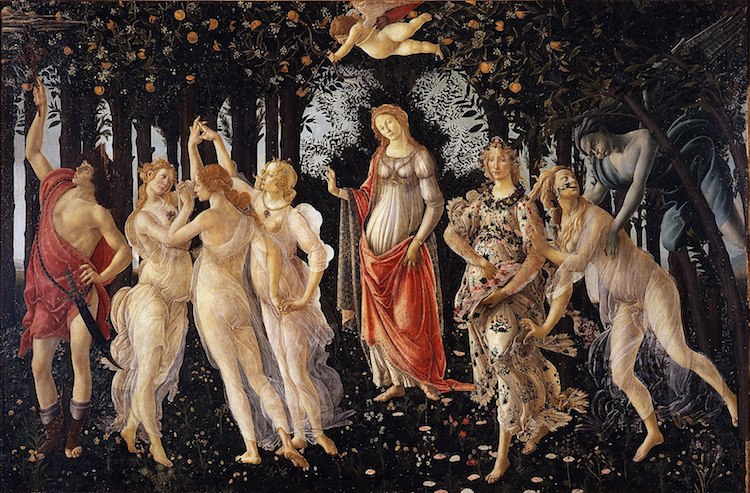
Of all the prospects before us we most eagerly looked forward to visiting the Uffizi Gallery, probably the foremost repository of Renaissance art in Florence. For us, the major draw was to see Botticelli’s paintings, which Terry and I both particularly liked  for their delicate linearity and exquisite detail. Sandro Botticelli was an early Renaissance artist (1445-1510) whose art often referenced mythological themes. His “Birth of Venus,” is generally acknowledge to be his most famous work, but our favorite is “Spring,” or “Primavera.” The figure of “Spring” is often seen as a detail from the painting, isolated as a single figure. 


Botticelli’s “Primavera” pointed between 1477 and 1485

Detail of “Primavera”

If the full painting is a marvel of composition and mysterious allusions to mythology, the detail shows the beauty of Botticelli’s delicate technique. People crowd this and other Botticelli works in the Uffizi, reluctant to step away and leave the experience behind.

One work that captivated both Terry and myself was an unfinished domestic scene, unlike any Botticelli we had ever seen. In the end, I was left wondering how much Botticelli was really in the painting, and suspecting that it had been executed primarily by students. Alternatively, was it a late manifestation of a new direction Botticelli had taken? My inclination is that it was the former.

Finally, as to major sites not to be missed, was Fort Belvedere. The fort lies high on a hill rising from the south bank of the Arno. While it was originally a fortification for the protection of Florence, today it is used for the exhibition of contemporary art, partly permanent works, but perhaps more importantly, large outdoor exhibits. Some have been stunning and Terry still regrets having missed a Henry Moore show that took place there during his early time in Italy. The day we visited, I was not so much appreciative as bemused by the larger than life musk oxen (or buffalo?) scattered through the outdoor spaces.

Musk Ox or buffalo from “My Land,” by Davide Rivalte

Virtually everyone, whether fans of contemporary art or not, praise the view of Florence from the edge of the fort.

Florence seen from Fort Belvedere

After walking down the hill from Fort Belvedere, we ended our day on the south side of the Arno at a small outdoor cafe where we enjoyed a spremuta, a generous glass of freshly squeezed orange juice. It was quiet and peaceful there, unlike the busy streets of Florence across the river and we relaxed for a while appreciating the difference.

Inevitably, the day of our departure arrived. Florence had been a fabulous treat but we did look forward to being back in Anghiari. We packed our large suitcase and the grocery trolley, slung extra bags over handles of the wheeled luggage, leashed up our dogs and went off to the taxi stop to catch a ride to the parking garage. And then watched taxi after taxi go by, all occupied and none stopping to pick up any of the hopeful crowd waiting with us. Oh yes, how could we forgotten? There was a transportation strike throughout Italy today and everyone who would normally be on a bus or train was using a taxi instead.

So we would have to walk to the parking garage, quite a few city blocks away but with no choice, off we went merging into an even larger than usual crowd. And again, how could we have forgotten? This was Friday, “Friday for Future” day and all of Florence it seemed had turned out to protest the failure to deal with climate change. Schools had closed to allow students to demonstrate and many did, though some chose to spend their time off in a cafe. Adults, too, banded together to march through the streets in support of Greta Thunberg’s call to action. However much we embraced the cause, walking through the shoulder to shoulder mob with all of our baggage and two dogs was a challenge we would rather have avoided.

Terry led the way, stopping periodically to wait for the dogs and me to catch up, then starting off again. I followed, pulling the grocery trolley that tipped and turned as we worked our way across the cobblestones, and the new peach-colored purse slid down the handle to bump along the street. The dogs pulled frantically this way and that, trying to avoid being stepped on and generally agitated by the chaos. Finally, though the trek seemed endless, our little circus arrived at the parking garage, a bit frazzled but this, at least, seemed like relative peace.

And soon, real peace was ours as we settled back into our Anghiari home. With the allowed three months in Italy nearly over, we had a mere two weeks to enjoy time there before leaving for Serbia. Meanwhile we had to meet with the team we had hired to build a closet in our dressing room and correct some design problems in the kitchen. Our medieval house had virtually no straight walls, but these workers were familiar with such problems and we could depend on them to construct a workable and attractive solution.

Florence–Magic and a Little Mayhem

Part I

With the approach of September, we bounced between the yin of having to leave Anghiari and the yang of exploring Florence. We hadn’t yet completely settled into our home and leaving would draw us away from matters waiting to be finished. Not only did we have that long held reservation from a year ago, but Florence was one of the Italian cities everybody needs to see and Terry looked forward to showing me what he had loved so much during his early years in Italy. He lived then in the small village of Montebeni, near enough to Florence to allow frequent explorations and discovery of all that the Renaissance city offered a young American experiencing Europe for the first time.

Terry’s friend, Elga, arranged to meet us at Pontassieve, the train station near Florence, where she would pick us up and drive us into the city. Elga was still a child when she and Terry first knew each other in Montebeni, but they had remained in occasional contact through the years as Elga grew into a sensitive and creative woman. She now lived her dream of owning an agriturisimo just south of Florence near Tosi where tourists could hike through the hills , experience life on a farm and learn to cook traditional dishes on Elga’s wood stove.

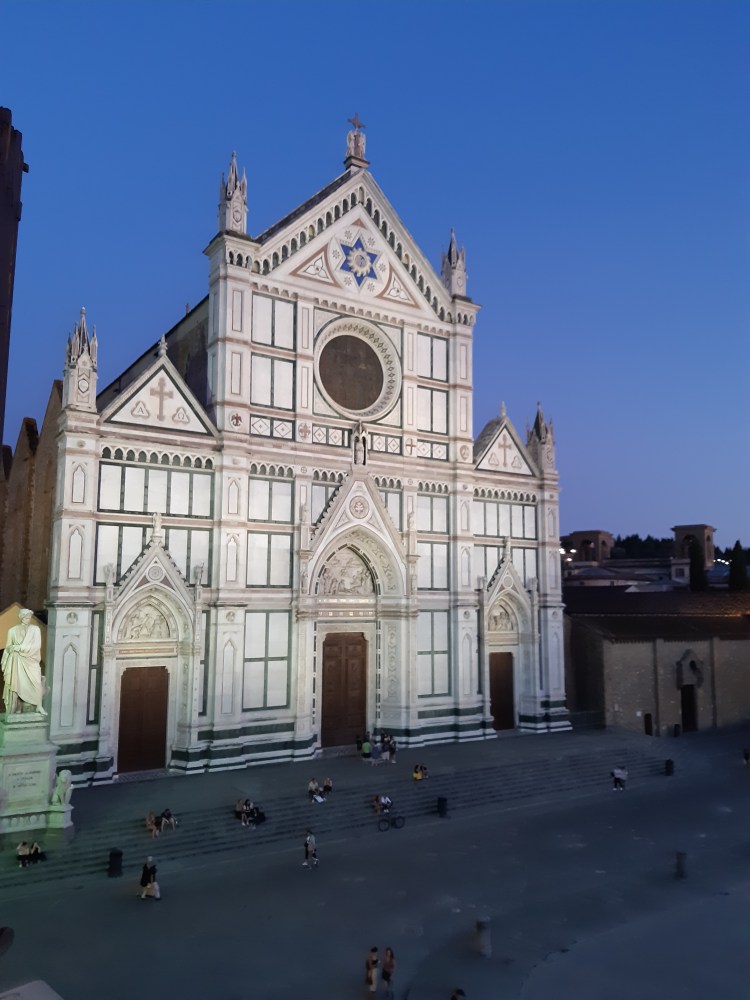
Driving in Florence is widely prohibited so we found a parking garage and then headed to our apartment, winding and bumping our way through cobbled streets, pulling luggage filled with clothes and supplies along with two disoriented but game dogs, who were once again at the mercy of their owners’ eccentric decisions. Our apartment overlooked the Piazza Santa Croce, a large square headed by the magnificent Santa Croce church and monastery. The River Arno was close by and across the river a more genteel Florence rose up into the hills.

Santa Croce with Dante’s statue
as seen from our apartment

The church of Santa Croce was built during the late thirteenth and early fourteenth centuries. Its original facade was simple stone and remained so until it was overlaid by green and white marble in the nineteenth century, reflecting the neo-gothic ideals of the time. We were struck by the prominent Jewish Star of David on the pediment, puzzled that it should appear on a Christian church. The reason for its inclusion here is purely speculative but it may be a reference to the Jewish faith of Santa Croce’s architect, Nicolo Matas. In another act of political sensitivity, or call it appeasing the masses, the exquisite statue of Dante, which originally stood in the middle of the piazza, was moved to to the side of the cathedral to make room for football games.

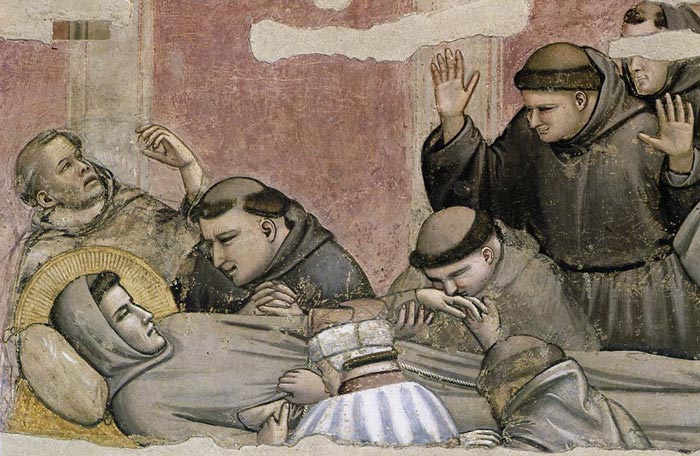
The interior is a treasure trove of Renaissance painting and sculpture. My favorite works, and most anticipated, were those by the early Renaissance painter, Giotto. His monumental figures and greater naturalism depart from the formulaic tradition of the late Medieval period, inspiring a new approach to representations of the human figure. Beyond that, the frescoes are simply beautiful with their broad areas of rich color.

detail from”Death and Ascension of St. Francis c 1325 Bardi Chapel, Santa Croce Florence

Frescoes by Giotto’s students carried on his work in Santa Croce, depicting the life of Christ in a series of chapels. Like most very famous buildings, multiple trips over time would be needed to fully grasp the significance and range of beauty of both interior and exterior. In spite of the proximity of the church, we never visited the interior again. Like most visitors, limited time and so much to see made it impossible to visit again and again. We count ourselves fortunate to have had even a glimpse of Giotto’s remarkable frescoes and the other masterpieces of Santa Croce.

We delayed visits to galleries and museums in Florence because we wanted to spend our first week merely exploring and, for me, getting to know the city. I planned to purchase a good leather purse, virtually a requirement when in Florence, and perhaps a pair of leather gloves. Clearly, my goal would be easy to fulfill as every second store sold leather goods of all sorts and before the first week had passed I owned a large bag of soft, peach colored leather that reversed to brown suede for the winter months. Gold was not on my need to have list, but if it had been the shops along the Ponte Vecchio offered every kind of body ornamentation a person could imagine.

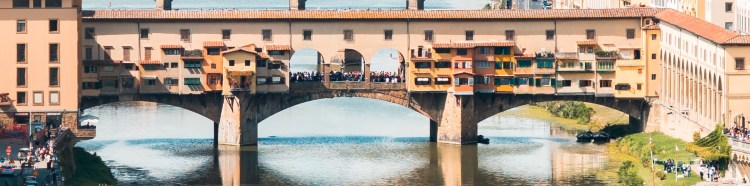
In spite of my disinterest in buying jewelry, a walk across the Ponte Vecchio is inevitable when touring Florence. Its name indicates great antiquity, but it only tells that a bridge spanned the river at that spot for a very long time. In reality there have been a series of bridges, which required rebuilding each time the Arno suffered a major flood . The original is thought to date to the Roman period and was at one time the only bridge to cross the Arno into Florence. Then as now shops lined the bridge, though in the past these were butcher shops not the gold and souvenir stores that entice tourists today . But when the Medici family built a passageway above the bridge, extending from the Palazzo Vecchio to the Palazzo Pitti the butcher shops were banned and goldsmiths took their place. A much more suitable walkway for the rich and powerful and no doubt a better experience for the modern tourist as well.

Ponte Vecchio in Florence Italy

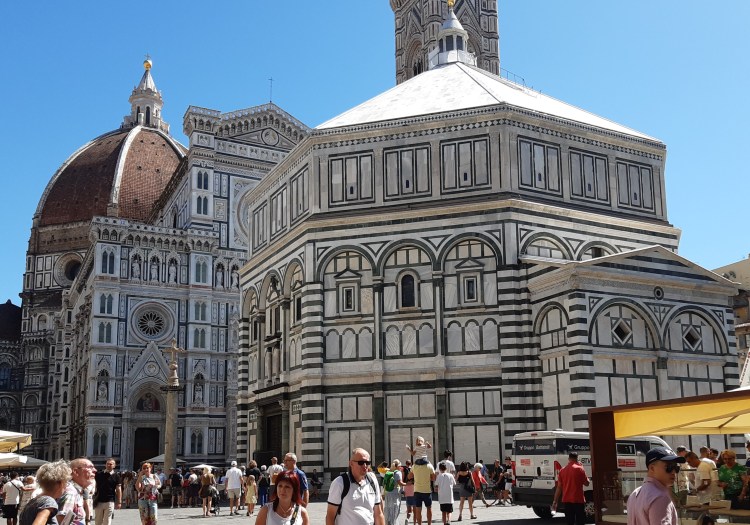
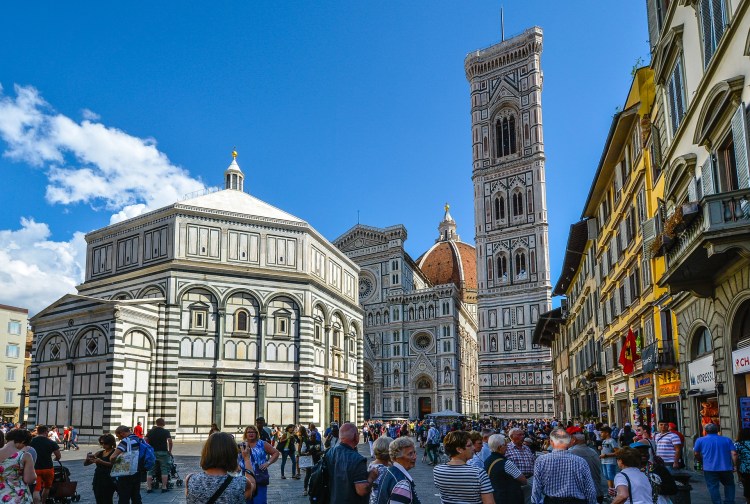
In our wanderings through Florence, we couldn’t miss the Opera del Santa Fiore where the famous Duomo stood. As a student of art history, I had seen the individual structures on slides, but coming upon them as a complex literally stopped me in my tracks.

Santa Maria delle Fiore Duomo, and Baptistry

The Duomo of Florence is perhaps the city’s most famous building. Started in the late thirteenth century, the enormous dome was only finished in its present form when the genius Fillipo Brunelleschi accepted the challenge of adding brick to the existing wooden scaffolding. The span of the dome was 45 meters wide, a vision of grandeur surely but an engineering problem, until Brunelleschi imagined laying the bricks in a herringbone pattern, creating a stable structure.

The Baptistry, adjacent to the Duomo, replaced an ancient baptistry dating to the fourth or fifth century, and that building itself may have been erected on an earlier pagan site. The illustrious Dante was baptized there as were many other notables, but it was and still is a baptistry available to an average family. The present structure was built between 1059 and 1128 AD, though its green, pink and white marble cladding was added only in the nineteenth century, along with that of the Duomo and the bell tower. The beauty and extraordinarily long history imbue this building with special significance, but it may be the doors to the Baptistry that draw the most attention.

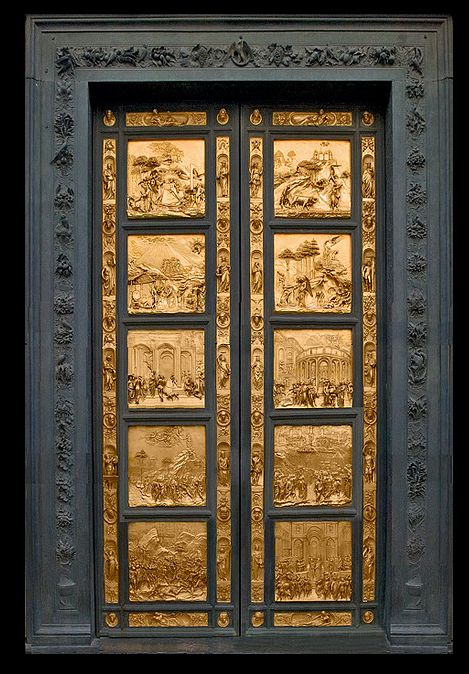
The most famous and beloved of the Baptistry doors is the “Gates of Paradise,” created by Lorenzo Ghiberti, collaborating with his two sons, Vittore and Tommaso. Lorenzo was born about 1378 in Florence and trained as a goldsmith, though like many Renaissance artists was skilled in a variety artistic disciplines. He was awarded the assignment for the east door of the Baptistry without competition because his work on panels for another baptistry door had proved his merit.

Ghibertis’ Gates of Paradise on east door of baptistry
OLYMPUS DIGITAL CAMERA Jacob and Esau (Wikipedia)

Unfortunately but necessarily, the doors of the Baptistry are replicas of the originals, which are in the Duomo museum (Museo dell Opera del Duomo). While I appreciate the need to protect precious works from assault by weather or even human agency, I find standing before a replica, however perfect, always slightly disappointing. The hands of Ghiberti or his sons never touched these works, thus in my purist view a certain intimate connection between artist and viewer is comprised.

Completing the Opera complex is the bell tower. Begun by Giotto in 1334, it took many years and many artists to complete it. After Giotto’s death Andrea Pisano took over the construction followed by Francesco Talenti, and further embellished by later artists including Donatello and Della Robbia. The facade is comprised of a multitude of niches containing sculptural depictions of biblical scenes such as Donatello’s Sacrifice of Isaac.

Giotto’s Bell Tower (photo by Kirk Fisher from Pixabay)
One of the many sculptural details on Giotto’s Bell Tower (Photo By Saiko-Own Work CC By 3.0 https://common)

The tower is a glorious monument when viewed from the street but, oh to be a bird flying through the air to see in situ the intricate sculptures that cover the structure. However, these too are replicas and at least some of the originals can be seen while standing firmly on the floor of the Museo dell Opera.

All of these wonders and more we saw during our first week and a half in Florence. Now we had to return to Anghiari for a while to take care of a few down to earth matters. The antennista was scheduled to extract our hornet’s nest and complete connection of the internet. We also had to drive to Rome to consult with the lawyer hired to plead our case challenging the visa denial. And, although unplanned, we would purchase a new stove to replace the recalcitrant and still somewhat sticky one left by the former owner.

Settling In

As we continued to unpack and put away dishes, books and clothing, we were also mindful that in less than a month, we were scheduled to go to Florence. We had rented, and paid for, an apartment there a year ago when we had yet to envision the fast track our plans would take. At that time, we thought we would use some of the month spent in the famous town, to look for property–hah! Now we would rather stay at home in Anghiari, but were committed to our reservation in Florence.

While still in Anghiari, we needed to take care of a few mundane matters like installing WiFi, finding a veterinarian for the dogs and a doctor for myself who could prescribe the daily dose of Synthroid. By this time, we had also made the decision to challenge the Miami consulate’s decision to deny us Elective Residency visas, and were in touch with the Italian lawyer we had asked to represent us. Exploring Anghiari and nearby areas was much more appealing than any of these tasks and we wanted to spare some time for that as well.

Out of all of these jobs, setting up WiFi was my most immediate concern. For this, we needed an antennista, the technician who would connect us to the system. Until that could be arranged, I sat on the steps outside our house and tapped into the WiFi of a nearby hotel to get onto the internet and into my email account. Not a very comfortable perch but it did serve the purpose and, incidentally, improved my greeting skills as neighbors and others walked by. In time, the antennista arrived, only to find that a large hornets’ nest in our attic prevented, or least discouraged, access. Before he could proceed the nest had to be removed, which proved to be surprisingly complicated. Bringing ladders and cans of spray was only the beginning. To attack the hornet’s nest, he needed permission from a neighbor to climb onto her roof in order to reach ours but she adamantly, and loudly, refused, fearing damage to the roof tiles. Thankfully, another neighbor acquiesced and, as far as I know, there was no damage to his roof. It would, however, be a month before Wifi was finally installed.

Because Grappelli was drooling regularly and a mouth check had revealed a sore spot, getting to a veterinarian was another priority. When we arrived at the small clinic, a Dutch couple who had brought a dog in for stitches were waiting for instructions before leaving. Since Terry spoke fluent Italian, the vet asked him to translate the information into English. Terry was, of course, happy to do it and I was happy that his language skills would help ensure a good connection with someone who would be important to us. When examining Grappelli, the vet found that a piece of tartar was causing the irritation so we scheduled a cleaning for a few days later. Unfortunately for poor Grappelli, the vet identified and pulled a couple of unsound teeth as well, so she returned home with fewer teeth and an anesthesia hangover.

For myself, finding and getting to a endocrinologist proved easy enough, but Synthroid is not available in Italy so, for the first time, I was prescribed a generic version. It is pretty well known among those planning to move to Italy that over the counter drugs are very expensive in Italy and one should bring a large supply of them when moving there. For prescription drugs, though, it isn’t possible to get a large supply and now we had learned that not all drugs commonly used in the states can be assumed to be available in Italy. In contrast, when Terry consulted with a pharmacologist regarding his daily medication he walked out with a supply on the spot.

Along with these tasks, we were replacing small appliances left behind in the U S with European compatible equivalents–a blender, a juicer, and, so important, a coffee maker. Terry loves cappuccino, so when we saw an elaborate device that could make all types of coffee we couldn’t resist adding it to our kitchen. We were eager to enjoy the brew from our fabulous machine but it clogged every time we tried to use it, leaving a wet mix of coffee and water in the clean out tray at the bottom–empty cups waiting to be filled saw not even a dribble of coffee. Although frustrated, I simply went back to using our French press. Terry, though was unwilling to give up a frothy, morning cappuccino and went each day to the nearby cafe to indulge. Terry eventually described our problem to the cafe owner, who offered to come by and give us a lesson. In just a few minutes he discovered the embarrassingly simple solution; the coffee beans should have been loaded into a receptacle at the back of the machine and we had been putting them into a small drawer meant for ground coffee. With that resolved, we could at last love our coffee maker; it warmed the cup, ground the beans, filled a cup with one of the several coffee choices, then rinsed itself. How amazing, and delicious.

Along with these routine matters, we continued to provide information to our lawyer regarding the challenge to the visa denial. Documents were collected and sent, questions answered and assurance given that we had a valid case for a challenge. The lawyer’s opinion derived from the fact that, under Italian law, a consulate must inform visa applicants of any deficiency that could cause a denial, allowing them the opportunity to correct or supplement information. Moreover, by July 11, when we received the denial citing failure to prove housing for a year, we had paid the full amount due on our property and sent the consulate receipts to verify it. A court date would be set for sometime around the middle or end of October, which unfortunately, put us past our allotted three months in Italy. By then we would already have left for a country outside the European Union, but we hoped that the court would decide in our favor and we would only have to be away for one month instead of three.

Moving Toward Moving In

Walkway to our new home

We checked into our hotel in Anghiari on July 13, happy to have finally arrived in the place we had chosen to live. The hotel was on the edge of Piazza IV Novembre across from the theater and our new home was nearby. We were given a top floor room with a large terrace where we enjoyed having a late afternoon glass of wine and the dogs could lounge in the sun. From there we could see across the Tiber Valley with the Apennines in the distance as well as most of Anghiari and its surrounding wall to our right. We also discovered after a day or two that if we walked to the far edge of the terrace and peered around the corner of our hotel, we could see our house.

An annual music festival was due to start in a week, which everyone in town was looking forward to. We were as well, but it meant that all the rooms in our hotel had been booked for some time and we would have to find another place to stay until our furniture arrived on August second. With the help of the hotel staff, we found an apartment a couple of blocks away though there was a two day gap between the last day at the hotel and the first day at the apartment. Funnily enough, we spent those two days staying in what was to be our new home. Roger, the owner, had used the suite on the top floor as an Air B&B, so it was well set up for our weekend stay.

The closing on the house was set for July 23. Roger had moved out the day before while we relocated to the apartment. After a lengthy closing session, we became the official owners of Vicolo di Monteloro 5 and went off to celebrate, having a final drink with Roger in a nearby piazza. With the house now our own, we were impatient to start making our mark on it and drove the next day to nearby Sansepolcro to purchase a couple of chairs and a small table for our little terrace. Although options were limited due to the space restrictions, we managed to find a small outdoor set and finished off the terrace with red geraniums and ivy to place along the railing. Now we had a place to sit and relax whenever we went to our new house to prepare for moving in.

There were also appliances to buy–a refrigerator and washing machine, both purchased at what would become a much frequented store, Euronics in Sansepolcro. Both appliances were delivered and running before the anticipated arrival of our furniture and I scrubbed, and scrubbed some more, the stove Roger left behind. More fun was walking through the rooms determining where each piece of our furniture should be placed. The house was, after all, three stories tall and we didn’t want to shift heavy items around once it was placed by the movers.

At last, August second arrived and with it one last move after so many. We left the apartment by 7:30 and headed towards our new home, pulling our luggage behind us and led by two eager dogs straining at their leashes. We arrived well before the movers, who were circling the town trying to find our house. Finally they appeared at nine o’clock and before long we were telling the three men where to place each piece. And sometimes, in spite of our pre-planning, where to move it when we realized that the designated spot was just not going to work. While they carried and heaved, we tore off tape and paper, unwrapping the furniture we hadn’t seen since May. When Django’s favorite couch was uncovered, he immediately jumped onto it and settled in, recognizing that he was at home.

Django claiming his favorite couch

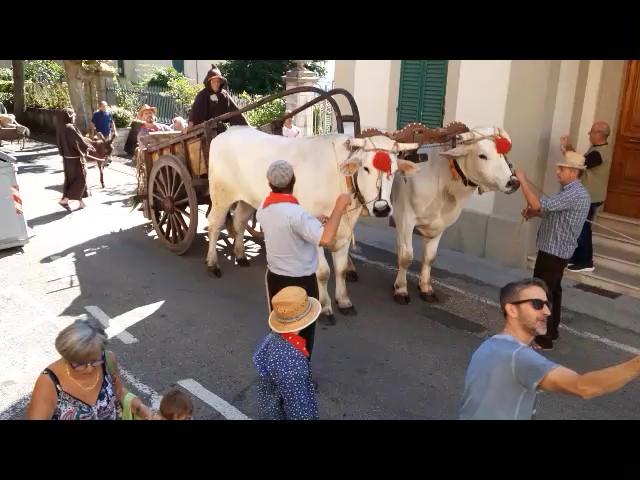
By the end of the day, with the workers exhausted, we paid the extra fee incurred by the unanticipated difficulty of the job, and then we too claimed our new home. The weekend would be spent in fast and furious unpacking of the many boxes that had been packed over months at our previous home. A delightful break came when Terry ran up to me saying, “you’ve got to see this!” A parade was working its way along the street in front of us, led by a man wearing drag and carrying a sign that said, “Finally, tomorrow I will marry Gigi and you’re all invited!” I missed that scene but saw oxen, mules and monks along with a few antique tractors celebrating times past. Anghiari was not only beautiful but promised to be interesting as well.

Here we are in Anghiari

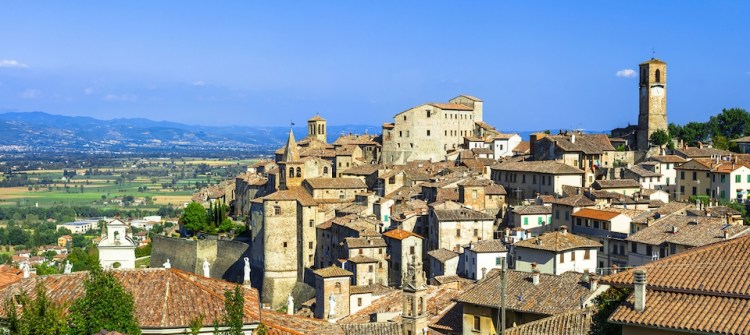
The medieval town of Anghiari and Tiber Valley with Apennines in the distance

As we drove up the street toward Piazza IV Novembre we were pleased and somewhat surprised at the beauty of Viale Gramsci, which led to our hotel and nearby new home. In January, when we were last in Anghiari, the chestnut and sycamore trees lining the street were dormant, and gave no hint of the leafy canopy we saw now in mid-summer. Large pots filled with hydrangeas stood in the spaces between trees and an occasional bench provided seating for those who wanted or needed to rest. The street itself climbs uphill with houses along the way rising above the street on one side and on the other, descending down a steep slope. Anghiari not only sits on top of a hill, but is itself made up of hills densely packed with ancient stone buildings.

Historically, it is most famous as the site of the Battle of Anghiari where mercenary soldiers gathered to fight for the respective interests of forces from Milan on one side and the Italian league representing Florence on the other. The battlefield is marked by a small stone building near the base of the long hill leading east out of Anghiari. Fought in just over four hours on June 29, 1440, the conflict resulted in only one casualty, the death of a soldier who fell off his horse and was trampled. The Florentine forces won and, according to some views, their victory and the power it gave to Florence ensured that the Renaissance would eventually take place.

The photo above shows our house. As you can see, it is actually a tower; you only need to imagine it without the small terrace. The Venetian soldiers, who fought on behalf of Florence, are thought to have been housed here during their stay in Anghiari. The house, sometimes referred to as a castello, was built in the 1300s.

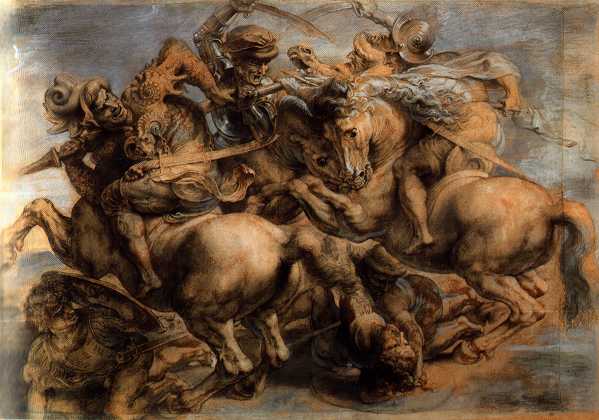
The Battle of Anghiari might have been largely forgotten if not for the lost painting by Leonardo da Vinci. Around 1503 the great artist was engaged to paint a fresco depicting the battle on a wall in the Palazzo Vecchio’s Hall of Five Hundred in Florence. Da Vinci’s propensity for innovation led him to experiment with the paints and technique, resulting in a fresco that was unstable. It was soon evident that the work was compromised and da Vinci abandoned the project. Fortunately for posterity, the Florentine artist and historian, Giorgio Vasari had described the fresco. Beyond that, sketches made by da Vinci as well as early copies of the work were available. Based on those sources, the scene of the battle was reproduced by later artists, most famously Peter Paul Rubens.

insert into Here We are in Anghiari
A drawing of Leonard da Vinci’s Battle of Anghiari by Peter Paul Rubens

Although the condition of the fresco today must be considered at least questionable, scholar Mauritzo Seracini believes it may still exist behind a wall on which Giorgio Vasari painted another battle scene. Seracini’s view is supported by Vasari’s expressed admiration for the da Vinci work and the fact that he had once before protected an earlier painting by erecting a second wall for his own fresco. Using modern technological methods, Seracini was able to establish that there was space between Vasari’s mural and another wall behind it, perhaps holding the lost da Vinci fresco. Moreover, Vasari left a tantalizing message on his mural: “cerc trova,” (he who seeks, finds.) For now, any further investigation is on hold and we can only know da Vinci’s Battle of Anghiari through copies such as the one by Rubens.

Today Anghiari is known as one of the most beautiful hilltop towns in Italy. It is a mecca for tourists who want to explore the ancient town, visit its museums and enjoy its wonderful restaurants. During the summer special performances of music or theatrical events are held in multiple piazzas and along the city wall, while in winter there are regular events at the theater. And, of course, there’s shopping.

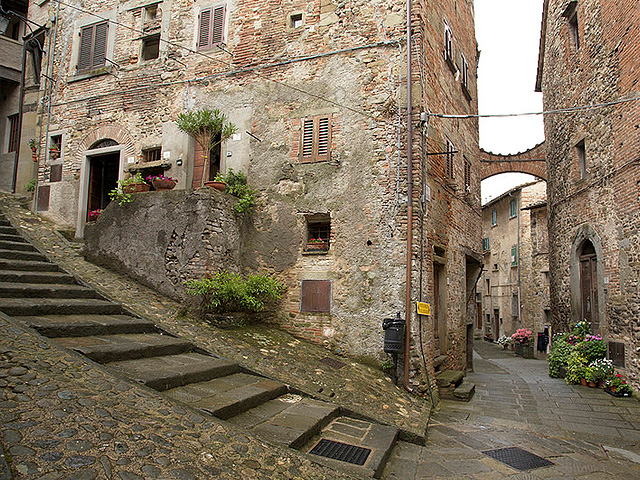
One of the streets in the ancient town of Anghiari

Walking through the narrow streets is the best way to see the town, which is small enough to cover in a day or two. For a longer stay, or for those who live here, continuing to explore is a constant pleasure. An early morning walk may take you by a bakery just opening and releasing the smell of freshly baked pastries or small fruit markets with the day’s offerings stacked outside. I was pleased to come across a tiny bin of vegetables that used the honor system for purchasing a few carrots, peppers or greens. On some days a street market is opening where anything from today’s dinner to antiques or clothing is on display. Relaxing, as the Italians do, with a coffee and cornetto is time well spent as is the pleasure of a late afternoon or evening gelato. Anghiari is a small town of only about 6,000 inhabitants, but it is an extraordinary place to visit or in which to spend a lifetime.

End Game

It was time to wrap up phase one of our plans to move to Italy. We had sold our car, moved to another and final hotel in Fernandina and now just waited for our passports to be returned, hopefully with the Elective Residency visa stamped inside. As we approached the ninety day limit that the Miami consulate could hold our passports, I began to pepper them with emails reminding them that the deadline was approaching, and asking “where are our passports?” To no avail; there was, as usual, no response.

Until, that is, the morning of July 11th, when I opened an email from the consulate to find a brief note simply giving a FedEx tracking number–FedEx? What happened to the U S Post Office, stamped Express mail envelopes we had submitted with our application? The consulate web site had stated that only USPO envelopes could be used to return our passports. Still, we now knew that our passports had been sent just in time to make the July 12 flight to Italy. We hurried to the local FedEx office to pick up our envelopes as soon it opened, only to find that they had been sent on to the Jacksonville office and shortly would be returned to Miami. The delivery to our former home address had failed since we no longer lived there. Had our USPO envelopes been used as expected, they would have been forwarded to us as we had instructed the post office to do.

We drove to the Jacksonville FedEx center in something of a panic, fearing that the envelopes had already been sent back to Miami. Thankfully, there they were, at last. We ripped open the envelopes, hoping for and maybe even anticipating, good news, but found instead a letter telling us we had been denied the Elective Residency visas. After all the effort, waiting, and expense, we now viewed an answer we had hoped not to see. The reason? Although we had fully paid off our house in Anghiari, the consulate determined that we lacked adequate proof of housing. Had they ever looked at the receipts and Certificate of Habitability I sent to back up our Preliminary Contract? Apparently not. In fact, the date of the denial was April 10, the day after we submitted our application. Italian bureaucracy is known to be inefficient, slack and uneven, and completely absent any policy of helpfulness to those needing their services; the process of applying for the ER had just given us our first lesson in how it all worked. Disappointed and more than a little perturbed at the hasty decision and failure to consider supplemental information, we drove back to Fernandina to finish packing before heading to Miami for our flight to Italy.

We had decided to drive part way to Miami that afternoon so that we would not have to make a long drive followed by an overnight flight the next day. It also gave us a little decompression time in which to absorb our situation. Lack of a long stay visa meant that we would have to leave Italy and the entire European Union, for ninety days out of every one hundred and eighty. With our primary, in fact only home now in Italy, we would have to figure out how and where to spend the time we could not be there.

It was a good thing we split the trip across two days; the traffic into Miami the next day was heavy and sometimes moved forward at barely a crawl. We began to fear that we would arrive at the airport too late to catch our flight; we were, after all, in Murphy’s Law mode with no reason to believe there might be a reprieve. In the end, we did arrive in time to return our rental car and reach the check-in desk a little over an hour before our flight was to begin loading. When we placed our suitcases on the scale, we saw that our heavily packed luggage was overweight, but the helpful lady at Air Italy suggested we simply purchase an inexpensive bag from a nearby kiosk and redistribute everything. When Terry returned with the new, ample but flimsy “luggage,”we began hurriedly unpacking items and throwing them into the spare bag. We must have looked as harried as we were feeling, but in a few minutes all suitcases were within the 23 kilo weight limit. We were alarmed all over again when told that rabies documentation for our dogs was missing, but thankfully the staff eventually found it among the sheaf of papers we had supplied. Finally, after going through the security checks, we got to our gate, where we could at last relax, looking forward to the long transoceanic flight that would put us into a state of suspended animation for the night.

The dogs slept through the flight and we were pleasantly surprised at the good quality of the service and food on this new-to-us airline. We arrived in Milan in late morning then picked up a rental car to make the four hour drive to Anghiari. Though we could not yet move into our new home, we would at least be in our new home town. By five o’clock, we were settled into a hotel on the edge of Piazza IV Novembre, a short distance from where we would soon live.

May Madness

Seeing the locked and sealed shipping container about to depart with our household furnishings brought on my first moments of nostalgia and a few tears. But, as I said to my neighbor when we hugged good-bye, “we won’t have what we had here, but we will have something else that promises to be good.”

Once the house was emptied we made sure that every surface was spotless for the arrival of the new owners, then loaded our two Boston Terriers, along with suitcases, food, computers, everything we would need for our stay in a local long stay hotel. We anticipated a two week lacuna between the time we vacated our house and the date of our departure. There were several matters remaining to be done and now we had the free time to focus on them. First on the agenda was sending the final payment for our house in Anghiari. Through our transfer company, we deposited the balance into the notaio’s account, completing the purchase and paying all fees due. With that done, I forwarded the receipts and a Certificate of Habitability to the Italian consulate in Miami to verify our purchase and further substantiate proof of housing in Italy. When I got no response, I sent it all again, but still received no acknowledgement. Nevertheless, I hoped that the information had been seen, and incorporated into our application.

I also had to complete required paperwork for taking the dogs overseas. There were forms to be filled out, some by myself and some by our local veterinarian, then sent to the USDA for validation. Because we were becoming increasingly uncertain that our passports would arrive in time for a May 26th departure, I knew that this paperwork might have to be repeated, but the passports could also come any day and we needed to be entirely prepared to depart when they arrived, possibly just before our scheduled flight.

Another “duty” was a colonoscopy recommended by my gastroenterologist. Because I had not fully recovered from a stubborn bout of bronchitis, the procedure had been delayed until May 23rd, just a few days before our scheduled flight to Italy. Though it might be difficult, we hoped to leave for New York in the afternoon following my release, or latest the next morning, arriving in New York in time for our flight. It would mean cutting short our visit with Terry’s daughter, but we had no choice and she understood the dilemma . We had yet to sell our car, so made an appointment with a dealer in New York to turn it in there, a mere twenty-four hours before we were to fly to Italy. A frantic schedule to be sure, but we were adapting to the strange new rhythms of our lives.

In the meantime we found that Grappelli would need another surgery. I had discovered a small mass close to the scar from her previous operation. I wasn’t certain whether it was simply part of the scar tissue or a new tumor, but the veterinarian saw that it was pigmented, indicating that it was live tissue, and agreed with my decision to have it removed. Because the mass was so small, the incision was only about two inches long and our stalwart little Grappelli hardly noticed it. In time we got the good news that this tumor was benign so her prospects seemed greatly improved. We could hope that removing the mast cell tumor along with the course of chemotherapy were enough to eliminate the cancer altogether.

Anticipating that our passports might not arrive in time to fly on the 26th, I called the airline to ask whether we would qualify for a refund. I explained that our passports were being held by the Italian consulate, and that, without them, we would not be able to fly overseas. “No, said the representative, we wouldn’t qualify. Now we were learning that purchasing tickets before our passports were returned was an ill-conceived and expensive, gamble.

The date for my colonoscopy arrived, still with no sign of our passports, so we could be pretty certain that there would be no drive to New York that day or the next. Instead, along with the morning procedure, it was moving day from our hotel to the home of a friend, who had offered her house for as long as we needed it. Everything was packed again, and Terry and I would move it all to our new lodging in the afternoon. Though not what we had planned or wished to happen, we were resigned to delaying our departure for a while longer and looked forward to being in a house instead of a hotel.

I woke from the anesthetic with a plastic tube in my mouth and a nurse ordering me to, “breathe, breathe.” And I was doing my best to breathe, though it was a struggle until the medication coming through the tube started to take effect. Having had a similar experience during a previous surgery, I assumed that, as before, I had had a reaction to the anesthetic. When the doctor stopped by to review what had happened, he told me that he had to abort the procedure when I went into stridor, caused by a laryngospasm during anesthesia. He had begun to remove a polyp, but couldn’t complete the excision, so I would have to return for another colonoscopy in the near future, information that was definitely groan worthy given the unpleasant prep and risk of another reaction to the anesthetic. Because the doctor thought the breathing problem might indicate pneumonia, I spent the rest of the day in the hospital being evaluated while Terry assumed the entire job of moving everything from the hotel to our friend’s house. Although a second colonoscopy was hardly welcome news, the situation would actually qualify us for a full refund of our airline tickets because now a medical emergency had prevented us from flying.

The next month, spent in our friend’s home, was a pleasant one, punctuated only by the second colonoscopy. But as the end of June approached, Terry and I decided we had imposed on the hospitality of our generous friend long enough and it was time to return to our long stay hotel–with attendant packing and unpacking. As it turned out, we would split our remaining time between two hotels because the July Fourth holiday was booked at our hotel of choice. Though we continued to look for Express mail envelopes holding our passports, we had given up any real hope that the passports and visas would be returned before the 90th day. Now we were looking at the ninth of July as our end date, a full three months after our application had been submitted. The consulate had warned us they had the right to hold our passports for ninety days and it seemed they were determined to stretch the hold as far as the legal limit would allow.

In spite of the ongoing craziness of our lives, we finally had a date we could plan on. I let our realtor in Anghiari know that we would have to delay the closing, unfortunately causing inconvenience to her and to the seller who decided to re-schedule his moving plans. But now I could book tickets for July 12, this time leaving from Miami. By that time our passports would have arrived and we could fly to Italy.

Breaking Down the Household

With the trip to Miami and our visa application completed, we turned to the next tasks confronting us. First, and more a pleasure than a task, we closed on the sale of our house in Fernandina a week after going to Miami. Closing day is always a good day and it’s even better if you don’t actually have to move then. We had arranged to rent back for a month, giving us until mid-May to finish packing. I had already been filling the many boxes Terry picked up each week and the guest bedroom was becoming crowded with boxes stacked against every available wall, but we were far from finished.

We had never questioned whether we should move our household furnishings to Italy, of course we should. We needed to furnish our house in Anghiari and some of our cherished antiques that would fit well into the historic home. What wasn’t antique or necessarily exceptional, we still liked well enough to take with us, so anything we could possibly use in Italy would be shipped. Outdoor furniture was to be left behind since we had no space for it in Anghiari and, reluctantly, we would sell our rather new car as the cost and trouble of refitting it to European requirements made taking it a poor choice.

There is, not surprisingly, a fair amount of paperwork attached to shipping furniture overseas. The company I had engaged was based in Florida, and offered house to house transferal; everything would be picked up at our house in Fernandina, and shipped to Italy, where a partner company would take over and deliver the contents to our home in Anghiari. For both companies, each item needed to be described and given a value–not only major pieces such as furniture, but also clothing, pots and pans…. every item that was to be shipped.

As usual, the Italian requirements presented the greatest difficulty. There was, once again, the matter of my married name vs my maiden name, requiring that I submit a copy of my marriage certificate to the company in Rome. In addition, I had to fill out an Autocertificazione, which promised that the shipment contained only personal household items, owned for at least a year, and which I would not sell or give away before our first year in Italy had passed. The greatest problem, though, was that we would not yet have a Permesso di Soggiorno. Anyone planning to stay in Italy must apply for this document on arrival but can’t expect to have it validated for several months. Unfortunately, it is also a requirement for moving furniture into the country. With luck we would land in Italy before our furniture did and would have at least applied for the Permesso, but we couldn’t count on that, let alone whether the mere application would be sufficient for bringing in furniture. Aldo, my contact at the shipping company in Rome suggested we could solve the problem by changing the port of entry from Livorno to Rome where he had a network of contacts. In Rome, he could utilize those contacts to get around the lack of a Permesso. Ah Italy.

With preliminary paperwork completed, we scheduled a pick up date, May 13, two days before we had to leave our house. Terry’s work load suddenly went into high gear, as he began to prepare for shipment of all his paintings from the past several decades. Paintings on stretchers would be crated by the shippers, but the many works on unstretched canvas had to be rolled and placed into cardboard tubes. While Terry attended to his paintings, I continued to empty cupboards, closets and drawers, packing some things for shipment and setting aside others for a garage sale scheduled for the end of April.

As all of our activities began to revolve around wrapping up our life in Fernandina, we decided to put the final stamp on our departure–purchasing the airline tickets that would take us to Italy. We planned to drive to New York, where Terry’s daughter lives, and fly from there after spending a few days with her. Adding together the several weeks the Miami consulate would need to process our application plus several more weeks as a margin of safety, we decided we could safely book a flight for the end of May.

Admittedly, by doing so, we put ourselves in some small jeopardy. We were ignoring the consulate’s advice not to purchase tickets until we received our visas as well as the possibility that our passports could be held for ninety days. However, we were concerned about the availability and cost of tickets if we waited until July to book. Moreover, waiting until then would delay our departure until well past the designated June 30 closing on our house in Anghiari, a date that might be altered but only at the inconvenience of everyone involved. And then there was that consulate dictum that we had to depart within ninety days of applying for visas. If one had to wait ninety days before booking a flight, violation was virtually ensured and what would be the consequence of that? Optimistically, we decided to rely on the consulate’s assurance that processing our visas would take only two to three weeks. As to the possible ninety day hold on passports, I considered that to be in the same category as the dire warnings attached to some medications–necessary for self-protection but highly unlikely to actually occur. We were quite confident that we could leave for Italy at the end of May and close on our Italian house soon after.

Going to Miami

As the date of our appointment at the Italian consulate in Miami approached, I finished organizing all of the documents gathered in the last few months. Everything was categorized and put into a tabbed notebook. I purchased two stamped, Express mail envelopes, filled out the application forms, attached the photos, and hired a dog sitter for the night we would be away. Miami is at least a six hour drive from Amelia Island, so we had decided to drive down the day before our appointment, staying overnight in a hotel near the consulate office.

The morning of our appointment we woke to discover that no coffee was available at our hotel, a serious lack on a day when we could use a dose of caffeine. We quickly packed and loaded the car then headed toward the consulate hoping to find a cafe near by. When that search failed, we settled our still caffeine-less selves in the consulate lobby, watching a clock measure off the minutes before the offices opened for business. Thankfully a small coffee shop in the consulate building soon opened and we could now enjoy a cup of coffee as we admired the Julian Schnabel paintings placed around the lobby.

While we waited, more people drifted in and found a place on one of the two sofas. I looked around at the others in the room, trying to identify which visa, or other business, brought them to the consulate. Several groups appeared to be Italians, perhaps seeking a family reunification visa. Two slim young men stood chatting together against the back wall, maybe athletes applying for a sports visa; an attractive, dressed for business Asian woman– work visa? No one I saw seemed to be of an age suggesting they were planning to retire in Italy as we were. Was there any advantage for us if we were the only ones to apply for an ER visa on this day?

Finally, as 9:00 approached, we were asked to check in, then took the elevator to an upper floor where we would present our files. We entered a small room filled with rows of chairs and took our seats, looking forward to the opportunity to verify our visa worthiness. Having read accounts of other ER applicants’ experiences, we anticipated a brief interview as we presented our documents. A bank of service windows on the far side of the room suggested that several staff members would be on duty to ask or answer questions and who would, hopefully, give some sign that an application had passed muster. Or, if it didn’t, indicate what further information was needed.

Instead, a lone man was the only staff there, serving the two dozen or so people waiting to be seen. In the course of the morning, every applicant or family group would go to each of the three windows. The first stop was a check to see that the application form was properly filled out; having done that, the applicant returned to his or her chair as another person took their place at the window. Window two was for ascertaining that all required documents were in place and again the applicant returned to their chair once that check had been done. Finally, at the third window the application form was signed, only to be done in the presence of a consulate official. All the to-ing and fro-ing by applicants was counterpointed by our man in charge who went from window to window, herding everyone through each stage of the process. The system seemed a burlesque to us, with the constant motion in the room and a single man alternating between three windows parodying a full complement of staff.

When it was our turn at the first window we were told to add a couple of details–former employers’ street addresses and our email, which, sacrificing legibility, we dutifully squeezed into the too small space. Returning to our seats we were slightly perplexed at the brevity of the encounter, but would learn soon enough that there never would be an opportune time to ask questions or discuss whether the Preliminary Contract would be accepted as proof of housing. Our carefully constructed letter of introduction describing our connection to Italy and explaining the desire to retire there would go unread. In fact, none of our documents, including financial information, would be seen until they landed in the hands of the consular assistant who would determine our fate.

After a cursory check of our file had confirmed we had all the necessary documents (window two), we arrived at window three where we signed the application form, ending our morning at the consulate. We left with the reminder that the consulate could hold our passports for 90 days, but, with a laugh, the man told us it was also possible that our files might be seen that same afternoon.

Though relieved to have completed the arduous process of applying for our ER visas, we were also disappointed that there had been no brief interview, no questions resolved, and no indication whatsoever of our position on the spectrum of likely or unlikely to succeed. Generally I would advocate getting as much information as possible when applying for the ER visa. But learning about other’s experience at their consulate appointment had predisposed us to expect a more helpful process, leading to our disappointment when that didn’t happen. For us, the only purpose of the long drive, the overnight hotel stay and the dog sitter was to transfer the file from our hands to theirs. How much easier it would have been simply to mail our application and that, unfortunately, was not an option. Still, it was over; if we were not entirely pleased with the process, that was only a state of mind, and not necessarily an indication of how it would all turn out. Now we could only wait for the result, a matter, according to the consulate website, of a few weeks

And What About the Dogs?

Terry would have been happy if I had regarded our move to Italy as an opportune time to find another home for my two dogs. Not that he suggested it, but Terry is a reluctant dog owner and only tolerates them for my sake. Of course for me there was no question as to whether they would accompany us. Both were rescue Boston Terriers, adopted shortly after my husband died, and so had been with me for some time. Django and Grappelli would go to Italy with us.

Taking pets to Europe requires another set of documentation layered on top of that required for their human owners. In February, I had sent for a packet of the forms and instructions needed for transporting animals to Italy. These papers would function as a passport of sorts, until, once in Italy, I could get an EU passport for the dogs. Because the U S and Italy are both rabies controlled counties, passage between the two is relatively simple.

Still, it is complicated enough compared to the experience of taking my first Boston Terrier to Europe. Then all I needed was a certificate of health from a vet for each of the trips into and out of France. Now new, more stringent, regulations were in effect, which I started addressing in early April. First the dogs needed to have an EU conforming microchip implanted, unless one chose to carry along a transponder that read the existing American chip. I couldn’t see that working well in a real life situation, so I opted for the EU chip. At the time the chip is implanted, the dogs also have to receive a rabies shot regardless of how recently he or she has been vaccinated. In strict order, the shot must follow implantation of the microchip. In time I would have to send all inoculation records, microchip numbers, description of each dog, and certification that they were not being transported for commercial reasons to the U S Department of Agriculture. A veterinarian in that department would, in turn, sign and return the very important papers allowing the dogs to travel. And, oh yes, a stamped and signed certificate of health filled out a few days before departure was still required.

While waiting in my vet’s office for the microchips to be implanted, I noticed that a lump on Grappelli’s side, which had been there for at least a year, maybe two, was today bright red and left a tiny drop of blood on my finger when I touched it. The mass had been aspirated previously and showed no sign of malignant cells. With that result and because it was symmetrical and soft, I had never been particularly concerned about this small lump. I could only surmise that its sudden change of color may have been caused by a scrape as she jumped into the car. The vet, however, recognized it immediately as a probable mast cell tumor–cancer. And it should be removed asap. Fortunately, she had an opening for surgery the next morning so I returned then with Grappelli, her bed, and a soft blanket to ease her post-surgical day.

When I picked her up in late afternoon, I saw an incision extending about seven inches down most of the length of Grappelli’s side. Though the mass was only about a half inch in diameter, good practice was to excise enough of the surrounding tissue to ensure that the margins were clear of any metastasis. Not surprisingly, Grappelli was in considerable pain the first day, but by the next was feeling better and was well enough within a week to rejoin Django and me on the daily walks. We had to return to the veterinarian’s office in ten days to have the stitches removed and I would learn then the results of the biopsy.

In the meantime. I studied mast cell tumors on the internet. They are graded one to three with one considered non-invasive and usually needing no treatment beyond removal. Three was a much more serious matter requiring further tests, perhaps radiation, and probable chemotherapy. Grappelli’s tumor turned out to be a three, and a very aggressive three with off the chart mitotic numbers. Because we were planning to leave the area, a course of radiation was not feasible so Grappelli began to take the only medication available for treatment of mast cell tumors, Palladia. Although it has some efficacy, Palladia is not a miracle drug and can have serious side affects. Still, there was little choice other than no treatment at all.

Before these unhappy developments, I had ordered two carrier bags, required by airlines for any dog flying in cabin with their owner. By the time they arrived I knew well the grave situation Grappelli was in and that it was possible only one of these bags would be used. I hid them away, unopened, in a closet to avoid any reminder of that sad prospect . But as the days passed with Grappelli tolerating her medication well and behaving normally, I began to feel much more confident that she would fly to Italy with us. As optimism grew, I ordered two muzzles and two travel bowls, and packed them into the carriers.

Applying for the Elective Residency Visa

Since our intention was to live in Italy, not just visit for a while, we needed to apply for the Elective Residency visa. Some readers may remember the good old days when anyone wanting to stay long-term in a European country simply crossed into a nearby country for a day, returning to home base with a passport stamped to show the new date of arrival. Since the birth of the essentially borderless European Union, that useful gambit no longer works. Now an Elective Residency visa was required for us to reside in Italy beyond three months and up to 365 days. To be granted an ER, applicants must have secured housing for at least a year and document financial resources sufficient to support oneself without working. Working, in fact, is not allowed for those living in Italy with an Elective Residency visa. It is the visa appropriate for retirees, as we were.

Applying for the ER visa is a strenuous exercise at best; many who have gone through it might describe it as horrendous. Applicants must apply through the consulate based in their jurisdiction, in our case the Italian Consulate in Miami, Florida, widely considered to be one of the most difficult consulates to deal with. Add to that the warning that “The Elective Residency visa is the most strictly regulated visa” and you get some idea of the task we were facing. Probably the most common complaint about the consulates and the process is the lack of good communication. It is not possible to call –they simply do not answer phone calls. Writing an email is the best bet, but more often than not the consulate does not reply and if they do, the response tends to be ambiguous and often no help at all.

Another problem is that information posted online by the consulates can be misleading or contradictory–some statements really should be followed by (LOL) or (HaHa). For instance, The Miami consulate asserts in its information for visa applicants, that “Visas will be issued in about 7-15 days.”(LOL) In another place they boast, “…although we take pride in keeping our processing time under 20 days (HaHa),…this consulate recommends that applicants do not purchase airplane tickets until they have received their visas.” No (HaHa) here–the latter part of this sentence is actually good advice. When describing how strictly regulated the ER visa is compared to other visa types, they explain that “The Ministry permits the consular officials to take up to 60 days to review and process an Elective Residency visa application.” Apparently violating the Ministry’s directive, they add that they may hold an applicant’s passport for 90 days even though “You can book an appointment at your convenience but your appointment date must be within 90 days of your departure.” A trick, for sure, if they still have your passports.

The first challenge, though, is to make an appointment to present yourself and your documents to the consulate. As a norm, the only available appointments are three months away. No wonder, given that the consulate sees applicants only four mornings a week–a paltry time allowance considering the demand for multiple kinds of visas in addition to other services. Moreover, just getting onto the appointment calendar page is somewhat confusing. When I experienced difficulty, I emailed the consulate for advice and their response was “people make appointments on our site everyday”–that was it. I did find my way to the calendar but needed a fair amount of imagination and some persistence to do it.

Because I booked the appointment immediately after returning home from Italy, I was able to schedule our appearance at the consulate for April ninth. Now I had to gather the required documents. First on my list, probably because it seemed simple, was to have fingerprints taken and sent to the FBI. Terry and I went to the local police station to have it done and sent prints and paperwork off right away. A week or so later, I received notice that my fingerprints were not clear enough to use and Terry got the same notice shortly after. So back to the police station for a redo, this time by someone who was able to get good prints. We weren’t surprised when the FBI cleared us of having fingerprints associated with any criminal activity.

Much of the other documentation was to verify that we met the financial criteria for an ER. We needed bank statements for the past six months, along with letters from our banks verifying the status of our accounts, tax returns from the last two years, documentation for annuities, social security or other sources that provided a regular income, and proof of housing for a year. In order to facilitate understanding of our financial picture, I added a summary that included all of the above, plus the amount we would net from the sale of our house, along with a copy of our buy-sell agreement.

We also had to supply passports (which would be kept by the consulate), proof of residency in the Miami jurisdiction, a letter explaining why we wanted to live in Italy and a stamped, self-addressed envelope that would be used to return our passports, hopefully with visas stamped inside. Finally, we had to submit a completed application, with our passport sized photos pasted onto the upper right hand corner. In keeping with the Miami consulate’s reluctant communication style, the tiny type set, inadequate spacing and diagonal lines crossing some areas had us squinting as we determined exactly what information we needed to provide.

While not difficult in the main, fulfilling each requirement was a process, sometimes a lengthy one. Banking information, for instance, had to be collected as it became available, and the documentation of our accounts required a couple of trips to each of our three banks to carry out the request. As I worked through the requirements, it began to seem that, as our fingerprinting experience suggested, everything needed to be done at least twice.

While I gathered the materials required for the ER visa, I studied everything I could find online for information and advice posted by those who had gone through the process. Some of these were discouraging, citing bad outcomes or difficulties with their consulate. If the problems were eventually resolved, as some were, I viewed that as a positive. There were also suggestions for ways of presenting your materials on the day of an appointment and even how one should dress. In addition, I reviewed information posted on the websites of other consulates in order to compare their approach and requirements with those of the Miami consulate.

We believed, as I’m sure most applicants do, that we met all the criteria to be approved for an ER. We both had a longstanding familiarity with things Italian, our income was above the required amount and we had purchased a home in Italy. True, we had not yet closed on the house, but we had a registered Preliminary Contract and had made a down payment. From perusing information online, I knew that Preliminary Contracts are accepted as verification of housing in other jurisdictions. But the Miami consulate hadn’t addressed Preliminary Contracts so I emailed them asking whether they would accept our contract as proof we had a place to live in Italy. I did get a response, but it said only that a determination would be made at the time we applied. Though the answer was ambiguous, it seemed as likely as not that our Preliminary Contract was sufficient evidence that we did have housing. Had the answer been a firm “no,” we would have been obligated to cancel our appointment and wait to apply again after we closed on the house.

Although we felt we had made a good case for visa approval, the Miami consulate protects its interests by posting the caveat, “Please be aware that submitting the required documentation does not guarantee the issuance of a visa.”

A Flurry of Paperwork

Almost immediately on our return home, life kicked into high gear. I had arthroscopic surgery for a torn meniscus, we were showing our house and hoping to receive an offer on it, and all the documentation required to buy the Anghiari house needed to be completed. I was inundated with paperwork and other tedious, sometimes stressful, tasks that resulted from setting our adventure into motion. At the same time that we were both selling and buying a house, we also began to prepare to apply for an Italian Elective Residency visa. Any one of these alone can dominate a person’s life; all three together are guaranteed to lead to sleepless nights. To look on the bright side, those sleepless nights provide a few extra, and much needed, hours in the day.

Beginning in December, before our house in Fernandina had been officially listed, a few people asked to see the house and we hoped for a quick and easy sale. When none of those viewings led to an offer, we began showing the house on a regular basis. Anyone who has put their house on the market knows the drill: declutter, remove personal objects, and make every surface shine. Present a house unmarked by the owners’ personality so that viewers can imagine themselves in it. Regardless of our efforts, we didn’t expect to make a profit or even recoup what we had spent on the house. We had lived there only two years, not enough time to see a substantial increase in housing values. Selling for approximately the amount you paid is a net loss given the cost of any improvements, repairs, taxes, insurance and won’t begin to cover the realtor’s commission.

As we proceeded with showing the house, I also began to provide the documentation required for our Italian purchase. As mentioned earlier, I had owned a property in Paris and the purchasing process was a cake walk compared to buying a house in Italy. To start with, in order to do any kind of business in Italy, one must have a codice fiscale, an assigned national code similar to a social security number. I had applied for it the previous fall as soon as we became certain of our plans, filling out the application form with my legal name, Margaret Birney. Before long, I was notified that the codice required my birth name, not my married name. Although a bit concerned that my legal name and my codice fiscale name would not match, I sent in a new application, using my maiden name. Unlike almost everything else I was to experience, my number then arrived promptly and without further complications. Terry already had a codice fiscale, acquired during his student years in Italy, so now we both had this basic requirement.

But, my name on the Preliminary Contract for the Anghiari house was Margaret Birney. Marta, with whom I was now working at the Romolini agency, needed my marriage license to verify that I had married and taken my husband’s name. In Italy, a female’s surname does not change when marrying so I understood Marta’s request for this extra step even if it seemed like a nuisance. Now I needed to send for a certified copy of my marriage license from the records office in the county where I married. I mailed the required application and waited, hoping for a quick turn around so that the process in Italy could go forward. Time passed and my license hadn’t arrived so I called the office to find out whether it had been mailed. No one answered, and it was a Thursday–why wouldn’t a government office be open on a weekday? I left a message, uncertain if it would be received and wondering what had happened to that office. As it turned out, a major snow storm was what happened and the employees didn’t come in to work that day. With apologies, a woman called me back a day later to let me know that the document was on its way.

With my name situation resolved, the signing of the Preliminary Contract could proceed. This contract is comparable to a Buy Sell Agreement in America, designating the agreed upon sales price and down payment amount along with a closing date and signatures of the buyer and seller. Written in both Italian and English, it was a multi-page document with each page to be signed by the buyers and the seller. While this may seem straight forward, there were, nevertheless, a series of problems that frustrated both Marta and myself. First, a few corrections needed to be made–simple enough. After all the details were corrected, we received, via an email attachment, a copy of the Preliminary Contract with instructions to print two copies. Each page of both copies had to be signed in the right margin, except for the last page, which was to be signed at the bottom. One copy we had to scan to email and send to Marta. Since my printer had refused to do the job, this and other tasks led to numerous trips to Staples to send materials from there. The other copy we were to send to Marta by courier and, mea culpa, I sent a photocopy of the contract rather than the one with our original signatures. That sent Marta into a bit of a tailspin because she was required to register it by a certain date and would now have to wait for the correct copy to arrive.

Now we needed to send money to cover the down payment, which would be deposited in an account of the notaio doing the legal work for our purchase. For this first payment, we simply headed to the local bank to make the transfer. It was the last time we would send money that way, having already decided to use a currency exchange company for the balance of the payments. The advantage of using such a service is that it locks in an exchange rate , hopefully a good one, which will apply each time you have to send money. Moreover, banks do charge more for transferring money and, as we found out, an intermediary bank steps in to charge an extra fee as it passes through their system. Though I had requested that all fees be charged to me, this one was taken from the amount to be deposited in the notaio’s account and so was short some Euros. Marta was not happy, but said not to worry, it would be adjusted at some later point.

On the same day that I was reading, copying and signing papers for the house purchase in Italy, we received an offer on our home in Fernandina. It was our first offer and lower than we wanted, or, in our opinion, should be able to expect. However, conventional wisdom purports that the first offer is usually the best one and turning it down might lead to serious regret. After mulling over the offer, I called our realtor to ask if she thought conventional wisdom had it right and she affirmed that in most cases it did. We then countered with a higher price and received another, still low, offer from the prospective buyers. That evening, Terry and I talked it over and decided to accept the last offer, though not happily on my part. Still, the amount was greater than the cost of the house in Anghiari so we resigned ourselves to a less than optimal sale. Imagine our mood, though, when an offer for significantly more arrived almost immediately. And two other couples expressed to us their disappointment at losing the house, for which they had been willing to pay close to the listed price.

With the fever pitch of buying and selling at the same time now abating, it was time to work through the application process for a visa that would allow us to stay in Italy for longer than the three months allowed for tourists. A subject for another post.

Book Flight, Pack Bags, Go to Italy

Now that we had seen a number of houses and apartments on line that appealed to us, we really needed take a look in person. Even we were not impulsive enough to buy a house online. But a few properties we liked had been sold as we waited to go to Italy so we were eager to be on our way. We had identified about ten properties we planned to see. In addition to freestanding houses, Terry had chosen several attractive apartments. I was less than enthusiastic about them because I had experienced condo living and knew that you can nearly always hear your neighbors. Not to mention that their water leaks may well become your leaks or, just as bad, the reverse. No, I wanted an “earth-sky” house–a house in which every floor belonged to a single owner from the earth to the sky. A townhouse might have walls adjoining another building, especially in a small borgo, or hamlet, but these were still essentially individual structures.

Our trip was booked for the end of January, the coldest time of the year in Anghiari. Though the timing had to do with other factors, going then would tell us what kind of temperatures to expect in deep winter. Much of Tuscany spans approximately the same latitudes as North Carolina so winter is real there, with daytime temperatures in the forties and snow a possibility. We had lived in Florida for some years, so we supplied ourselves with more coats and sweaters than we had worn for a long time in anticipation of much colder weather.

We arrived in Anghiari on a Sunday afternoon and checked in to our room at an Agriturismo on the outskirts. These farm-turned-lodging accommodations are popular throughout Italy and offer a change from the usual hotel. After spending a night or two in the room we had reserved, the owners offered to trade it for a full apartment at the same price. There were few people staying there at that time of year, and no one in the apartment, but it was still a more than generous offer, which we were happy to accept. Breakfast was included, of course, and it was hearty, with cheeses, meats and a variety of home baked breads.

Nine o’clock Monday morning, we had our first appointment to tour houses we had only seen on line. We met the young realtor, Federico, in Anghiari’s main piazza and he suggested we start with a trip to Caprese Michelangelo, birth place of the Renaissance artist, where two houses had looked promising. Caprese Michelangelo is a beautiful, very small town situated above Anghiari. The road leading to it wound through curve after curve, always on an uphill grade. Grateful not to be driving myself, I gazed out the window at the landscape. Heavily forested and spotted with an occasional lake, the great beauty of the Tuscan countryside reinforced our decision to settle in this area. The two houses we had asked to see, though, were disappointing and we didn’t stay long in either. Perhaps it was fortunate that we didn’t fall in love with one of them because the long, difficult drive to more populated areas, with services, had eliminated Caprese Michelangelo from our list.

In the afternoon we headed to nearby Sansepolcro. It’s almost possible to see Sansepolcro from Anghiari when standing at the top of a dramatic road leading to the flat land of the Tiber Valley. At the base of that hill lies the presumed location of the Battle of Anghiari, marked by a small stone building. The road continues along a nearly straight line to Sansepolcro, home of Buitoni pasta. Natives of Sansepolcro, the Buitoni family lived and worked there before before expanding to international locations. Today, you can tour their facility and enjoy a pasta lunch afterwards. But we were here to see houses, not the process of making pasta.

All of the properties we were to visit in Sansepolcro were apartments, located in or near the town center. While some of them were lovely, I walked through them with little interest since I had pretty much ruled out buying an apartment. Next we drove to Citta di Castello where I had seen the perfect house online. Perfect, in part, because it had two terraces, one covered by an arbor loaded with grape vines. The house itself was also appealing, with a corner fireplace, plentiful windows letting in the light, and spread over just two floors. Not only that, but Citta itself was a moderate sized city offering lots to do and an attractive downtown area. But “Perfect” faded away when we arrived at the property to find it was not actually in or very close to Citta, but twenty or more miles away in a small borgo named Lugnano. Not a person in sight until we met the owner of a pizza restaurant, which was the only place for a dinner out in Lugnano. This was a place for people seeking quietude, or who were willing to drive some distance for activities. Terry and I both feared we would simply huddle in our perfect house, watching NetFlix movies every night, meeting few people and withdrawing evermore into ourselves.

Following that disappointment, we drove into Citta di Castello proper to see an apartment there. And it was terrific, but still an apartment. Perhaps if we had not been impatient to buy, we might have been willing to wait for new properties to appear on the market. We thought then, and still do, that Citta di Castello would be a wonderful place to live. But we had an agenda, a schedule, which, along with our own impatient natures, egged us on to begin our Italian adventure sooner rather than later.

We had seen a lot of properties and covered a lot of area on that first day. Tuesday promised a look, finally, at the places we wanted to see in Anghiari. The first was an apartment and lay on a fairly busy road, so definitely out, though the apartment itself was quite nice. After that we went to one of our favorite properties located just outside the city walls. It was almost an earth-sky house, but not quite. Neighbors in the attached house next door had extended their top floor, incorporating the upper floor of the house we were going to view. The property was lovely though, having a beautiful vista across an olive grove and an easy to live in floor plan. Built in bookcases could hold our many books, the kitchen was large and updated, as were the bathrooms. We both loved some sconces the owner had placed around the living room. Would it be so appealing that we could overlook the apartment above our heads? Possibly, but we needed to see our other favorite before making any decisions. You can see this house at:

http://www.romolini.co.uk/en/panoramic_apartment_sale_anghiari_tuscany_1469/

We then walked to the house that had accelerated our search, changing it from “next year” to “we don’t want to wait that long.” The owner, a slightly disheveled but very friendly Brit, met us there and accompanied us throughout our tour. While that is discouraged in the U S, we appreciated his information about the heating system, double glazed windows and so forth. He had owned it for about ten years and done some major renovations, including installing new bathrooms and changing the location of the kitchen from the 1st floor (second floor in the U S) to the ground floor. His home had been on the market for well over a year so he was no doubt anxious to promote it to us. He was planning to relocate to Umbria where he had lived before and where he played tennis twice a week.

This house did have everything we were hoping to find. Terry loved the beamed ceilings, the exposed stone and the terracotta floors. I loved its location overlooking the Tiber Valley. We both liked its proximity to the Piazza IV Novembre, where there was a theater, a cafe and on Wednesdays a market. And it had all the rooms we needed. As interested buyers everywhere tend to do, we began to imagine our furniture in each of the rooms. Still, the house just outside the city wall remained a contender. It was clear that we would need to take another look at both.

A visit to the Wednesday market in Piazza IV Novembre in the morning helped pass a day given mostly to discussing the virtues of each property. Our return flight left on Saturday, so, if we were to make on offer on either before we left, we needed to do it within the next day or two. Federico agreed to join us Thursday for second visits to both properties. At this point, I leaned toward the property outside the city wall, though with serious doubts about the upper floor, while Terry preferred the medieval townhouse within Anghiari. This one had an extra room, which Terry could use as a painting studio. That room advantage carried a lot of weight.

In the end, after second visits to each, we reached the decision to make an offer on the earth-sky townhouse. Federico encouraged us to start low, very low in our opinion. He, of course, knew the market and the procedures better than we, so we agreed to his opening offer. Not surprisingly, the owner countered with a somewhat higher amount, but it was still well below the asking price. We were satisfied and ready to sign the papers.

It’s time to tell our friends and family

Now that we had more or less decided to buy a property rather than rent, we began in earnest to see what was available. Terry, in particular, spent hours looking at real estate sites, especially Romolini where we had made a connection, but a few others as well just to cast a broader net. In Italy, as I believe in most of Europe, each agency represents only the properties they have listed. That contrasts with standard practice in the U S where agents show, and can earn commissions for, real estate offered by a variety of realty companies.

I remember vividly the day Terry called me into our office to show me a house he had found. A stone tower dating from the thirteenth century, it had beamed ceilings, terracotta floors, and exposed stone in some of the walls. Perched on the exterior was a tiny terrace that overlooked the street and the view beyond. With each photo, my interest built and at the end of the slideshow we faced each other in a silent but powerful communication that had me rising from my chair to say, “I’m calling a realtor to list our house.” You can see what we saw that day by going to: http://www.Romolini.co.uk/en/town_house_panoramic_view_for_sale_anghiari_1570\

With a For Sale sign soon to be planted in our yard, we were now on the edge of having to reveal our plans to children and friends. As the 2019 holiday season approaches, my mind returns to the first time we announced “We’re moving to Italy”. On Thanksgiving day a year ago, we joined our hosts, a few lively members of their family, and a number of good friends for dinner. Terry, by now bursting with the need to share the news, let everyone know what was afoot. Surprise all around, including my own since I was not expecting to make our plans known quite yet. But the response was positive and encouraging, the only question being what had made us decide to do it. Easy enough to answer: As we age, we become aware of the need to make the most of every day and what we were seeking was one last, great adventure before health or other matters made that impossible.

While that first announcement to friends was easy and well received, our children were a bit greater challenge. Between us, Terry and I have four adult children who are scattered across the United States, from Long Island, NY to Brea, CA and two living in Houston. That means that communication with them is not about driving across town to say hello or ask a favor, but instead relies on long distance phone calls, text messages, and when we’re lucky, the occasional visit. From our point of view, living in Italy wouldn’t greatly change our ability to keep in touch with them. So we were quite surprised by their responses, which ranged from tears, to silence, to “OK, I get it (but I hope it doesn’t really happen”) to “Terrific, when can I come to see you?” Inevitably, though, all became accustomed to the idea and it was, after all, still in the temporal distance.

As word of our plans spread to other friends, most of them responded, “You are going to rent, aren’t you? That’s what I would do.” Well….no we aren’t. For one thing, dipping a toe into the water of uncertainty was not our style. Moreover, as we explained each time, renting was more difficult than it appeared and would deplete funds needed for a presumed eventual purchase. Underlying that explanation was the experience Terry and I both had living abroad. Terry had spent a decade in Italy pursuing his medical degree and would liked to have stayed on as an American doctor in Florence. In the end he didn’t because he was encouraged to return to the states to join his in-laws’ practice. For my part, I had lived in England for a year, owned an apartment in Paris for five years, and spent a couple of seasons working on archaeological sites in Italy and Serbia. Beyond that, both Terry and I had traveled extensively. Both of us knew that moving to another country was well within our comfort zone.

Design a site like this with WordPress.com
Get started