
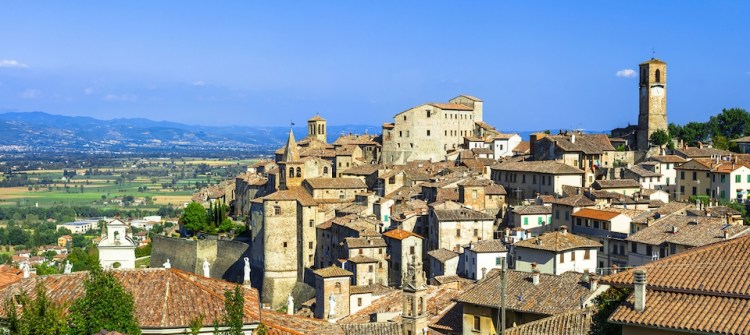
As we drove up the street toward Piazza IV Novembre we were pleased and somewhat surprised at the beauty of Viale Gramsci, which led to our hotel and nearby new home. In January, when we were last in Anghiari, the chestnut and sycamore trees lining the street were dormant, and gave no hint of the leafy canopy we saw now in mid-summer. Large pots filled with hydrangeas stood in the spaces between trees and an occasional bench provided seating for those who wanted or needed to rest. The street itself climbs uphill with houses along the way rising above the street on one side and on the other, descending down a steep slope. Anghiari not only sits on top of a hill, but is itself made up of hills densely packed with ancient stone buildings.
Historically, it is most famous as the site of the Battle of Anghiari where mercenary soldiers gathered to fight for the respective interests of forces from Milan on one side and the Italian league representing Florence on the other. The battlefield is marked by a small stone building near the base of the long hill leading east out of Anghiari. Fought in just over four hours on June 29, 1440, the conflict resulted in only one casualty, the death of a soldier who fell off his horse and was trampled. The Florentine forces won and, according to some views, their victory and the power it gave to Florence ensured that the Renaissance would eventually take place.
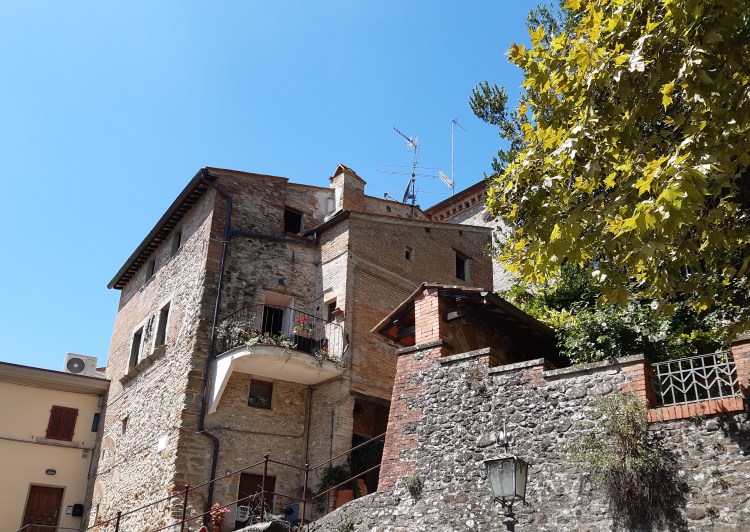
The photo above shows our house. As you can see, it is actually a tower; you only need to imagine it without the small terrace. The Venetian soldiers, who fought on behalf of Florence, are thought to have been housed here during their stay in Anghiari. The house, sometimes referred to as a castello, was built in the 1300s.
The Battle of Anghiari might have been largely forgotten if not for the lost painting by Leonardo da Vinci. Around 1503 the great artist was engaged to paint a fresco depicting the battle on a wall in the Palazzo Vecchio’s Hall of Five Hundred in Florence. Da Vinci’s propensity for innovation led him to experiment with the paints and technique, resulting in a fresco that was unstable. It was soon evident that the work was compromised and da Vinci abandoned the project. Fortunately for posterity, the Florentine artist and historian, Giorgio Vasari had described the fresco. Beyond that, sketches made by da Vinci as well as early copies of the work were available. Based on those sources, the scene of the battle was reproduced by later artists, most famously Peter Paul Rubens.
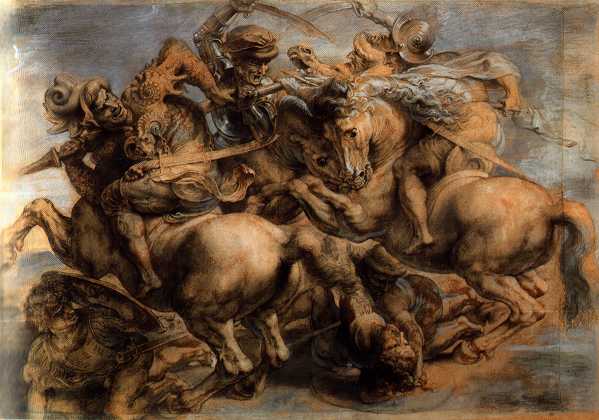
Although the condition of the fresco today must be considered at least questionable, scholar Mauritzo Seracini believes it may still exist behind a wall on which Giorgio Vasari painted another battle scene. Seracini’s view is supported by Vasari’s expressed admiration for the da Vinci work and the fact that he had once before protected an earlier painting by erecting a second wall for his own fresco. Using modern technological methods, Seracini was able to establish that there was space between Vasari’s mural and another wall behind it, perhaps holding the lost da Vinci fresco. Moreover, Vasari left a tantalizing message on his mural: “cerc trova,” (he who seeks, finds.) For now, any further investigation is on hold and we can only know da Vinci’s Battle of Anghiari through copies such as the one by Rubens.
Today Anghiari is known as one of the most beautiful hilltop towns in Italy. It is a mecca for tourists who want to explore the ancient town, visit its museums and enjoy its wonderful restaurants. During the summer special performances of music or theatrical events are held in multiple piazzas and along the city wall, while in winter there are regular events at the theater. And, of course, there’s shopping.
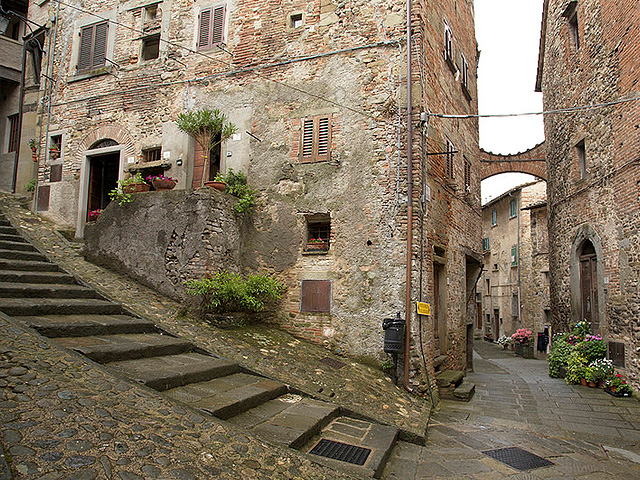
Walking through the narrow streets is the best way to see the town, which is small enough to cover in a day or two. For a longer stay, or for those who live here, continuing to explore is a constant pleasure. An early morning walk may take you by a bakery just opening and releasing the smell of freshly baked pastries or small fruit markets with the day’s offerings stacked outside. I was pleased to come across a tiny bin of vegetables that used the honor system for purchasing a few carrots, peppers or greens. On some days a street market is opening where anything from today’s dinner to antiques or clothing is on display. Relaxing, as the Italians do, with a coffee and cornetto is time well spent as is the pleasure of a late afternoon or evening gelato. Anghiari is a small town of only about 6,000 inhabitants, but it is an extraordinary place to visit or in which to spend a lifetime.

