Part II
Getting to Know Our Neighborhood
Our apartment was on a block that included a mosque, a Christian church with monastery and a brewery. At 6:30 in the morning, I heard the call to prayers as I drank a cup of coffee. A half hour later, church bells chimed. The brewery was silent, though perhaps gearing up for the day’s work. This close quarters mix of religious and secular institutions reflects the cultural composition of Sarajevo. The majority of the population is Muslim, while, except for a very small Jewish community, the remainder is Christian, both Serbian Eastern Orthodox and Roman Catholic. But at the same time, Sarajevo is a highly secular city and its people identify as Bosnians first and place their religious orientation second. Although embracing Islam, the Bosnian Muslims, (Bosniaks) are, in fact, descended from Slavic peoples of the south who converted to Islam during the Ottoman occupation of the Balkans.
Still, the Islamic majority of Sarajevo was evident in the many mosques located throughout the city, outnumbering Christian churches significantly. At times I was able to hear the call to prayer from several mosques simultaneously as each reminded its followers that it was time to pray. And Muslim women of Bosnia do express their religious affiliation in their clothing, most wearing a calf length skirt or dress over slacks and always a scarf on their head. Many younger women, however, give just a bare nod to hijab by wearing a scarf but otherwise dressing as any other stylish Sarajevan female would.
There are burial grounds adjacent to most mosques in Sarajevo. The one pictured below was near our apartment and I stopped often to look at it, curious about the grave markers I saw there. Cemeteries are both historical records and repositories of cultural information and while I couldn’t read any of the information on these stones, I was fascinated by the forms. Of particular interest were the simple shafts topped by a bulbous finial swept by incised lines that followed its curves. Any number of possibilities from the mundane world could be read into this form if one’s imagination were let loose and mine ranged from a Dairy Queen cone to the human body. I was never able to find a good explanation for the history or source of these shapes, though sometimes saw the top identified as a turban. The information I did find described head stones as a means of locating the burial site of a loved one, not a memorial to them as western markers often are, thus the tendency to be somewhat restrained.

Across from our apartment and just steps from the mosque and cemetery, stood a lovely villa surrounded by a stone wall. I never saw anyone going in or out through the gate and didn’t know whether it was occupied or not.
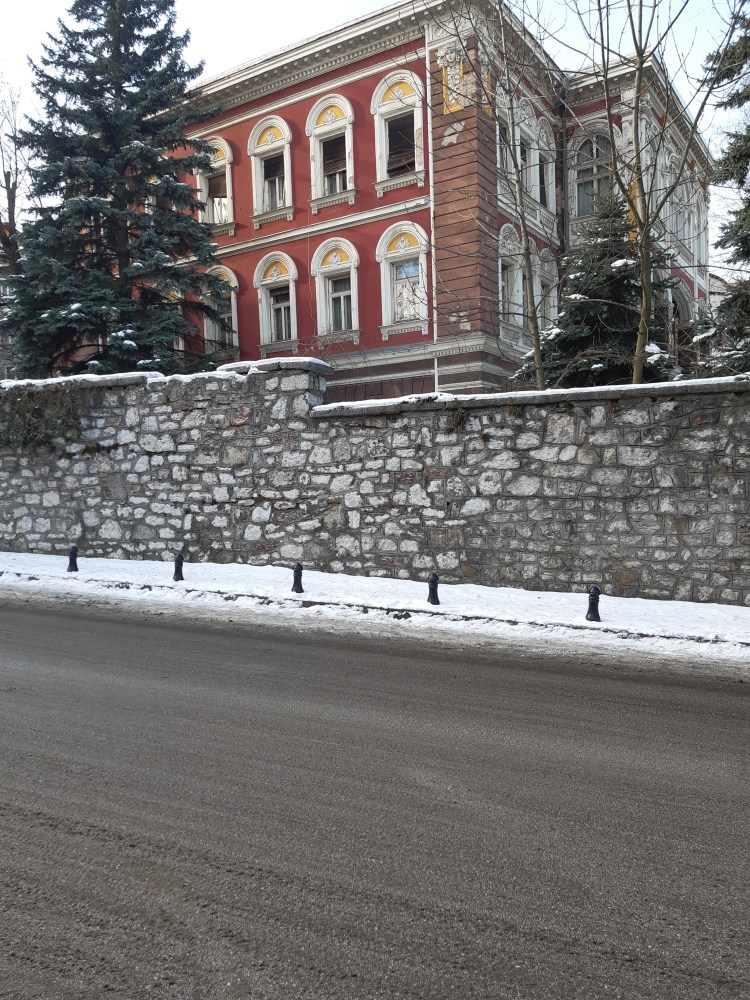
While walking on the street behind it, however, I saw the back of the villa and any question of whether someone lived there was answered.
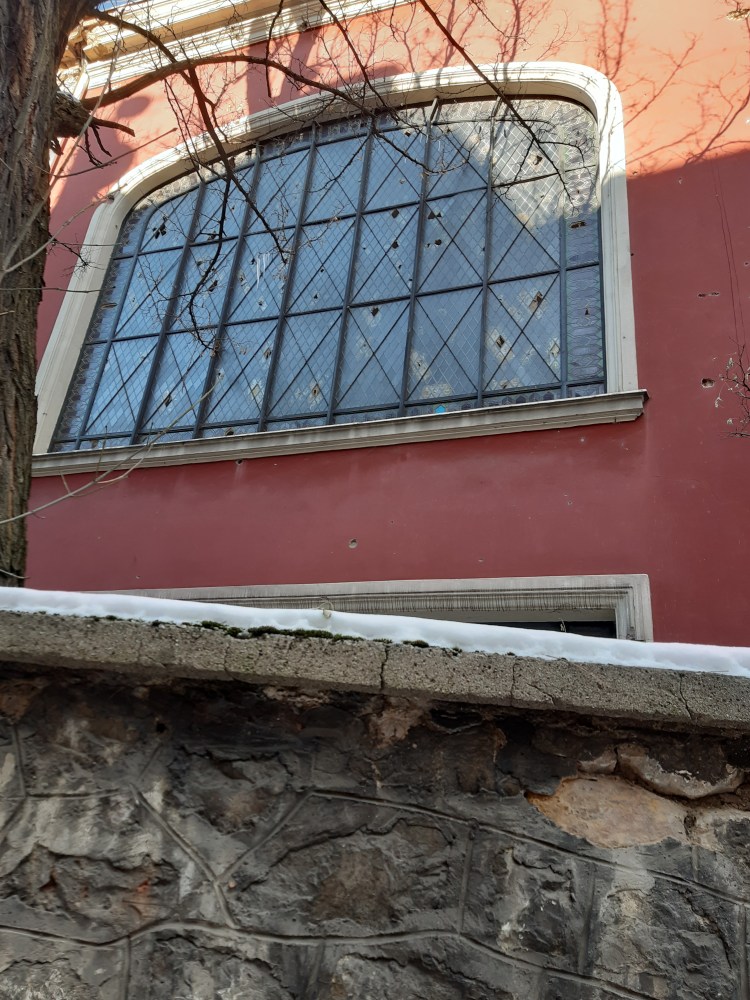
With wind, rain and other elements able to blow through bullet holes in the window, it was clear that no one could live there. This villa, like a number of other homes in Sarajevo, had been abandoned by its owner; sometimes these were not reclaimed simply because the owner hadn’t returned after fleeing Sarajevo during the war. Ownership claims could also be complicated by legal intricacies such as multiple owners of the property so some may simply have declined to fight the battle.
Many houses in our neighborhood were similarly peppered with bullet holes including the building in which we were living, which had been occupied throughout the siege by the owner, our host. Both the villa shown above and our apartment building were adjacent to the brewery, which suffered more severe shelling than domestic structures but has been completely rebuilt. While new stucco and windows on some homes were evidence that they had been restored, those that still bore the scars were a constant reminder of the fighting that occurred in and around the area.
The brewery, on the opposite corner from the villa, played an important role during the Siege of Sarajevo, when production of beer slowed to a fraction of its former volume. The springs used in producing the beer became a major source of water for the citizens of Sarajevo who came to the brewery with containers to fill and carry home for family and friends. In order to get to the brewery from anywhere outside the immediate neighborhood, people, often children, had to cross the river and the two streets that flanked it, exposing themselves to snipers. Once at the brewery, those standing in line to get water became easy targets for soldiers poised in the hills above; then as they returned home, they recrossed the river, now carrying heavy jugs of water, again risking their lives. Water is a necessity so taking risks to get it was an inevitable and constant challenge and not infrequently led to loss of life.
We regularly walked around the neighborhood and into the hills above and nearly daily crossed the Latin Bridge into the city center, where there were restaurants, markets and museums to visit. On a corner immediately across the river, a plaque and small museum identify the site of the assassination of the Archduke of Austria-Hungary, Franz Ferdinand and his wife Sophie who were in Sarajevo for an official visit. The date was June 28, 1914, wedding anniversary of the couple and, significantly, also the Serbian national holiday commemorating bravery of Serbian soldiers who fought at the Battle of Kosovo.
The group behind the assassination, “The Black Hand,” sought to withdraw from Austria-Hungarian control and return the southern Slavic area to Greater Serbia. Of the six members assigned to carry out the killing, five were ethnic Serbs including the man who ultimately shot the royal couple, Gavrilo Princip. Another member of the group had tossed a bomb into Franz Ferdinand’s motorcade but it bounced off his car and instead wounded others following behind. Though alerted to the dangerous mood in Sarajevo, the celebrations continued and ultimately Franz Ferdinand and his wife lost their lives as a result. Most of the world deplores the assassination, attributing the beginning of WWI to it, and regards those who committed it as terrorists. Many Serbians and Srpska citizens, however, honor the assassins as heroes for their effort to restore Serbian culture to lands held by the Austria-Hungarian dynasty.
Around our neighborhood and throughout Sarajevo, one can see the “Roses of Sarajevo.” The name suggests something pleasant but these are, in fact, horrendous mementos of the war. The “roses” are depressions in the pavement left by a mortar strike that killed or wounded anyone standing nearby. After the war, as a memorial to the victims, the depressions were filled with red resin and though some have been obscured over time as street repairs were made, many remain. The first one I saw was at a market and I was so shocked at its depth and width that I quickly turned away.
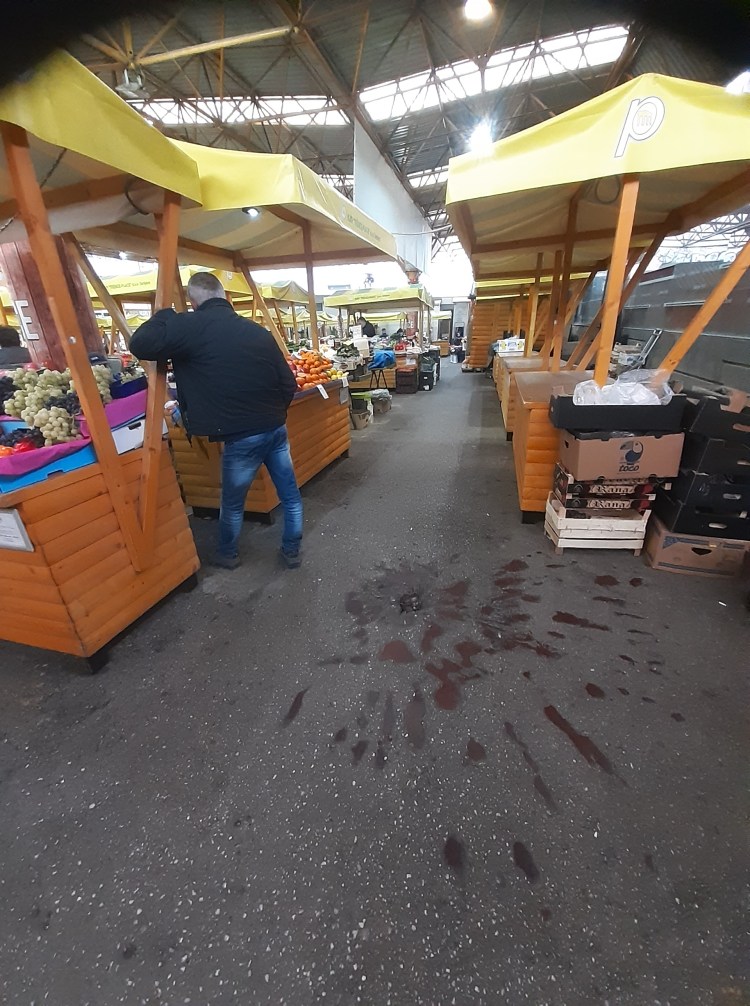
With pockmarked buildings and roses to remind us daily of all the tragedy Sarajevo had suffered, we elected to avoid museums devoted to the war. The Museum of War Crimes and the War Childhood Museum would certainly have been too much for us and we stayed away. There were other museums and sights to see and wonderful restaurants serving good food to try so as we adjusted to what we were learning about the past, all that Sarajevo offers in the present began to attract us. The season of Christmas was only slightly noted in Sarajevo but our hosts gave us a bottle of their homemade rakia as a Christmas gift and while we found this “white lightening” overly powerful, the gesture was a positive to take us into the New Year. As the year 2020 dawned and with only two weeks left in the Balkans we began to expand our experience of Sarajevo, looking beyond the war and starting to enjoy its unique character before it was time to leave.
 Lurching towards Italy
Hi Margaret,
Well, you’ve done it again! You have an engaging writing style while providing historical context and a US citizen’s perspective regarding some of our nations more current political/military involvements.
Thanks.
-Victor
LikeLike