Part I
With the approach of September, we bounced between the yin of having to leave Anghiari and the yang of exploring Florence. We hadn’t yet completely settled into our home and leaving would draw us away from matters waiting to be finished. Not only did we have that long held reservation from a year ago, but Florence was one of the Italian cities everybody needs to see and Terry looked forward to showing me what he had loved so much during his early years in Italy. He lived then in the small village of Montebeni, near enough to Florence to allow frequent explorations and discovery of all that the Renaissance city offered a young American experiencing Europe for the first time.
Terry’s friend, Elga, arranged to meet us at Pontassieve, the train station near Florence, where she would pick us up and drive us into the city. Elga was still a child when she and Terry first knew each other in Montebeni, but they had remained in occasional contact through the years as Elga grew into a sensitive and creative woman. She now lived her dream of owning an agriturisimo just south of Florence near Tosi where tourists could hike through the hills , experience life on a farm and learn to cook traditional dishes on Elga’s wood stove.
Driving in Florence is widely prohibited so we found a parking garage and then headed to our apartment, winding and bumping our way through cobbled streets, pulling luggage filled with clothes and supplies along with two disoriented but game dogs, who were once again at the mercy of their owners’ eccentric decisions. Our apartment overlooked the Piazza Santa Croce, a large square headed by the magnificent Santa Croce church and monastery. The River Arno was close by and across the river a more genteel Florence rose up into the hills.
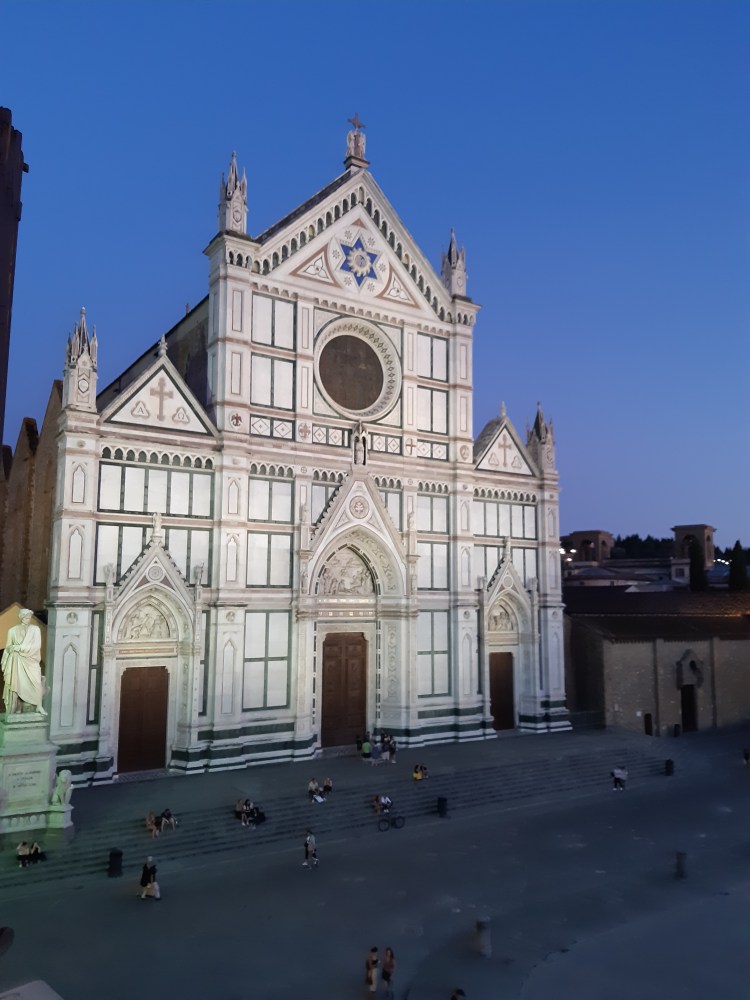
as seen from our apartment
The church of Santa Croce was built during the late thirteenth and early fourteenth centuries. Its original facade was simple stone and remained so until it was overlaid by green and white marble in the nineteenth century, reflecting the neo-gothic ideals of the time. We were struck by the prominent Jewish Star of David on the pediment, puzzled that it should appear on a Christian church. The reason for its inclusion here is purely speculative but it may be a reference to the Jewish faith of Santa Croce’s architect, Nicolo Matas. In another act of political sensitivity, or call it appeasing the masses, the exquisite statue of Dante, which originally stood in the middle of the piazza, was moved to to the side of the cathedral to make room for football games.
The interior is a treasure trove of Renaissance painting and sculpture. My favorite works, and most anticipated, were those by the early Renaissance painter, Giotto. His monumental figures and greater naturalism depart from the formulaic tradition of the late Medieval period, inspiring a new approach to representations of the human figure. Beyond that, the frescoes are simply beautiful with their broad areas of rich color.
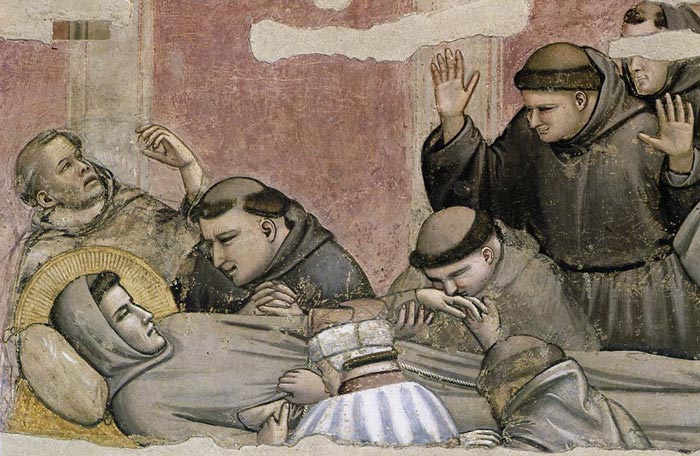
Frescoes by Giotto’s students carried on his work in Santa Croce, depicting the life of Christ in a series of chapels. Like most very famous buildings, multiple trips over time would be needed to fully grasp the significance and range of beauty of both interior and exterior. In spite of the proximity of the church, we never visited the interior again. Like most visitors, limited time and so much to see made it impossible to visit again and again. We count ourselves fortunate to have had even a glimpse of Giotto’s remarkable frescoes and the other masterpieces of Santa Croce.
We delayed visits to galleries and museums in Florence because we wanted to spend our first week merely exploring and, for me, getting to know the city. I planned to purchase a good leather purse, virtually a requirement when in Florence, and perhaps a pair of leather gloves. Clearly, my goal would be easy to fulfill as every second store sold leather goods of all sorts and before the first week had passed I owned a large bag of soft, peach colored leather that reversed to brown suede for the winter months. Gold was not on my need to have list, but if it had been the shops along the Ponte Vecchio offered every kind of body ornamentation a person could imagine.
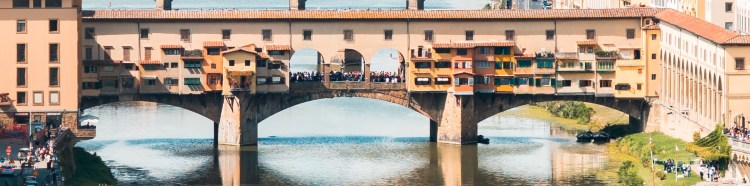
In spite of my disinterest in buying jewelry, a walk across the Ponte Vecchio is inevitable when touring Florence. Its name indicates great antiquity, but it only tells that a bridge spanned the river at that spot for a very long time. In reality there have been a series of bridges, which required rebuilding each time the Arno suffered a major flood . The original is thought to date to the Roman period and was at one time the only bridge to cross the Arno into Florence. Then as now shops lined the bridge, though in the past these were butcher shops not the gold and souvenir stores that entice tourists today . But when the Medici family built a passageway above the bridge, extending from the Palazzo Vecchio to the Palazzo Pitti the butcher shops were banned and goldsmiths took their place. A much more suitable walkway for the rich and powerful and no doubt a better experience for the modern tourist as well.
In our wanderings through Florence, we couldn’t miss the Opera del Santa Fiore where the famous Duomo stood. As a student of art history, I had seen the individual structures on slides, but coming upon them as a complex literally stopped me in my tracks.
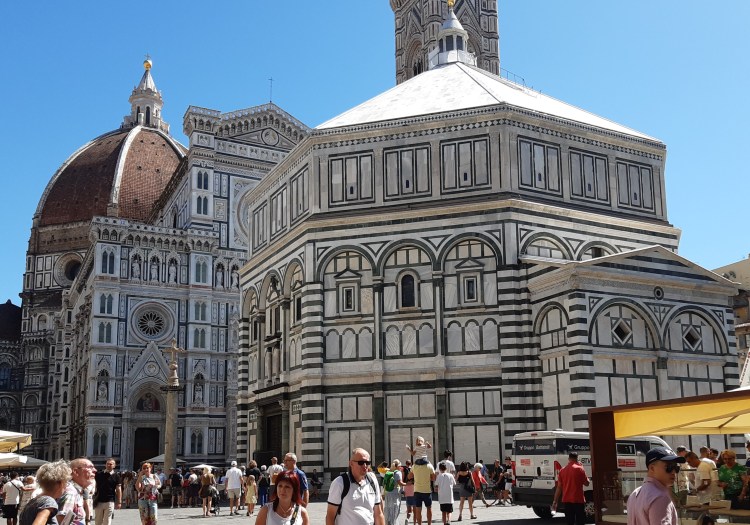
The Duomo of Florence is perhaps the city’s most famous building. Started in the late thirteenth century, the enormous dome was only finished in its present form when the genius Fillipo Brunelleschi accepted the challenge of adding brick to the existing wooden scaffolding. The span of the dome was 45 meters wide, a vision of grandeur surely but an engineering problem, until Brunelleschi imagined laying the bricks in a herringbone pattern, creating a stable structure.
The Baptistry, adjacent to the Duomo, replaced an ancient baptistry dating to the fourth or fifth century, and that building itself may have been erected on an earlier pagan site. The illustrious Dante was baptized there as were many other notables, but it was and still is a baptistry available to an average family. The present structure was built between 1059 and 1128 AD, though its green, pink and white marble cladding was added only in the nineteenth century, along with that of the Duomo and the bell tower. The beauty and extraordinarily long history imbue this building with special significance, but it may be the doors to the Baptistry that draw the most attention.
The most famous and beloved of the Baptistry doors is the “Gates of Paradise,” created by Lorenzo Ghiberti, collaborating with his two sons, Vittore and Tommaso. Lorenzo was born about 1378 in Florence and trained as a goldsmith, though like many Renaissance artists was skilled in a variety artistic disciplines. He was awarded the assignment for the east door of the Baptistry without competition because his work on panels for another baptistry door had proved his merit.
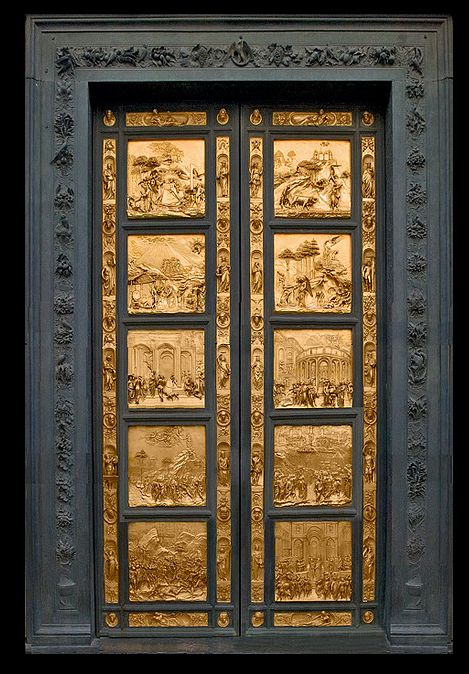

Unfortunately but necessarily, the doors of the Baptistry are replicas of the originals, which are in the Duomo museum (Museo dell Opera del Duomo). While I appreciate the need to protect precious works from assault by weather or even human agency, I find standing before a replica, however perfect, always slightly disappointing. The hands of Ghiberti or his sons never touched these works, thus in my purist view a certain intimate connection between artist and viewer is comprised.
Completing the Opera complex is the bell tower. Begun by Giotto in 1334, it took many years and many artists to complete it. After Giotto’s death Andrea Pisano took over the construction followed by Francesco Talenti, and further embellished by later artists including Donatello and Della Robbia. The facade is comprised of a multitude of niches containing sculptural depictions of biblical scenes such as Donatello’s Sacrifice of Isaac.
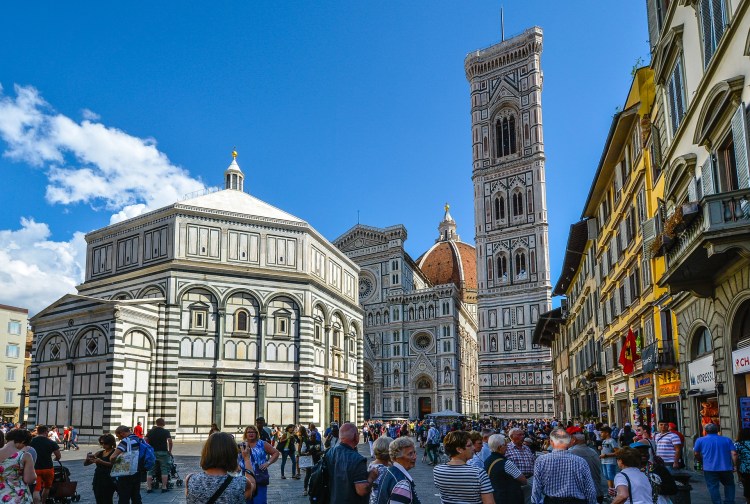

The tower is a glorious monument when viewed from the street but, oh to be a bird flying through the air to see in situ the intricate sculptures that cover the structure. However, these too are replicas and at least some of the originals can be seen while standing firmly on the floor of the Museo dell Opera.
All of these wonders and more we saw during our first week and a half in Florence. Now we had to return to Anghiari for a while to take care of a few down to earth matters. The antennista was scheduled to extract our hornet’s nest and complete connection of the internet. We also had to drive to Rome to consult with the lawyer hired to plead our case challenging the visa denial. And, although unplanned, we would purchase a new stove to replace the recalcitrant and still somewhat sticky one left by the former owner.
 Lurching towards Italy
Hi Margaret This was very interesting. Don and I had an apartment with 2 balconies over looking the Duomo and it was a wonderful memory of that spring. Thanks Mimi
Sent from my iPhone
>
LikeLiked by 1 person