Our Return to the United States

Double Trouble

When we made the decision to relocate to Italy it was not only the arts and beauty that drew us to the ancient country, but also, and perhaps primarily, concern about conditions reigning in the United States. Gun violence and the increasing rancor of American politics seemed to us to have become entrenched in the nation with little hope for improvement during our lifetimes. Although political chaos and even violence in some areas are not unknown in Italy, the small Tuscan town we had chosen for our new home offered a tranquil location in which to spend our later years.

Little did we know that in early spring of 2020 Coronavirus would create a state of emergency in Italy, challenging the country in ways unknown to most of the population. Just before a nationwide lockdown was imposed I met a woman from nearby Monterchi who was an American expat. After we automatically shook hands before remembering we shouldn’t, she said that her eighteen years of living in Italy taught her that Italians were very resilient and that they would survive the pandemic with courage and grace.

As lockdown began we witnessed the truth of her words. First we saw Italians making music on balconies all around Italy, then we saw “Andra Tutto Bene” (Everything will be alright) signs posted everywhere. We watched Premier Giuseppe Conte lead firmly and intelligently as conditions worsened and he had to tell the people of the difficult restrictions that were being set in place. We watched as retired doctors and medical students joined with the health community to meet the challenge of increasing patients in facilities not designed to manage a pandemic. As schools and other institutions closed, we saw museums, libraries and concerts offer videos that took us into spaces no longer open to the public. In our little town residents cooperated from the beginning; staying at home mostly, but wearing masks and gloves and carefully avoiding close proximity when they did go out. In larger cities, where not everyone adhered to the restrictions, we saw penalties imposed, increasingly stringent as time went on and violations, especially among restless young people, began to occur more frequently. Sensitive to the economic impact on working people, the Italian government created funds for the unemployed and established decrees that delayed or ameliorated financial obligations such as rent, taxes or other usual costs of living. It cannot be said that this was a good time to be in Italy, but it was a good time to see how a country might deal with a horrific situation complicated by ever evolving information.

While we were still in Italy the coronavirus took hold across the U S. We watched, appalled, as the lessons of Italy’s experience were ignored and closing of public spaces delayed even as the number of cases increased. We saw reports of men armed with assault weapons storming the capitol in Lansing, Michigan to protest COVID-19 restrictions imposed by the governor. We saw the president downplay the threat of the virus, even calling it a hoax, and offer inappropriate advice for its treatment and prevention. We saw him and other leaders appear in groups without a mask. Particularly in the early phases, the contrast between the sometimes belligerent reaction in America and Italians singing on balconies is stark and seems to sum up the difference in the two nations’ personae.

When we at last were able to fly back to the U S, we came to a state where COVID-19 cases were increasing but restrictions had been loosened so the risk of contracting the virus was significantly greater than in Italy. And as if this were not enough, within days of our return the country was devastated by the brutal murder of George Floyd by policemen and the repercussions that followed. While still in Italy, we had learned through FaceBook and Italian television of the killing of Ahmaud Arbery in Brunswick, Georgia. The two crimes exposed America’s problem with racism in a dramatic and horrible way and Terry and I were both saddened and frustrated as we plunged back into this national blight. As thousands of protesters reacted across America, television broadcast images of mass crowds, sometimes peaceful but often angry and aggressive. And we saw how law enforcement reacted, sometimes with control and even sympathy, but too often themselves angry and aggressive.

This drama begged for a comparison of policing in our native country and our adopted one. America is on the top ten list of the most brutal police forces in the world (Wonderslist; Top Ten Countries With The Worst Police Brutality” by Wardah Hajra). However, Italy too has a reputation for police brutality and has been cited by The European Court of Human Rights for attacks on demonstrators at the 2001 G8 summit in Genoa. A great deal of attention was given to police policy in Italy after the Court’s findings but unfortunately even bringing the matter before the Parliament did not lead to a new Federally mandated standard. Since then there have been a number of cases in Italy of death resulting from beatings of an accused prisoner and while the police officers perpetuating the offenses may be charged and go to trial they tend, as in America, to receive light sentences and even these may be reduced over time. And also, as in America, police may not only be poorly trained, but in general are likely to follow embedded, conservative approaches to crime and criminals. There is, however, no evidence that police brutality in Italy is particularly directed at people of color.

To see Italian police in action check YouTube showing how Italian police deal with crowds of protesters:

http://www.youtube.com/watch?v=2SyxlD8itFA&has_verified=1 and

http://www.youtube.com/watch?v=3BCW3XmM9hE .

Notice that in both instances the demonstrators approach the police force and it’s not until they are actually in contact that the police react. The demonstrators are throwing stones or smoke bombs before and after the police charge them, contributing to the violence. The Italian police are armed with batons and use them against protesters; in the U S the police are more apt to use tear gas, pepper spray and rubber bullets, which can cause serious injury, to keep the crowds at bay or to clear an area of their presence. An example on YouTube:

http://www.youtube.com/watch?v=nMdcOt1Ow8Y

While demonstrations or protests can be assumed to result from some form of dissatisfaction, Italy does not have a history of long term, systematic suppression of a particular ethnic group so protests do not bring that particular rage to the streets. Graphic videos of murders and other vicious attacks committed by police, or former law enforcement individuals as in the case of Ahmaud Arbery, brought white America to a new and shocked understanding of what black America has long known. This “new” body of evidence is only available because of cameras installed on police cars or videos taken by bystanders–the horrible consequences endured by victims of police brutality in America would have remained unexposed without this footage.

The egregious behavior of American law enforcement has inspired demonstrations not only in America but around the world. In Rome and Florence protest groups gathered on Saturday, June 6 to express their own outrage at what they have seen. Interestingly, Antifa, which has a particular opposition to police, will also stage a protest in Florence that day. The group, often branded by President Trump as terrorist, held another demonstration in Vicenza, Italy on June second. Click below to see a few moments from that event.

http://www.youtube.com/watch?v=uJQUkwWFkkA

It would take an expert to fully analyze all the reasons for differences or similarities in policing in Italy and America and well beyond the scope of my own knowledge. I can only say that the kind of horror we are witnessing now is not something seen in Italy. In spite of the beauty and good will of the city of Hickory, NC our return to the states has been fraught with disturbing events that portray a nation in trouble. Will recent events promulgate the real change that so many hope for? Maybe this time.

And maybe next time we return to the U S from Italy the coronavirus challenge will be better understood and managed and some progress will have been made in the standard of policing. Maybe we will return to a home country more at peace with itself. Maybe the New Normal we speak of will actually have started to be accommodated.

Diary of an International Trip During the Time of Coronavirus

Today is Monday, the eighteenth of May 2020 and our trip back to the United States begins today. After our original reservation to fly back on April 14 was cancelled, I rescheduled for the 19th of May, hoping that by then restrictions would start to loosen and flights would be taking off. As it turned out, it was a fortuitous choice and, after one more cancellation it seems that this reservation will actually hold.

As we began to believe that we would be able to leave, we filled out autocertification forms, required to describe where we are going and why, reserved hotels, scheduled appointments for matters that needed to be resolved before we left Italy and finally pulled out the suitcases. All seemed to be moving toward departure when Terry was told by a friend that it would be impossible for us to drive to Rome to catch our flight because travel out of our region was still prohibited. Although I had checked relevant websites and was sure we would be able to travel, Terry called another friend for her opinion about the matter. She confirmed, that no, she thought we would not be able to travel but offered to call our Questra (Regional headquarters) in Arrezzo to verify. I wasn’t surprised when she found that we could, indeed, make the trip; as U S citizens we were allowed to travel in order to return to our home country.

With a car rented for the trip to Rome and a night’s stay reserved in a hotel near Fiumicino airport, preparation for phase I of our journey was in place. Today, we will leave in the morning to arrive at our hotel this afternoon. It will be the first of five days of hotels, before moving into the condo we’re purchasing in Hickory, NC. Hotels, of course, are places we would prefer to avoid during a pandemic–will they have been sanitized? Should we wear gloves for the entire time we spend in them? What about sheets, blankets and bedspreads? Let alone bathrooms and all surfaces within the room. Will a nearby restaurant be open where we can get an evening meal? We have a bag of food to take in case there isn’t. The same bag of food may be our evening meal when we arrive in Atlanta after 8:00 p.m on Tuesday, probably not reaching our hotel until 10:00 or so after going through procedures at Hartsfield International airport.

And then what about the airports? We presume that our temperatures will be taken. In Rome the latest means of doing that is through a helmet worn by airport personnel that protects against close contact between the worker and passengers.

Boarding–will people observe distancing at the gate and during boarding? Will there be staggered seating as we are told will be done? Will Django’s carrier fit under the seat of the “city hopper” Embraer 190 that takes us to Amsterdam and what will happen if it doesn’t? And, oh yes, we have a layover in Amsterdam, a major and unfortunate change of schedule from our original reservation to fly non-stop Rome to Atlanta. Will it be possible to take Django outside for bathroom relief during the two hour layover? He will have no compunction against releasing his bladder in the airport so I have paper towels packed for that eventuality. Will we again have our temperatures taken? Will we have to transfer between terminals and, if so, how far would that be?

Today is Thursday, May 21 Our travel is behind us and we are now in Hickory, NC. It is the third day of transition between our home in Italy and and our soon to be home in the United States. Monday was the easiest of those entailing only a three and a half hour drive to our hotel next to Fiumiciano airport. The hotel is an oasis within a commercial area and features a large, fenced in yard where Django could wander freely, roll in the grass, and generally enjoy being a dog. We sat at a table at the edge of the yard to enjoy a glass of wine and a take out Chinese supper, enjoying a pleasant lacuna of relaxation before beginning remaining travels the next morning.

We headed to the airport early the following day in order to return our rental car and check in, not knowing how difficult or time consuming it might be. As it turned out, in spite of necessary distancing, the fewer number of passengers meant that procedures went quickly. We expected to have temperatures taken and perhaps testing with swabs, but neither happened–and we never saw a person wearing the helmet shown above. Although there were a few exceptions, virtually everyone from staff to passengers were wearing face masks and any passenger not equipped with one would be handed a mask before boarding.

Spacing during our flight to Amsterdam on a small “city hopper” was as it should be, with only alternate seats assigned in order to maintain distance between passengers. As we reached our seats we saw a little packet of food waiting for us containing our snack for the flight– half a cheese sandwich, a cookie and a bottle of water. Django’s carrier didn’t quite fit under the seat but was safely enough stowed to pass muster.

Both at Fumicino and Amsterdam’s Schiphol airports, all was extraordinarily quiet; most shops were closed but the few offering snacks and drinks were sufficient to serve the limited number of people flying during these strange days. At Amsterdam, the duty free shop was fully operational, customers allowed in limited numbers, each handed a basket that had been sterilized, to fill with candy, alcohol, syrup pancakes, perfumes or any of the usual duty free items one finds at these markets where the prices are not so low, but the opportunity to pass time is tempting.

At the boarding gates, the number of people waiting was considerably less than normal and seats were marked off so that thee meters separated each person. As we waited, we saw an apparently at risk individual deplaning from an incoming flight. Clearly frail, she was pushed in a wheel chair and equipped with a full face plastic shield; a companion accompanying her wore protective covering and a face shield. Whatever the reason for her extreme care, this woman epitomized the heightened health situation we all live with these days.

Again at Amsterdam’s Schiphol airport, we were not subjected to any form of health monitoring though there were a number of Red Cross personnel present throughout the terminal. As boarding time approached, one them stood in front of the boarding desk, using an IPad for some purpose we couldn’t determine: was it a means of taking temperatures? She did focus on each passenger as they approached and it hardly seemed plausible that she was simply taking photographs.

When we boarded with, of course, proper distancing, we again found food provided for the flight on our seats. This time, a full cheese sandwich, an assortment of cookies and candies, two oranges and three small bottles of water. There would be no food service otherwise, nor drinks of any kind available. This flight was on a 747 loaded with about 30 people, each with abundant room to stretch out and sleep or just relax for the eight and a half hour trip.

As we deplaned in Atlanta, we were met by a CDC representative wearing a face shield who instructed us to self-quarantine for fourteen days following our arrival. After retrieving purse and glasses I had left on the plane, then going through immigration, where our remaining fruit was confiscated, we finally were free to go pick up the rental car we would use to drive to Hickory. The rental center was far, far, from the terminal but we were shuttled there, then eventually found the Avis desk, loaded our luggage into the car and headed off to find our (substandard) hotel to sleep before heading to Hickory the next day.

Almost as soon as we began our drive the next morning, heavy rain began and continued for the entire trip, making for a harrowing drive instead of one filled with anticipation of completing our travels and seeing Hickory for the first time. When we finally arrived in Hickory we spent an hour or so trying to locate our hotel using inaccurate directions from MapQuest and confused by the complicated system of assigning addresses in Hickory. By the time we had stopped twice to get help and at last reached our, thankfully pleasant, hotel we were frustrated and exhausted. But there was little time for resting as a walk-through of our heretofore unseen condo was scheduled for four o’clock. After the driving challenges we had already experienced that day, we were grateful when our realtor offered to come to the hotel to guide us to the condo. She, of course, knew the city well and took us speedily through the trip.

We were pleasantly surprised to find that the condo exceeded our expectations. Moreover, it was set in a beautifully wooded area not far from Lake Hickory. Both the location and the meticulous condition of our soon-to-be part-time home reassured us that we would be happy here. Since we had spent so much time first wandering through Hickory then following our realtor across town, we were becoming somewhat familiar with the area, at least as far as the primary roads were concerned. It is a small city of about 50,000 residents, significantly larger than any town Terry or I had lived in recently and much more heavily trafficked. But the great diversity of restaurants, stores and activities more than compensated for greater distances and a higher volume of traffic.

Now today, we have shopping to do. It is almost impossible to function in the time of coronavirus without a phone, and since we have only our Italian one at the moment, a pay as you go phone will be one of the first items we need to buy. And, as we will soon be out of our hotel, we need a mattress. Hopefully by the end of the day we will have both. But we have a completely empty home to furnish not to mention setting up services that will turn on the lights and provide Wifi for using the computer or watching TV. There’s a lot to buy and do and I suspect we won’t be able to just enjoy our new home and city for a while. Tomorrow at 10:30 we will sign the final papers, becoming home owners and residents here, but tomorrow seems a world of work away.

Today is Saturday, May 23. And it is move in day. We purchased mattresses on Wednesday, which will be delivered this morning so tonight we sleep in our new home. We also bought dishes, silverware and linens earlier in the week and yesterday furniture for our den, also to be delivered today, so we have enough to get by, more or less, for the immediate future. The condo is large so we will confine furnishings initially to just a few rooms that will become our living spaces. In time it will be fully furnished but that may not be for a while and perhaps not fully completed before we leave in the Fall.

Today is Friday, May 29, nearly a week since I last wrote. And a busy week it was. Inevitably we spent considerable time looking for furniture and, though we still await the delivery of much of it, we think we will soon have enough to make a comfortable home. Probably because Hickory is a major center for furniture manufacture and sales, the consignment stores here offer exceptional pieces for sale at prices much lower than new furniture. All but the mattresses and a sofa and love seat for the living room came from these stores and we will no doubt continue to check them out for the final, smaller pieces we will need to complete the furnishing of our townhome. And, yes, it is a townhome, not a condo as the HOA president explained. Townhomes include exterior walls, not just the space between them as a condo does, and ownership extends an additional two and a half feet beyond the walls. Virtually everyone here has used that area to plant a garden, many of them reaching beyond the legally recognized two and a half feet. As I walk around the complex with Django I admire the personal touches that make each townhome unique. Unable to resist starting one of our own, we have purchased a few plants to get started.

Saturday, May 30 Clearly, with all the shopping, arranging services, and necessary visits to complete legal processes, we have not self-isolated during our time here as the CDC advised us to do. We have, of course, followed social distancing practices, always wore masks when we entered any place of business and adhered to hygienic recommendations. Further protecting us, and those with whom we came in contact, some stores required appointments to enter, others marked off spacing or installed directional indicators, many offered hand sanitizers at the entrance, employees all wear masks or are protected by shields and in most stores sanitizing of surfaces is ongoing. Still, in practice there is uneven adherence to those protections and opportunities for contagion are high. In the meantime North Carolina is experiencing a 40% increase in the number of COVID-19 cases. The safety from exposure we knew in Anghiari cannot be assumed here.

Surely no one will forget the experience of living during the coronavirus pandemic and, for us, traveling and relocating during this time is an adventure wrapped in the bizarre. But, spotted here and there are moments of relative normalcy or normal as we now know it.

Not Just a Pretty Town

Part II

Ephemerata

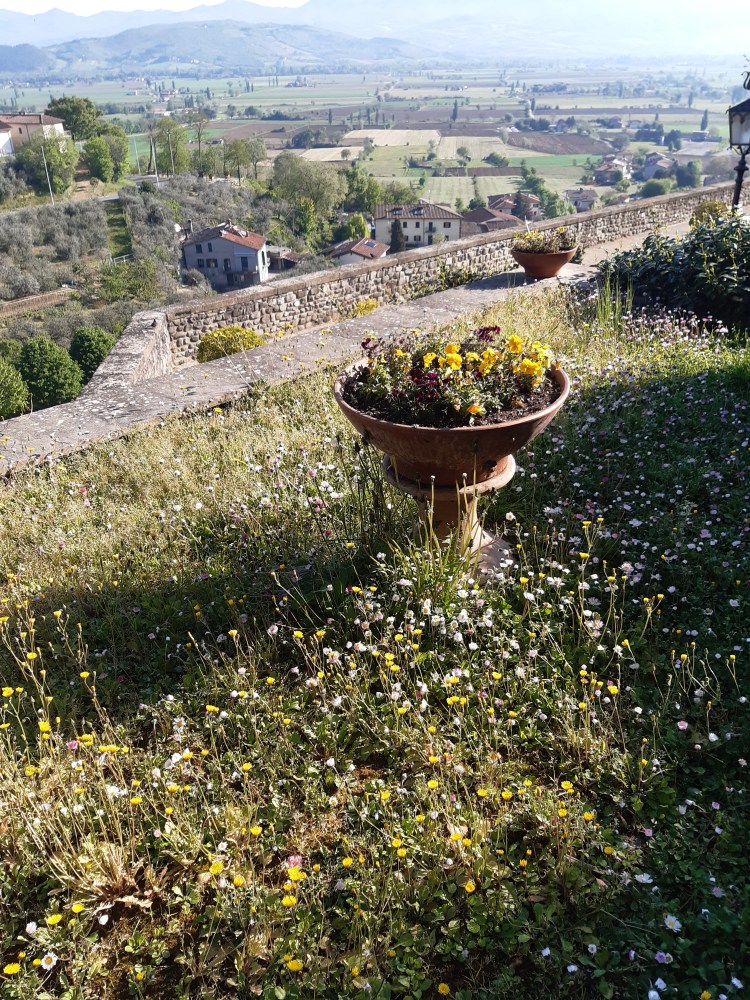
Last week’s post described the institutions that enhance life in our little town but on a daily basis there are more subtle benefits to living here–the ephemerata. Probably primary among them is the view from our balcony across the Tiber Valley to the Appennine mountains in the distance. When we decided to buy this house, Terry was most entranced by its historic character while I was particularly keen on the location; both remain important to us, but the view is a daily gift we never fail to enjoy.

From our balcony we can see snow accumulating then melting away on the most distant mountains, or be awed by cloud formations hovering over the hills, or follow the changing light that alters those hills from blue to varying shades of green or watch in anticipation as a rain storm crosses the Tiber Valley on its way to Anghiari. In the near distance we see houses on the flat of the valley where people live outside the town limits; occasionally we hear their dogs bark in the distance. As dawn approaches a rooster crows to summon a spectacular sunrise like the one below.

Sunrise seen from our balcony


As I write in the early morning, I can hear a clock chiming 6:00. We have two town clocks set in ancient bell towers, the Big Clock and the Little Clock. The Little Clock is not really smaller, just further away so it sounds smaller. Big Clock always chimes first and moments later, Little Clock follows suit, striking the time again. Then, as if to verify the actual and indisputably correct time, Big Clock tolls the hour once more. On the half hour, Big Clock first sounds the hour and then adds a higher tone to indicate half past; Little Clock has its own means of announcing the half hour, first chiming the hour then pausing before adding another beat in the same register . Thanks to these two time keepers, no one in Anghiari ever needs to be ignorant of the hour of the day.

Even if it’s not a Sunday or holy day, church bells ring morning, noon and early evening, often accompanying the clocks as they chime the hour. But on a religious holiday they ring out in exuberant celebration all through the day and it is a joyous sound. In fact, all the chiming, tolling and gonging of Anghiari’s bells is an aural pleasure on any day.

If bells are a pleasure, water is a necessity. I have lived in places where water is sub-standard, but in Anghiari water comes from springs and is clear and good. For decades I either purchased bottled water or I distilled tap water to remove the impurities. That provided palatable and safe drinking water but didn’t resolve the problem of buildup on dishes, especially glasses, after being washed in a dishwasher. Anghiari’s spring water is perfectly good for drinking right from the faucet and dishes are actually clean when I remove them from the dishwasher.

As a bonus, the city has installed fountains throughout the town where anyone can fill a water bottle, give their dog a drink, or rinse their hands if they want. Most cities in Italy provide fountains, big or small, for the pleasure and utility of residents and visitors. On top of a hill above us, there is even a water dispenser where jugs can be filled at no cost with either still or effervescent water to take home.

One of many water fountains found throughout Anghiari

Air quality here needs to be mentioned too, though it is easy to take for granted when it is good. Since there is no industry in the area, and maybe because we sit high on a hill, or perhaps because we are surrounded by oxygen producing trees, the air is clean and fresh. Normally it is also relatively dry, a quality that keeps my curly hair from being frizzy hair, a much appreciated boon to good grooming.

Today is Wednesday and it is market day in our piazza. In another few minutes, the vendors will start to arrive for the first time in a couple of months; with the coronavirus lock down outdoor markets such as this one have been prohibited. Though we have been able to get all the vegetables and fruits we needed from a local shop, we look forward to walking again through our market in the piazza with its air of festivity and the glorious bounty offered by various stalls. As I mentioned in a previous post, the vegetables and fruits are exceptional–the tomatoes brighter, larger, and tastier than we normally find in the U S and the same can be said for all produce. I love the radicchio here for its generous size and low price compared to the U S where buying a tiny head to add to a salad seems like a luxury.

Our market also offers roasted meats, cheese, sweets, household goods and, particularly in summer, inexpensive clothing; I have bought a couple of 10 Euro dresses for warm summer days, replacing the shorts I wore in Florida. As our market reopens today, Terry and I will head down to take advantage of it, happy for this beginning of a return to normalcy.

Living in a place where seasons are more emphatically defined has been another, somewhat unexpected pleasure. Having come originally from the north (Michigan and Pennsylvania) Terry and I both appreciated the benevolent climate of Florida when we lived there. But I missed the flora that signaled spring further north–the early blooming forsythia and lilac followed by bearded iris, peonies, and delicate lilies of the valley; all of these have either already bloomed and faded or are blooming now in Anghiari. Seeing these favorites again felt familiar and right, inspiring prospects for gardening whenever we spend a few months as “half-backs” in North Carolina.

Weather sites describe Anghiari as having ‘long cold winters’ and ‘short hot summers’ but the winter seemed mild to us and summers nowhere near so hot as in Florida. Anghiari can get snow on occasion, as the scene below attests. The 3″-4″ snowfall that greeted me one morning was a surprise, a beautiful change of scene, and it melted in a few hours under a sunny sky–a perfect snowfall. And, except for on distant mountains, it was the only time we saw snow this winter.

Morning surprise

Although I enjoy cooking most days, we do sometimes like to take advantage of one of the restaurants scattered through our little town We have a few favorites, one of them the recipient of a Michelin award but all offering good meals in a pleasant setting. It is nice to be recognized as a regular customer when we walk in, which doesn’t guarantee a table on a busy night, but is nevertheless appreciated. Our local deli provides us with good ready made food when we want it and Terry goes there to buy most of the wine we drink. And then there is gelato, the best in town at the cafe next door–an evening treat for us at any time of year.
Not surprisingly, an important part of the quality of life here are the friendships we have formed with people in town. As strangers, and American strangers at that, we weren’t sure how successful we would be in integrating into a social life in Anghiari. But that has indeed happened, particularly with neighbors living along our street. Lock down has naturally impeded the process but at one of our last dinner gatherings, a neighbor told us, “you are part of the family.” And there is Valerio who lives down the street from us, but whom we know only slightly as a friendly neighbor and as a fixer when it comes to certain repairs we needed. He passes by our house often, his bright florescent green shoes and laces leading the way as he ambles up the street. Last winter before the coronavirus hit, Valerio invited us to a lamb and chestnut roast at his country property in the spring; now we hope that the invitation is still open for next year.

Another opportunity to connect is within the expat community. Prior to moving here we learned that there is a fairly sizable number of British expats in town; we have so far met only a few of that group but presumably in time will meet others. Thanks to dog walking we have become acquainted with an American couple, owners of two Italian greyhounds and we often see and visit with Greg, who walks them in the city center by morning or along our street at night. We have also met another American couple who spend a few months of the year here, and look forward to seeing them again when they can get to Italy. Terry’s ability to speak Italian is an enormous asset, but even for him communicating with friends in English is easier and definitely an advantage for me with my still rudimentary skills in the Italian language.

But while all of these benefits combine to enhance life here in Anghiari, the greatest benefit of all is simply being here. We conceived of this move as a last, great adventure before we no longer had the energy to take it on. Anyone following my blog knows that not all has gone as planned, starting with the denial of an Elective Residency visa and the consequent need to leave Italy every three months. Now we will return shortly to the States and once there can again apply for the ER visa. Although we feel hopeful for a better result this time, we know that we will continue to spend at least six months of the year in Anghiari, extending that to nine months if we return to Italy with visas. Stay tuned.

Not Just a Pretty Town

It’s actually a good place to live

Part I

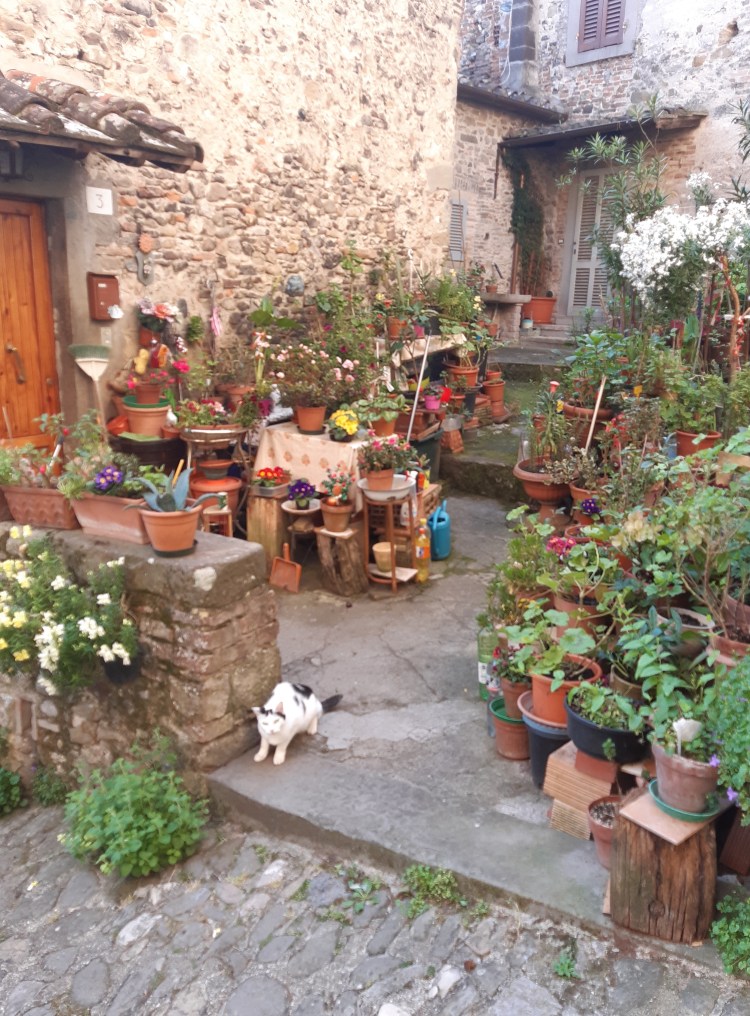
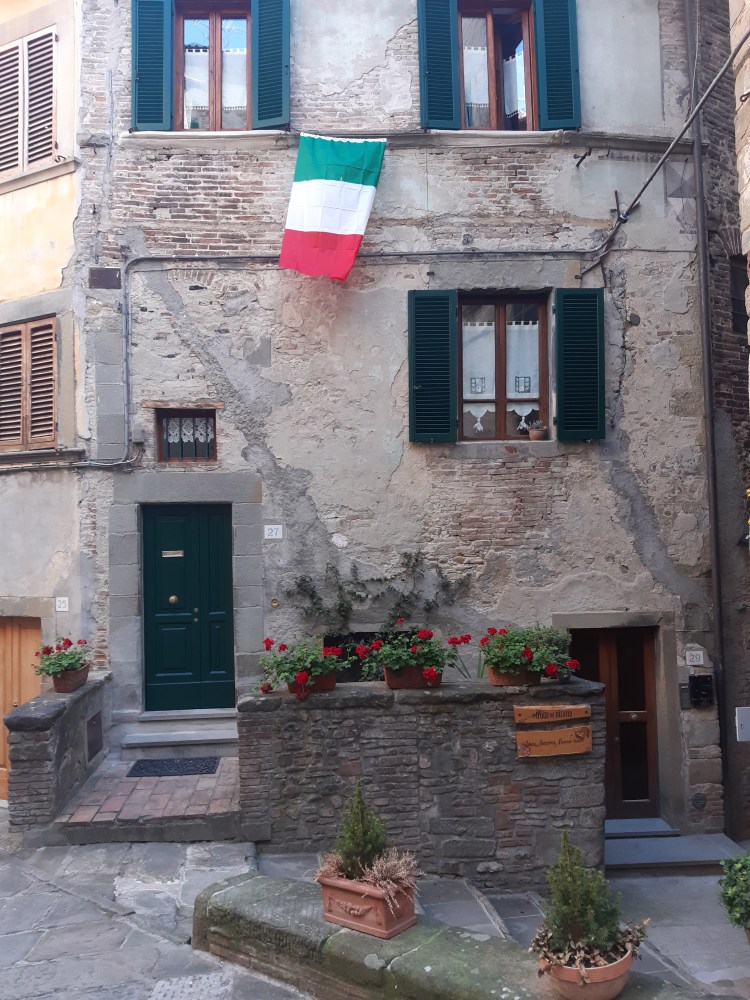
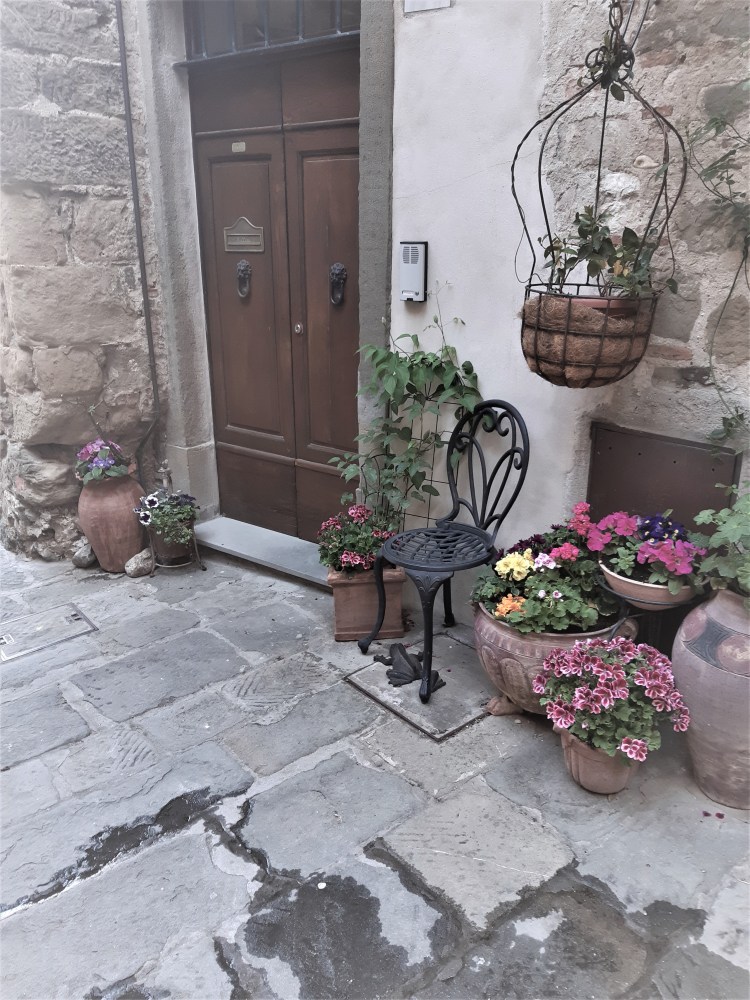
If you search online for information about Anghiari you will almost certainly read that it is considered one of the most beautiful medieval hilltop towns in Italy. It is, and walking through and around the town as I do most days is unquestionably a sensory delight. The ancient stone houses crowding narrow streets never fail to intrigue and regardless of the season many facades are brightened with plants placed around entryways and steps.

But our decision to move here after Terry’s serendipitous discovery of the town has shown us that Anghiari has much besides beauty and charm to offer. When we arrived last summer, the town was beginning to fill with visitors in anticipation of the Southbank Sinfonia, a concert series held every July. The musicians are graduate students from London taking part in a fellowship program that provides the opportunity to gain experience on their way to a professional career. We went to a number of performances ranging from soloists, to a chorale group, to symphonic music. The concerts, all free, took place in central Anghiari, usually in one of the several piazzas in town, once in a church–settings that could only enhance the experience. Numbers of people from out of town arrange their vacation in Anghiari around this event and we noticed that the conversations around us were in English as often as Italian.

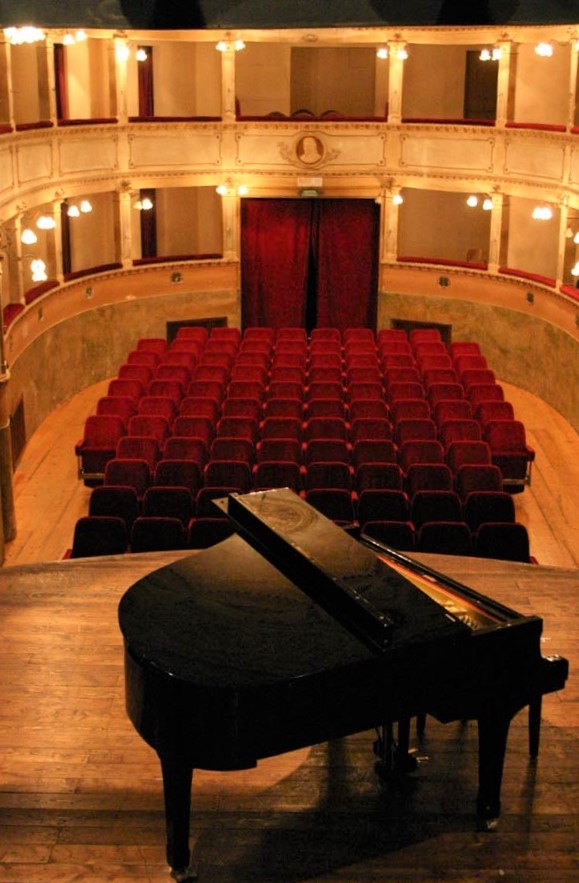
While Southbank Sinfonia is a once a year pleasure, Teatro di Anghiari is a regular source of lectures, plays, readings and classes taking place just steps from our front door. I once slipped into the back of the hall as a reading was underway and though it was in Italian and I didn’t understand the words, I could still appreciate the enthusiastic response of the audience. It was my first sight of the interior of the theater and I was surprised to see that though small, it was as beautiful as most theaters in much larger cities.

Theater of Anghiari-from Theater website

For the major part of the theater season we were either away in the Balkans or the scheduled performances had been cancelled due to the coronavirus pandemic, so we haven’t been able to take advantage of the theater this year. We do, though, look forward to next season’s programs after we return next Fall.

During August, Terry and I could hear applause and laughter from the Checkered Tablecloth or the Tavaglia a quadri, a four course Tuscan dinner accompanied by a theatrical production at the Piazzeta del Poggiolino on the town wall. This week long event has been produced for over twenty years and is attended by hundreds of people seated family style at long tables. It is not expensive, about 45 EU per person for meal and theater. The performers, servers, and cooks are all drawn from town residents; our neighbor, Valerio, by day a furniture restorer, works each season as a server and has been doing it for most of the event’s existence.

And the play may also reflect local concerns as it was in “ci Amazzon.” This performance from 2018 portrayed the impact that online shopping sites have on small shop keepers and artisans who make up the business community in Anghiari. The hearty menu for the production was:

  • Pinzimonio dell’orta
  • Red and Black Croutons
  • Flan with Red Onion Valtiberina
  • Bringoli with Fake Sauce
  • Chianina Stew with Potatoes
  • Cantucci Tuscan
  • “Piavesino” del Chieli

and to drink:

  • Acqua d’Anghiari
  • Red Wine’Farmer’s Vinsanto
  • Barley Coffee with Rum

The dishes offered are traditional Tuscan foods, the menu written in a combination of English and the Tuscan dialect.

Pinzimonio dell’orta— an appetizer of raw vegetables served with a dip of oil, vinegar and spices. Red and Black croutons; this is perhaps a variety of breads rather than what Americans consider croutons; Flan with red onion Valtiberina; Valtiberina means Vale or Valley of the Tiber, commonly used to describe the geographical area in which Anghiari sits; Bringoli with fake sauce; spaghetti and red sauce without meat. The dish developed during hard times in Tuscany when meat was an expensive luxury; Chianina stew with potatoes; Chianina refers to the specialty beef cow that produces an exceptionally tender and tasty meat and is largely raised in Tuscany; Cantucci; essentially a biscotti, but half the size and laden with slivered almonds; “Piavesino” del Chieli;” In Italian this might mean either “playing footsie with heaven” or “one step from heaven” and in this context may mean either one or neither but does make some sense as a tasty dessert.

A popular event promoting the tastes of Tuscany is the I Centogusti dell’ Appenino (The Hundred flavors of the Apennines) held in autumn in Anghiari. The festival takes place in the medieval center, offering the opportunity to taste and purchase a variety of locally produced commodities. Agritourism is spotlighted as well, not surprisingly as agriculture is a major business in this part of Tuscany; a patchwork of fields growing sunflowers, vegetables and tobacco lies along the road to Sansepolcro and tractors are not an uncommon sight. No doubt we can thank the alluvial plains of the Tiber for the rich soil and the sumptuous vegetables that grow here.

Anyone who is interested in the literature of biography, memoir or storytelling may know that Anghiari is the “City of Autobiography,” as a sign at the city limits proclaims. The Libera Universita dell’Autobiografia (Free University of Autobiography) presents its major event, the “Festival of Autobiography” in late summer but offers a broad range of classes and events throughout the year. Even while closed due to the coronavirus in March and April 2020 the university solicited stories of living through the pandemic and to date has received at least two hundred personal accounts of the experience.

Further opportunities for anyone interested in the narratives of personal life are available within a half hour drive from Anghiari. A sign at the city limits of nearby Pieve Santo Stefano identifies it as the “Citta del Diario, (City of the Diary), a spiritual sister to The City of Autobiography. The town of little more than three thousand citizens is home to the National Diaristic Archive where over 8,000 diaries of ordinary people are stored. The Little Diary Museum is the interpretive arm of the archives with a collection of diaries available to be viewed by visitors. The diaries are written in Italian presumably, but the museum offers English signage and technological assistance so that Anglophones can enjoy the experience as much as Italians. Pieve Santo Stefano is also home to The “Memory Route” a program offering three to five day seminars combining autobiographical writing and opportunities to experience local culture, cooking and crafts. Truly the possibilities of enrichment through these institutions are so great that I suggest going to their websites where you can see all that is offered here and, perhaps, sign up for a class.

http://www.lua.it

http://www.memoryroute.org/

One of the options when doing the Memory Route, is a trip to the Busatti weaving facility, also open to tours for individuals or groups. The Busatti family presence in Anghiari dates to their arrival in 1755, when they purchased the Palazzo Morgalanti, which today remains Busatti headquarters. Forces of Napoleonic soldiers took over the Palazzo in 1797, using the facility to produce blankets and uniforms for the army of Napoleon. The Busattis were able to reclaim their Palazzo in 1815 after the forces left.

The Busatti textile enterprise dates from 1842 when eight wooden looms were installed in the basement of the palazzo to set up a weaving mill . Today, their business is world wide offering high end fabrics and assorted linens including kitchen towels, baby clothes, sheets and virtually any item of cloth you might find useful in your home. When we first arrived, we were told that we should not buy any Busatti products because they would outlive us, I hope a testament only to the quality of Busatti goods, not a comment on our ages. You can learn more of the history and shop their online store at:

http://www.busatti.com/anghiari or http://www.busatti.com/en

Note: Two generations of the Busatti family share the large villa next to our house where they are visited regularly by children, also involved in the business, and grand-children. A furry member of the family is the little brown dog whom I have nicknamed Houdini for his proficiency as an escape artist. He doesn’t stray far and once his wanderlust is satisfied Houdini returns to sit patiently outside the gate waiting to be let in, sometimes getting a little help from a friend eg Terry.

Another family business we have yet to visit is Ravagni since 1421, where olive oil, vinegar, seasoned oils and soaps are made and sold. Visitors can enjoy tours, tastings and light meals along with demonstrations and explanations of the processes. The tour gets rave reviews on TripAdviser with people exclaiming over the olive oil, the lunch and the host, Francesco. The business has a long history, first mentioned in 1421, hence the name Ravagni since 1421. It is set in the countryside on the outskirts of Anghiari where traditional methods are used to press the oil and all products are handmade. Although good olive oil is easy to obtain here, we are eager to try the local oil produced from the olive trees that grow everywhere in this area. This business, too, sells its products all over the world.

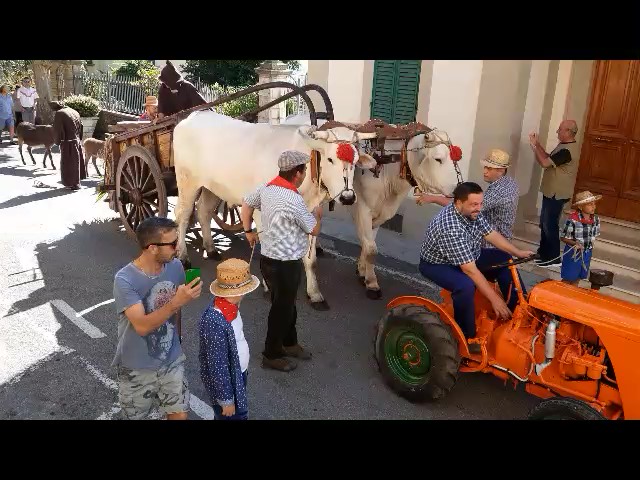
Anghiari loves parades and we are fortunate to live on a street where they pass by so we can watch from our balcony. A day after we moved into our house, we saw the parade pictured below, a celebration of the farming history of Anghiari and surrounding areas.

August 3 parade in front of our house

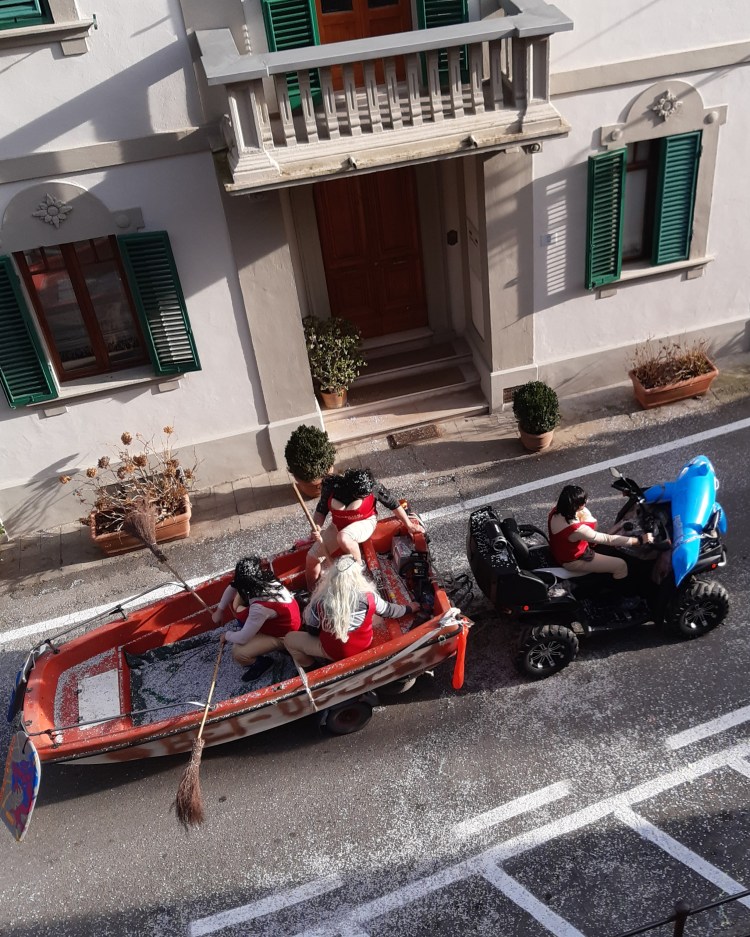
And shortly after we returned from the Balkans another parade passed by, this one a celebration of Children’s Day.

Chilldren’s Day parade-this float represents the School of Music and Dance located at the top of Anghhiari


Childrens Day Parade-Buxom Beauties


The parade ended in Piazza Novembre IV next to us where the children were treated to a magician performing and kiosks selling all manner of items that could appeal to a child. The parade and Piazza activities were the culmination of several days celebrating Childrens Day, a holiday exciting considerable attention from Italians who seem especially devoted to their youth.

And finally, there are several museums in our town, most notably the Museum of the Battle of Anghiari and the Museum of Palazzo Taglieschi, both located in the Piazza Mameli. Of even greater interest to me are the archives located in our library, where I hope to find further information about the history of not only our house but all of the churches, palazzos, gateways and other architectural features of this ancient town. Due to the coronavirus pandemic, the archives have been closed for much of the time since we returned so that project is another that will be delayed until we return next Fall.

Although we’ve owned our house in Anghiari for three quarters of a year, our opportunities to explore and enjoy all that is offered here have been limited by both the requirement to leave for three months and then the COVID-19 pandemic. Now we anticipate departure in just a short time and with movement still restricted must wait until our return to take in more of Anghiari and the area beyond. We look forward to taking full advantage of all I have mentioned above and all that we have yet to discover.

COVID-19 Hits Italy

Part I

An Overview

We drove from Zagreb through Croatia, Slovenia and northern Italy in a day, arriving at our house in early evening, January 15, 2020. Home again, and excited to see the completed construction projects we had commissioned before leaving for Serbia. There were new shelves in the kitchen, all the cupboard doors now worked, a new sink and faucet had been installed and the old damaged counter top replaced with a new and more impervious butcher block surface. Upstairs we found our new closet/ armadio de mura extending across an entire wall of the dressing room so at last we could store our clothing in a convenient place. The specially made blanket from the fabulous Busatti company was waiting for us in their store a block away. Not only we were home at last, but in an improved and updated home.

After a month of settling in, again, we turned to perusing real estate sites, looking for a second home in the U S to use when we were not in Italy. Going through the process from a distance presented some challenges but our helpful realtor was willing to check on properties we identified as good prospects. Eventually we narrowed our search to a condo that Terry and I both liked and before long we were negotiating a price, arranging for inspections and completing all the tedious details of buying a house.

Our flight reservations had been made months before and we were to leave for the U S on April 14 at the end of the allowed ninety days. As anyone can by now surmise, that didn’t happen. I am sitting in my living room in Anghiari on April 20, suspended in time as so many in the world now are. Currently we have new flight plans, scheduled for May 19, but we cannot be certain that we will be able to fly even then; already our itinerary has been altered and our original non-stop flight Rome to Atlanta now has a layover in Paris.

So here we remain in Italy, one of the countries most afflicted with the coronavirus, COVID-19, (CoV-2,corona virus 2) a SARS virus. So what is this abominable entity that has paralyzed so much of the world?

First, let me say that viruses in general are microscopic monsters. They invade the body’s cells and convert them to function as agents of the virus’ DNA, or RNA in the case of the coronavirus. When they take over the cell completely, the cell dies or explodes, spreading the virus’ genetic material to adjacent cells. Think of the 1956 film, “Invasion of the Body Snatchers” but on the cellular level. Thankfully, unlike the film, the host body’s immune system normally fights off the attack and health is restored–sometimes immunity is the reward for having suffered, but it is often temporary.

The coronavirus that causes COVID-19 is an aggressive virus, covered with spikes that enhance its ability to take over a cell. Beyond that, it is a sneaky virus loaded with characteristics meant to insure that it fulfills its mission to survive and proliferate. Sneaky in that a person who is asymptomatic can spread the virus unwittingly as he/she continues to follow normal routines. Sneaky also in that some of those infected remain positive for the virus after symptoms abate and may still be contagious. Sneaky again as the virus can survive for extended periods in droplets of moisture distributed by an infected person. Sneaky, once more, though not unique to coronavirus, because many human habits create invasive opportunities for a virus–think of touching your face, where the virus gains access to mucous membranes or neglecting to wash hands thoroughly many times a day or of the normal practice, currently mostly avoided, of greeting people with a handshake or a hug. We are adjusting to altering or compensating for these habits, but in the early days of the pandemic, long held practices were hard to abandon.

Significantly, the cornavirus is a novel one so predicting its behavior is difficult. Researchers are still struggling to understand it fully and treatment is really just a matter of controlling symptoms. The scarcity of testing materials, flaws in the testing process itself, and a policy of not testing asymptomatic persons further complicate the problem as the true numbers of COVID-19 spread are unknown. Without that information, predicting the rise, duration and decline of the pandemic is exceedingly challenging so the medical community as well as policy makers have had to take a step by step approach based on current data, however flawed, as it becomes available.

The result, as we all well know, is that what is left to us is avoiding as far as possible the contact that would lead to contagion. So we wear masks and rubber gloves and practice social distancing, the latter being the most problematic and most difficult to enforce. The restrictions as to which businesses can continue to operate, and which can remain open but with limited access, have resulted in severe economic consequences for significant numbers of people and ultimately for the economy of their country. Moreover, too many people choose to simply violate government policy and although incurring penalties, have already done the damage meant to be avoided. And so contagion continues and by the nature of the beast, expands.

Part II

The Coronavirus Experience in Italy

Initially, the first cases of coronavirus in Italy were thought to have arrived with two tourists who had traveled from China in late January. Soon after, an asymptomatic but virus carrying Italian citizen returned from China and maintained an active schedule, infecting a number of people in the northern region of Lombardy. The latest information, however, suggests that the virus was already circulating in Italy earlier in January and hasn’t been connected to travel from China. In any case, Terry and I returned to Italy just as the epidemic was beginning here.

Italy, like most countries when COVID-19 first appears, hesitated before imposing restrictions stringent enough to effectively control contagion. Initially, authorities banned flights from China hoping that this would prevent spread of the virus but before long it became clear that contagion was being transmitted within the Italian population. On February 21 sixteen cases were diagnosed in the region of Lombardy primarily in the capital city of Milan. By the next day sixty people had contracted the virus and across the next two weeks numbers continued to grow and people were dying. Two weeks later on March 8th, desperate to contain the now rampant spread of the disease, Lombardy began a lock down. On March 7, in anticipation of the decree, hoards of Milanese packed their suitcases and fled to the south, many using public transportation, risking contagion among themselves and carrying the virus to southern regions. The following day, Italy’s prime minister, Giuseppe Conte, extended the lock down to the whole of Italy as it became clear that the virus was spreading throughout the Italian peninsula.

Lombardy and then Veneto with Venice as its capital, quickly became the “hot spots” for COVID-19 and remain the areas most affected. But in a short time, other cities were counting significant numbers of infected and virtually no place in Italy could be considered safe. Often a single case was first identified, then several, then hundreds and the virility of the virus could not be ignored. The restrictions imposed as the evidence mounted were defied by many but most Italians accepted that the country was in crisis and began to adjust to a new life style.
Being Italy, music became a means of expressing encouragement and solidarity. In a number of cities, the evening of March 13 brought musicians and music lovers to their balconies to sing, play instruments or just enjoy a few moments of entertainment in the face of a challenging situation. Songs ranged from the national anthem to popular folk music to opera and those who had no particular talent to share were encouraged to just bring spoons and pans to accompany the music. Fortunately, for those of us who could not participate in person, videos of some of the impromptu concerts played across the internet. There are many videos sharing the events on YouTube, one example below:

http://www.youtube.com/watch?v=EBByYjjvNzs

Music continued to provide respite from the drear of the virus even as spontaneous balcony performances began to dwindle. On Easter, the beloved Italian tenor Andrea Boccelli presented his “Music for Hope” concert from the nave of Milan Cathedral. Standing alone in front of the altar, facing rows of empty pews, Boccelli sang a number of sacred songs accompanied only by organist Emanuele Vianelle. Following that portion of the program, Boccelli stepped outside to stand at the cathedral entrance for his final offering. As a slight breeze ruffled his hair, Boccelli sang the beloved “Amazing Grace” with intermittent scenes of stricken cities around the world playing across the screen. When the hymn ended the camera panned away showing the barren forecourt of the enormous Milan Duomo and the small but big singer still standing before it.

In case you missed this moving event, you can hear Boccelli sing “Amazing Grace at the link below:

http://www.youtube.com/watch?v=bpXwOSHTwsY

Not long after his solo concert, Bocelli joined Lady GaGa, Celine Dion, John Legend, and pianist Lang Lang along along with scores of other musicians for the “One World Together at Home” video concert. Separated by oceans and continents but joining together in a concert of encouragement, it was in Lady GaGa’s words, a “love letter to the world”.

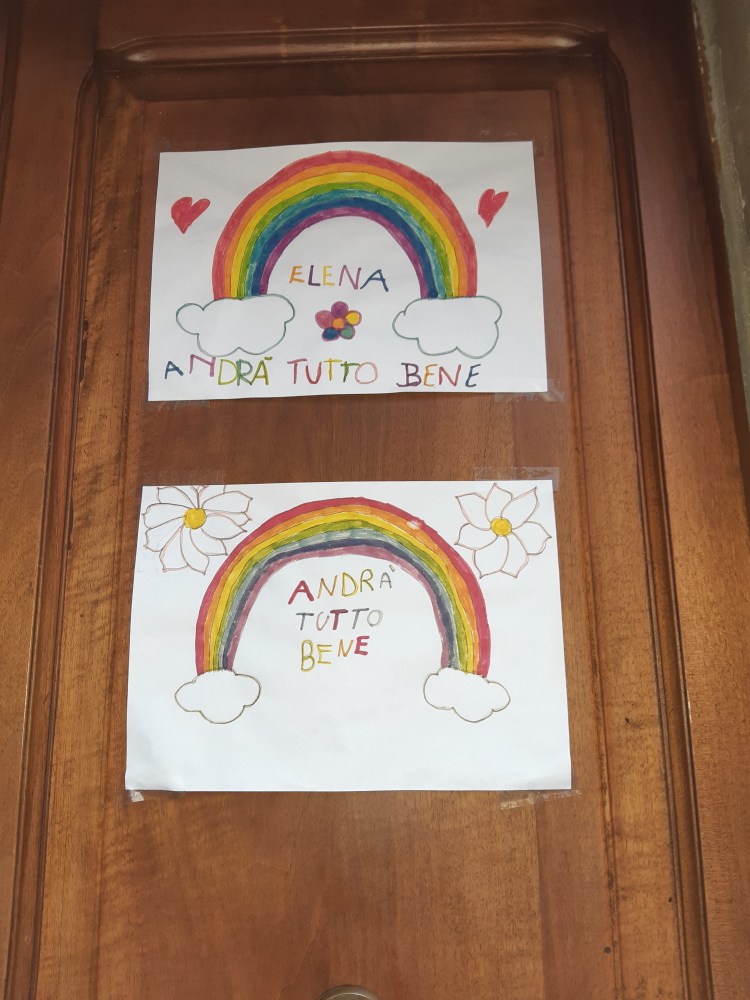
All over Italy, posters appeared depicting rainbows with the phrase, “Andra Tutto Bene” (Everything will be fine). Though some were professionally printed, many were drawings by children. Below are two I saw posted on a front door in our town, Anghiari.

Andra Tutto Bene–thank you Elena

Below is another example of a local Andra Tutto Bene poster, this one having suffered from the elements in spite of its plastic covering. The young artist included the Italian flag, a picture of Anghiari and a hand print, presumably that of the artist. The Italian flag is red, white and green, though here green has faded to brown.

A different word order, same meaning

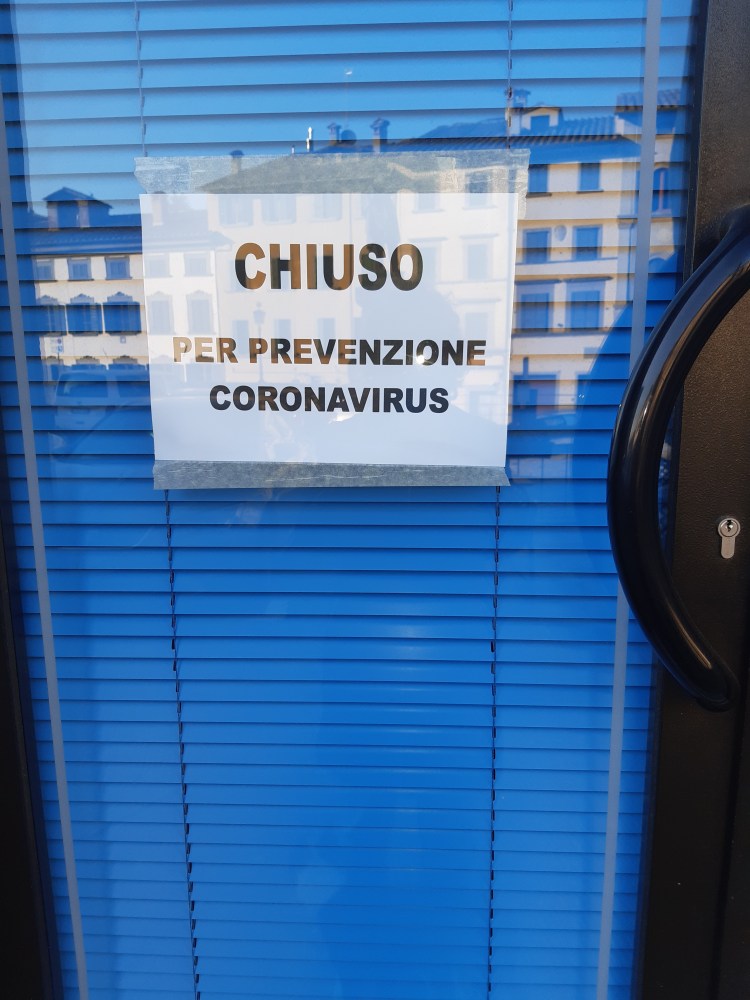
Not all of the signs were uplifting messages; the one below tells the story.

Closed for the prevention of coronavirus-Piazza Baldaccio,, Anghiari

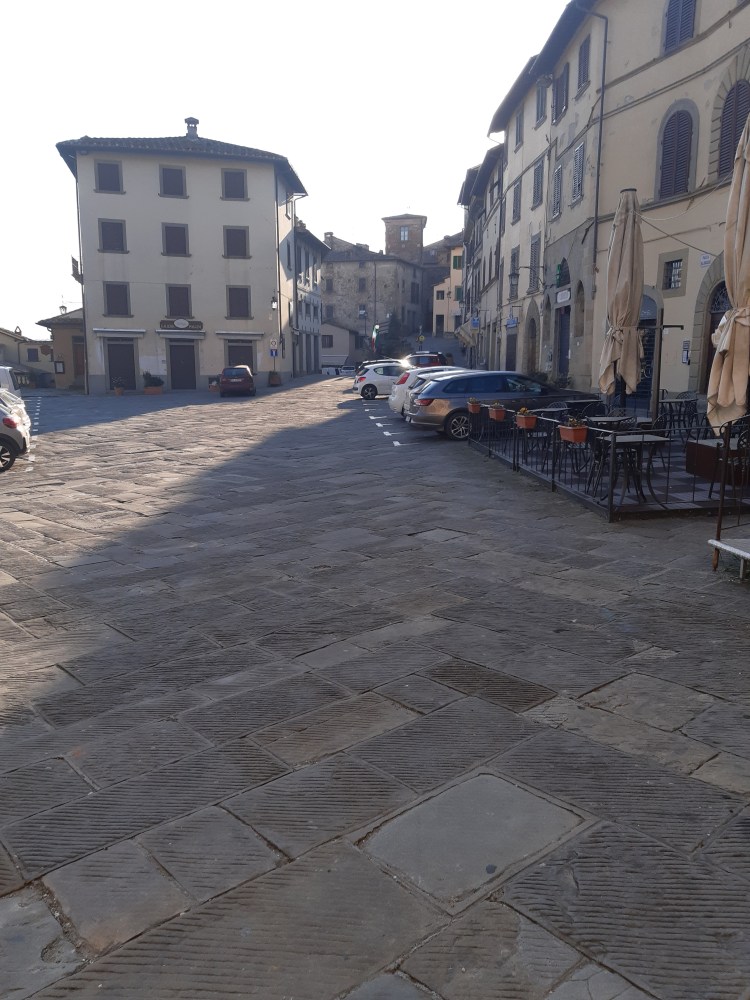
Anghiari’s main piazza, Baldaccio, was empty of people, as were all the piazzas in town–doors to businesses were shuttered, cars parked with no place to go, cafe tables and chairs without customers.

Piazza Baldacchio, Anghiari, Italy


Though our town was very quiet with motor and foot traffic notably lighter than normal, we maintained contact with our neighbors. Across the street, Umberto and Graziella greeted us every day with ‘come va‘ (how’s it going?) and we were their audience as they dug and planted in their garden. Down the street our friends, Piero and Lela chatted with us from behind their fence when we walked by. Django always stopped at their gate, pushing his nose through an open space in hopes that Lela would offer him a treat–and she usually did, handing it to him through the bars. One person who had previously walked by our house multiple times a day completely disappeared. An older, very withdrawn man, he avoided speaking or acknowledging others, but I had begun to say hello to him, hoping for a ‘buon giorno‘ or ‘buona sera‘ in return. Initially he looked away when I spoke but in time he began to respond with a nod, and eventually spoke a mumbled greeting. I hope he is alright.
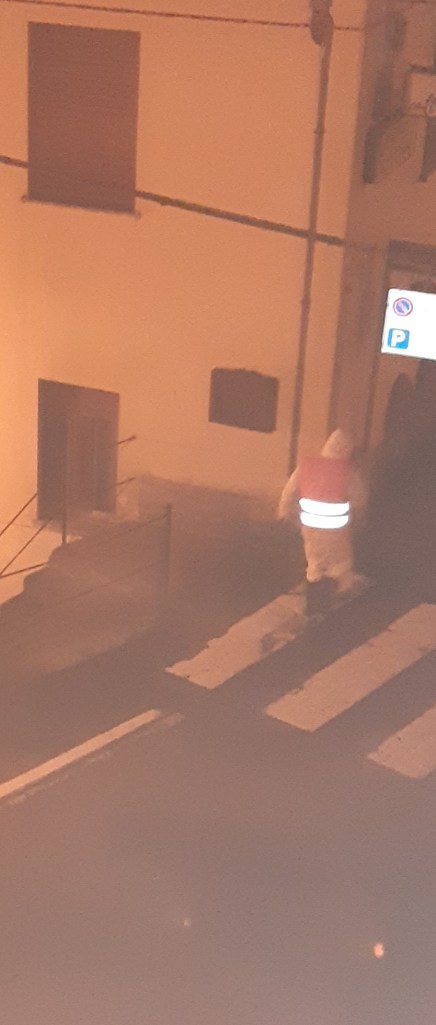
In part because Anghiari is a very small town, we feel safe from the threat of coronavirus here. Not only do we lack the pressing crowds of a larger city, but people in Anghiari take the restrictions seriously, maintaining a distance of at least six feet, and wearing masks even when just going for a walk. Everyone also puts on gloves in addition to a mask when going to stores and some grocery stores and pharmacies provide them along with hand sanitizer in the event a customer shows up unprepared. As if those precautions were not enough, I looked out the window one night to see a truck disinfecting our street. A few minutes later, I heard the noise of machinery outside and when I looked saw two individuals in haz-mat suits disinfecting the stairs, railings, and street in front of our house. The picture below shows one of them at the top of the stairs.

Disinfecting stairs and street

When I called Terry to see what was happening he immediately got the phone to take this picture and document the eery sight. Looking at each other in amazement, we both felt as if we were living in a science fiction novel. We have never seen the disinfections repeated, though it may have been going on in other parts of town, or deeper into the night.

For a long while we thought there were no cases of COVID-19 in Anghiari but yesterday learned that two nurses from our town had contracted the virus. Both have recovered.

Because of the course the virus had taken in Italy, I followed developments in the United States as the coronavirus began to take a toll there. My greatest interest was in our former home town, Fernandina Beach, and the places where our children live–New York, Nevada and Texas. One of my daughters is sure she had the coronavirus as did one of her daughters. Neither was tested but friends of theirs were and found to be positive. My son was ill in the very early phase of coronavirus in Houston, but is not sure whether it was a cold or the coronavirus. My other daughter seems to have been spared as has Terry’s daughter and her children who live in hard hit New York.

I emailed friends in Fernandina as soon as I knew that the virus had taken a foothold in Miami and other Florida cities, urging them to take precautions and particularly to practice social distancing. As I followed developments on FaceBook I was astounded to see that the primary topic seemed to be going out to eat–which restaurants people planned go to or had already visited, and what they had eaten or would eat when they got there. Having witnessed the pace of contagion in Italy, it was frustrating to watch the casual and even dismissive attitude, not just in Fernandina but in the states generally. There was a considerable body of evidence documenting the devastation in other countries and it was hard to understand why that was being ignored. Things there have changed somewhat as cases grow but still there is generally a much more cavalier attitude in the U S than in Italy–not, I should add, with everyone but with too many who risk their own health as well as that of others.

Having shared with Italians the experience of living with the concerns and inconveniences of coronavirus, I have developed a much greater appreciation for the culture than I had when we arrived last summer. The spirit, generosity and resilience with which Italians met the crisis has made me a great admirer of the country and the people. Terry and I had discussed a number of times whether we should apply for the long stay visa again; Terry was always convinced that we should but I was hesitant. Now I feel like a citizen of Italy, my ‘status’ conferred by shared experience, and we agree that applying again is the obvious thing to do.

As I write this, Italy is waiting word from Prime Minister, Giuseppe Conte announcing some relaxing of restrictions beginning May fourth. No one anticipates the current guidelines will be abandoned entirely, or even largely, but all are looking for any sign that life will return to normal.

ANDRA TUTTO BENE

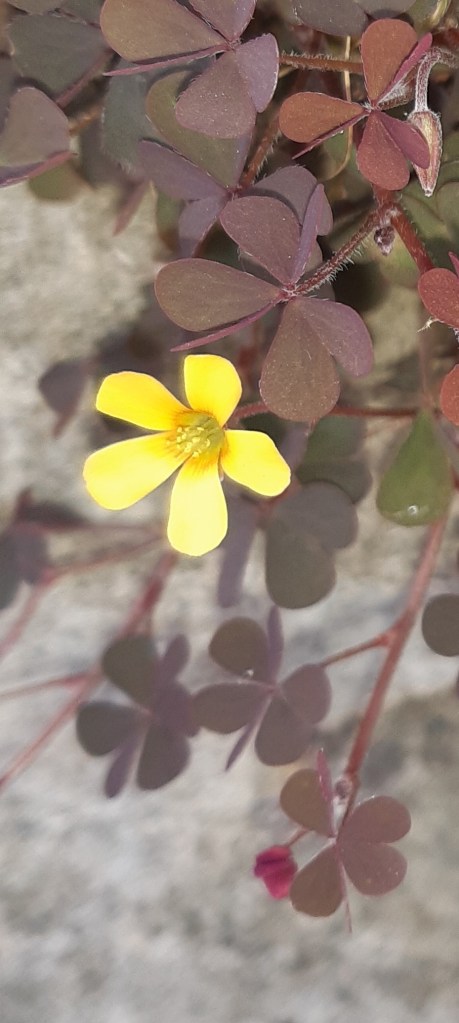
Sometimes flowers grow out of stone

And Now Sarajevo

Part III

Enjoying Sarajevo

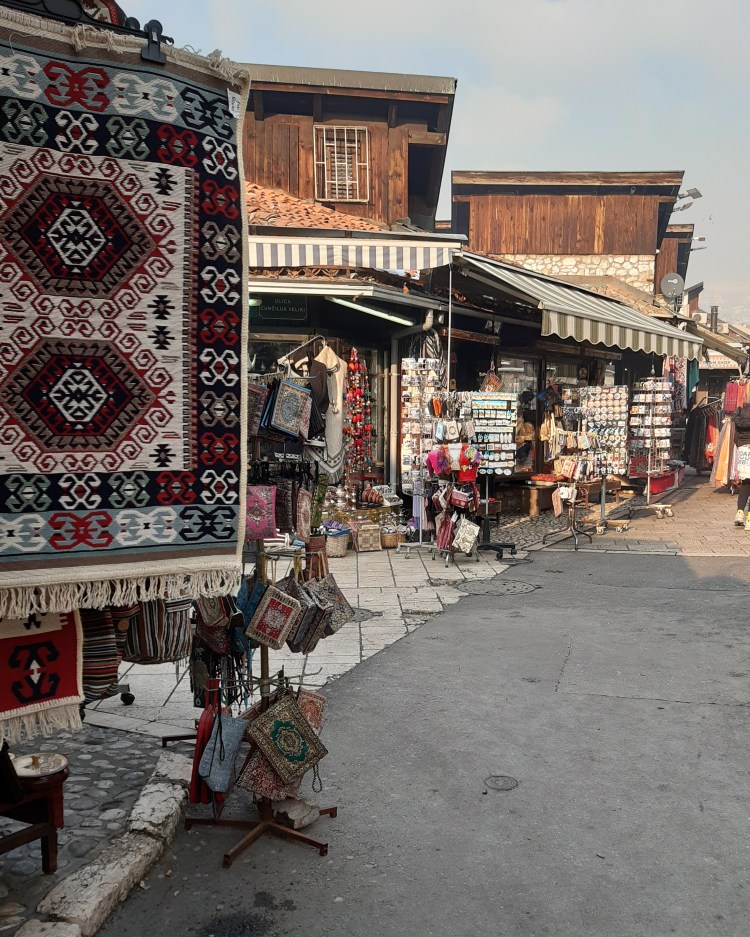
We had been enjoying aspects of Sarajevo, even as we coped with all that we learned of its difficult history. Not a day went by that we didn’t pass through the old market, sometimes simply to take in the colorful scene, or on the way to an errand, and the morning walk with Django almost always took me there just as proprietors were setting up for the day. The market, Bascarsija, dating from the fifteenth century, is today a collection of kiosks, stores and restaurants covering several city blocks. Its varied collection of ethnic goods appeals to tourists, but locals frequent the area as well.

Market i(Bascarsija) in Sarajevo Old Town

We were not interested in buying any of the exquisite purses, rugs or jewelry sold here but instead deferred to practical purchases–Terry bought a pair of slippers and we found a carry on bag we could use for our flight out of Bosnia. Candy stores tempted with their great variety and color so we indulged without caloric penalty by buying a gift box to give to our hosts.

What did not tempt us……………

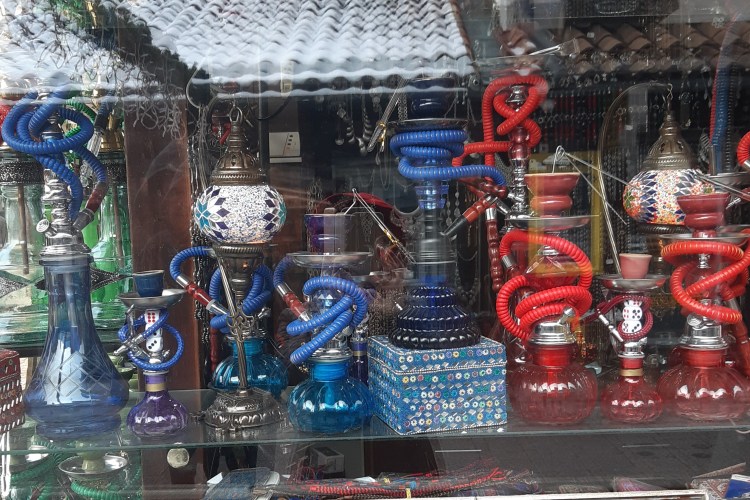
Hookahs for sale at the Sarajevo market

Hookah cafes could be found every few blocks around the market and, though interesting to see, we had no enthusiasm for experimenting. Hookah cafes have become rather popular in the U S and Canada, favored mostly by young adults who are attracted to this more exotic form of smoking and enjoy the social setting where people gather while indulging. The substance smoked might be either a flavored tobacco or an herbal mix, (shisha) which is filtered through water in the base of the hookah. Since we never went inside a hookah cafe I am not sure whether they serve a regular clientele or are simply a curiosity for visitors.

When we felt like eating out, the market area was usually our destination. Terry particularly liked a Chinese restaurant there and went so often, usually for take out, that the staff greeted him like an old friend when we appeared. Sometimes we grabbed a gyro from a tiny shop offering a choice of chicken or lamb topped with lettuce, onions or other veggies. And one chilly evening Terry and I both savored a traditional goulash in a cozy restaurant where artifacts covered the walls and a cat curled up next to me while we ate. My favorite restaurant, though, was one near the top of the market where I inevitably ordered spinach pie and Bey’s soup. This chicken based soup is a Bosnian specialty containing okra, a vegetable I had always associated with dishes of the American south.

Bey’s Soup Recipe

  • 8 oz fresh okra
  • juice of 1/2 lemon
  • 8 cups water
  • 3 chicken legs or thighs (or 2 breasts if you prefer white meat)
  • 2 carrots
  • 1 stalk celery
  • 1 tsp salt
  • pepper to taste
  • 1 bay leaf
  • 2-3 Tablespoons butter
  • 1 egg yolk
  • 1 Tablespoon sour cream
  • 1-2 Tablespoons parsley

Dice the okra and place in pan with 2 cups water along with lemon juice. Cook for 50 minutes, then drain. Simultaneously, put chicken, carrots celery, salt and pepper, and bay leaf in a deep pot with 6-7 cups water and cook for 1 hour. Remove skin from chicken and dice. Return to pot with the okra and cook an additional 10 minutes.

Make a roux from the flour and butter and add to the soup. Mix the egg yolk with sour cream then add to the soup and cook for an additional 5 minutes. Sprinkle with the parsley and, if you want a little more lemon flavor, add a splash of lemon juice or a slice of lemon.

The result will be a slightly thick, lemony soup that is quite hearty and could suffice for a meal.

Bey’s Soup

There were many museums in Sarajevo to choose from but we were naturally eager to see the museum at the Sarajevsko Pivara brewery near our house. Because of its role during the siege we expected descriptions of that period to be a significant part of the museum’s exhibit. That was not the case, however, and displays were dedicated primarily to such things as labels and bottles through time, phases of their production of beer and a big shout out to the Coca Cola company which began to utilize the brewery after the siege to produce soft drinks. It was a tiny museum and tours of the facility were not included as we had hoped, so our visit there was brief.

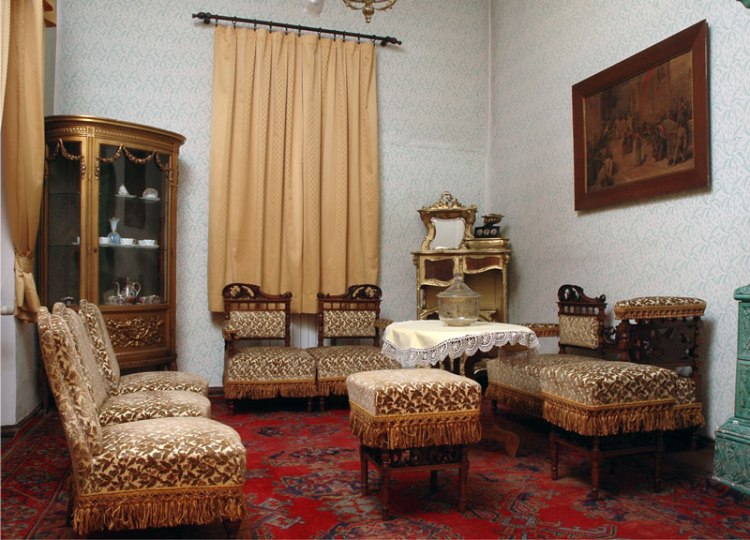
More interesting were the two house museums we visited. One, the Despic house (top photo below), stood on the street beside the river and had been owned by a wealthy Turkish businessman who eventually donated it to the city. The furniture shown in the photo is from the period when Austria-Hungary ruled Bosnia and sophisticated owners chose a decor reflecting the times. Throughout the Despic house, however, Turkish kilims, some of great size, covered the floors linking the decorative principles of two cultures.

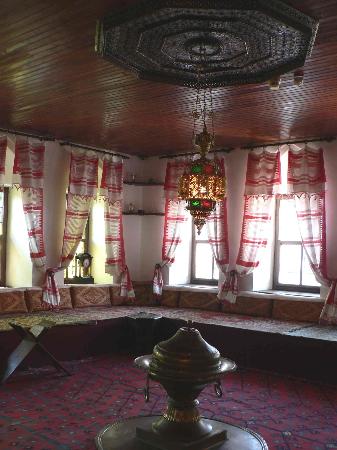
The other (Surzo’s) house, lower photo) required a walk into the hills beyond the market, passing by “Pigeon Square,” where huge numbers of pigeons cooed and bobbed as they settled onto the cobblestones. Surzo’s house was more extensive than the Despic house, with various rooms, passageways, and porches rambling across a large courtyard. Both were beautiful, as the photos below attest, but the Despic house was a city house, while Surzo’s house was built in what would have been countryside at the time.

The Despic House- dating from 1881 (photo credit, Trip Adviser)


Surzo’s House Banquet room (photo credit- Trip Adviser)

Surzo’s house, although contemporaneous with the Despic house and both owned by wealthy Turkish businessmen, showed greater affinity with its mid-eastern connection. It was divided into public and family spaces, and further into separate rooms for men and women. The Despic house, in spite of western decor in many areas, did have an assembly room similar to the one in the photo above. In both houses these were formal meeting places, presumably used for large gatherings as the banquettes lining the room suggest. The brazier in the center of the room provided heat during cold months of the year.

At the end of our visit to Surzo’s house the museum official, who had let us wander through the house on our own, approached to see if we had any questions. His English was fluent and he seemed eager to talk about the house and we, of course, were eager to listen. He described the house as having been abandoned and reduced to a “tumbled down,” state as a result of the Siege of Sarajevo. It was saved from declining into further ruin through the efforts of Sarajevan citizens who managed the restoration and opened it to the public as part of the city’s museum system.

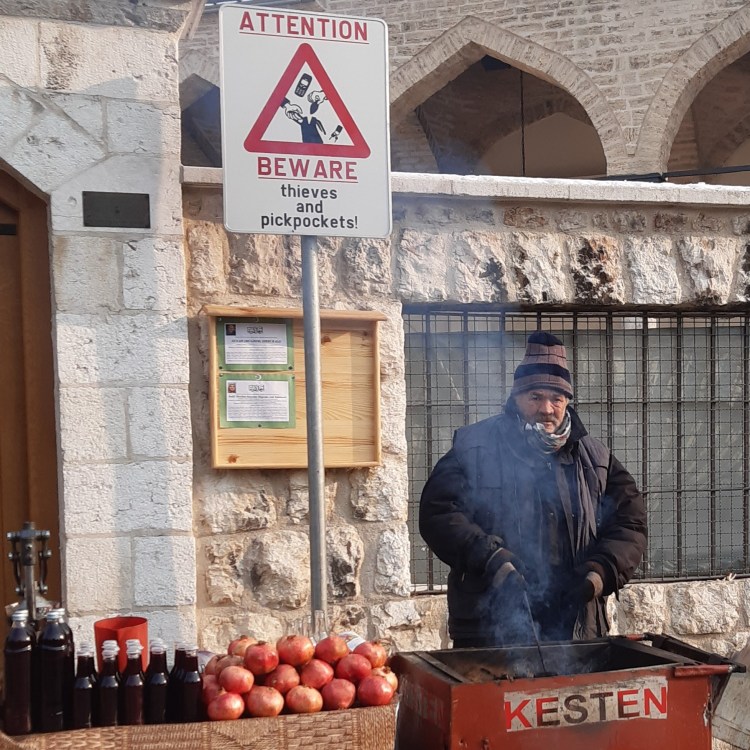
As we walked back home, we bought a bag of roasted chestnuts from a vendor braving the cold to offer a little refreshment. The chestnuts were tasty and no doubt the pomegranate juice would have been as well–we should have taken a bottle back to our apartment.

Roasted chestnuts and pomegranate juice–not sure the sign served his business well

We had been living in our apartment for some time before we stopped to read a plaque on an outside wall. Although it was written in Bosnian, we could identify the name of the person, Augustin Tin Ujevic, and saw that he had lived in this house from 1930 to 1937.

A search on the internet told us that Tin, as he chose to be known, was a Croatian poet (1891-1955) revered by his home nation. He is considered one of the most significant poets of the twentieth century and without parallel in Croatia. Unfortunately, as respected as he is, not a lot of his poetry has not been translated into English. One of his most famous has been though, and I excerpt the first stanza below:

Daily Lament

How hard it is not to be strong

how hard it is to be alone

and to be old, yet to be young

and to be weak and powerless,

alone, with no one anywhere

dissatisfied and desperate

And trudge bleak highways endlessly”

(translated by Richard Berengarten & Dasa Meric)

I read a few of the translated poems and found them to be generally morose, but lyrically very beautiful. We were intrigued that he had lived in our building and wrote many of his poems there–perhaps in front of the fireplace in the very rooms we occupied.

John Kruth, an American poet and musician, so deeply admired Tin Ujevic that he created an album devoted to Tin’s work–“the Drunken Wind of Life-The Poem/Songs of Tin Ujevic. You can hear it at:

https://johnkruth.bandcamp.com/album/the-drunken-wind-of-life

As our month in Sarajevo ended, our host offered to drive us to the airport to catch a plane for the short flight to Zagreb. We were happy at the prospect of returning to Italy, but nostalgic about leaving Sarajevo where we had learned so much. On our way out of the city we would cross the Miljackia River for the last time and pass through streets that had become familiar during the last month. We were leaving the Balkans behind, which, had we not been required to leave Italy we would not have visited, but where our lives and minds had been so expanded. Assuming that all would go smoothly, we would spend a night in Croatia, then drive through Slovenia, Terry’s ancestral home, and lastly into Italy, the place we now thought of as home.

Last view of the Miljackia River

Post Script

As the time approached for us to leave Sarajevo we had to take Django to a veterinarian to get a health certificate allowing him to travel to another country. This time we were flying into Croatia, the first EU country we would be in since leaving Italy in October and we had some trepidation that the lack of a rabies titre test might catch up with us there. The vet tech was dubious about our chances of clearing borders without a problem but we had already set our course and could only hope for the best. The ambiguous comments by veterinarians in Belgrade and Novi Sad had left us uncertain whether lacking the titre test should be an issue so we relied on luck and crossed fingers to take us through the various borders, hoping that we could slide Django past without a problem.

And we did pass through all border controls with no questions. The authorities at the Zagreb airport only wanted to certify that rabies vaccinations were up to date, and that his health certificate verified he had seen a veterinarian and had no health conditions that would prevent travel. Officials at the border crossings into Slovenia and Italy took no notice of a dog in the back seat.

And Now, Sarajevo

Part II

Getting to Know Our Neighborhood

Our apartment was on a block that included a mosque, a Christian church with monastery and a brewery. At 6:30 in the morning, I heard the call to prayers as I drank a cup of coffee. A half hour later, church bells chimed. The brewery was silent, though perhaps gearing up for the day’s work. This close quarters mix of religious and secular institutions reflects the cultural composition of Sarajevo. The majority of the population is Muslim, while, except for a very small Jewish community, the remainder is Christian, both Serbian Eastern Orthodox and Roman Catholic. But at the same time, Sarajevo is a highly secular city and its people identify as Bosnians first and place their religious orientation second. Although embracing Islam, the Bosnian Muslims, (Bosniaks) are, in fact, descended from Slavic peoples of the south who converted to Islam during the Ottoman occupation of the Balkans.

Still, the Islamic majority of Sarajevo was evident in the many mosques located throughout the city, outnumbering Christian churches significantly. At times I was able to hear the call to prayer from several mosques simultaneously as each reminded its followers that it was time to pray. And Muslim women of Bosnia do express their religious affiliation in their clothing, most wearing a calf length skirt or dress over slacks and always a scarf on their head. Many younger women, however, give just a bare nod to hijab by wearing a scarf but otherwise dressing as any other stylish Sarajevan female would.

There are burial grounds adjacent to most mosques in Sarajevo. The one pictured below was near our apartment and I stopped often to look at it, curious about the grave markers I saw there. Cemeteries are both historical records and repositories of cultural information and while I couldn’t read any of the information on these stones, I was fascinated by the forms. Of particular interest were the simple shafts topped by a bulbous finial swept by incised lines that followed its curves. Any number of possibilities from the mundane world could be read into this form if one’s imagination were let loose and mine ranged from a Dairy Queen cone to the human body. I was never able to find a good explanation for the history or source of these shapes, though sometimes saw the top identified as a turban. The information I did find described head stones as a means of locating the burial site of a loved one, not a memorial to them as western markers often are, thus the tendency to be somewhat restrained.

Cemetery at the mosque near our apartment

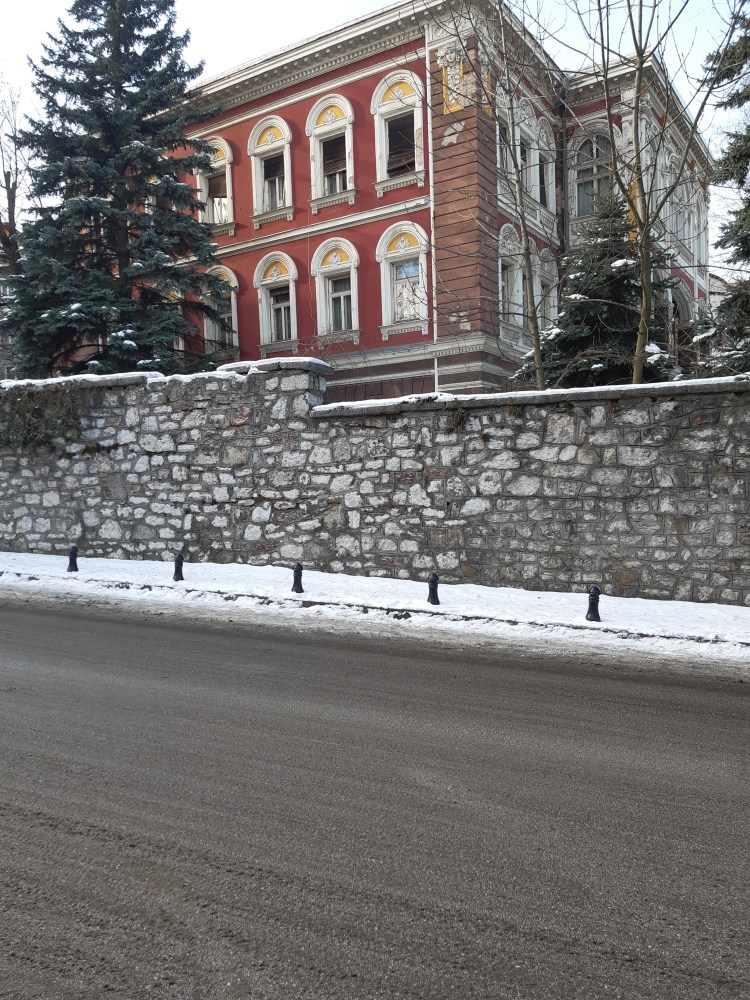
Across from our apartment and just steps from the mosque and cemetery, stood a lovely villa surrounded by a stone wall. I never saw anyone going in or out through the gate and didn’t know whether it was occupied or not.

Villa across from our apartment

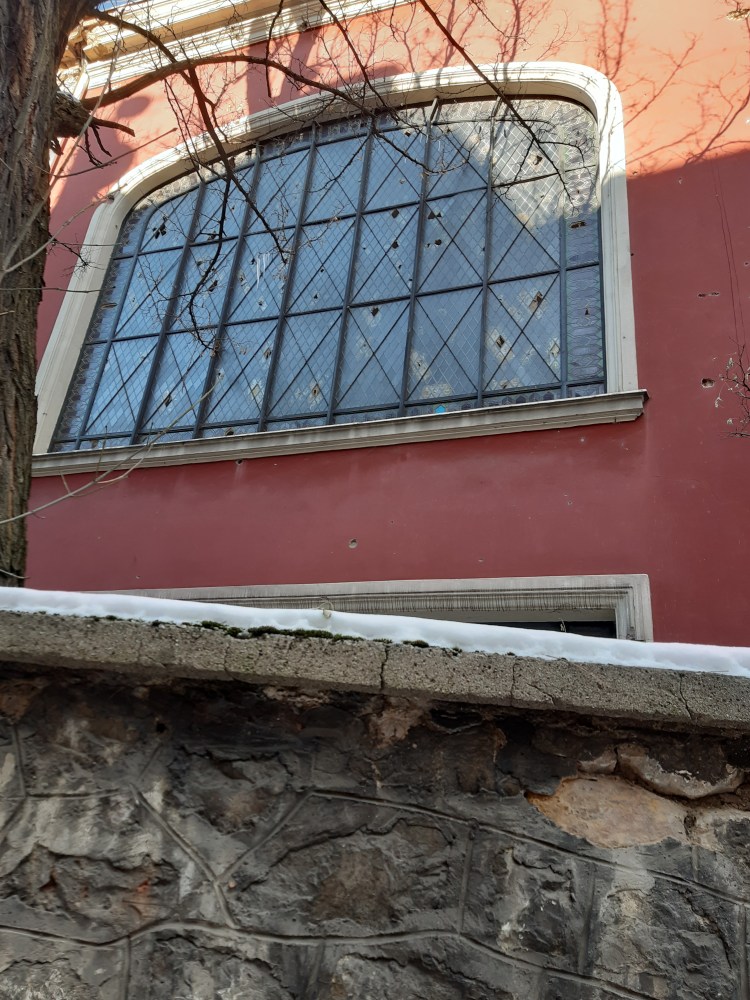
While walking on the street behind it, however, I saw the back of the villa and any question of whether someone lived there was answered.

Window of villa across from our apartment

With wind, rain and other elements able to blow through bullet holes in the window, it was clear that no one could live there. This villa, like a number of other homes in Sarajevo, had been abandoned by its owner; sometimes these were not reclaimed simply because the owner hadn’t returned after fleeing Sarajevo during the war. Ownership claims could also be complicated by legal intricacies such as multiple owners of the property so some may simply have declined to fight the battle.

Many houses in our neighborhood were similarly peppered with bullet holes including the building in which we were living, which had been occupied throughout the siege by the owner, our host. Both the villa shown above and our apartment building were adjacent to the brewery, which suffered more severe shelling than domestic structures but has been completely rebuilt. While new stucco and windows on some homes were evidence that they had been restored, those that still bore the scars were a constant reminder of the fighting that occurred in and around the area.

The brewery, on the opposite corner from the villa, played an important role during the Siege of Sarajevo, when production of beer slowed to a fraction of its former volume. The springs used in producing the beer became a major source of water for the citizens of Sarajevo who came to the brewery with containers to fill and carry home for family and friends. In order to get to the brewery from anywhere outside the immediate neighborhood, people, often children, had to cross the river and the two streets that flanked it, exposing themselves to snipers. Once at the brewery, those standing in line to get water became easy targets for soldiers poised in the hills above; then as they returned home, they recrossed the river, now carrying heavy jugs of water, again risking their lives. Water is a necessity so taking risks to get it was an inevitable and constant challenge and not infrequently led to loss of life.

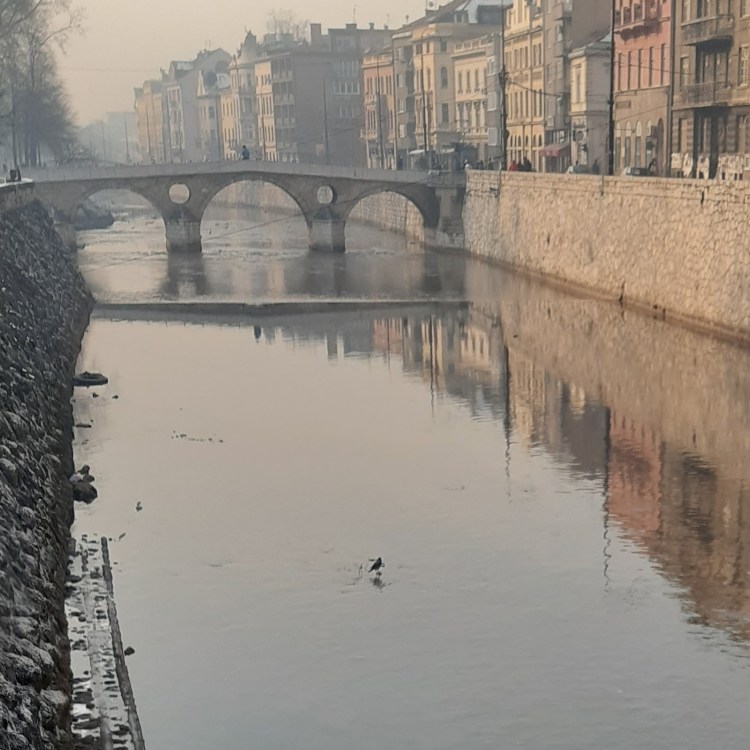
We regularly walked around the neighborhood and into the hills above and nearly daily crossed the Latin Bridge into the city center, where there were restaurants, markets and museums to visit. On a corner immediately across the river, a plaque and small museum identify the site of the assassination of the Archduke of Austria-Hungary, Franz Ferdinand and his wife Sophie who were in Sarajevo for an official visit. The date was June 28, 1914, wedding anniversary of the couple and, significantly, also the Serbian national holiday commemorating bravery of Serbian soldiers who fought at the Battle of Kosovo.

The group behind the assassination, “The Black Hand,” sought to withdraw from Austria-Hungarian control and return the southern Slavic area to Greater Serbia. Of the six members assigned to carry out the killing, five were ethnic Serbs including the man who ultimately shot the royal couple, Gavrilo Princip. Another member of the group had tossed a bomb into Franz Ferdinand’s motorcade but it bounced off his car and instead wounded others following behind. Though alerted to the dangerous mood in Sarajevo, the celebrations continued and ultimately Franz Ferdinand and his wife lost their lives as a result. Most of the world deplores the assassination, attributing the beginning of WWI to it, and regards those who committed it as terrorists. Many Serbians and Srpska citizens, however, honor the assassins as heroes for their effort to restore Serbian culture to lands held by the Austria-Hungarian dynasty.

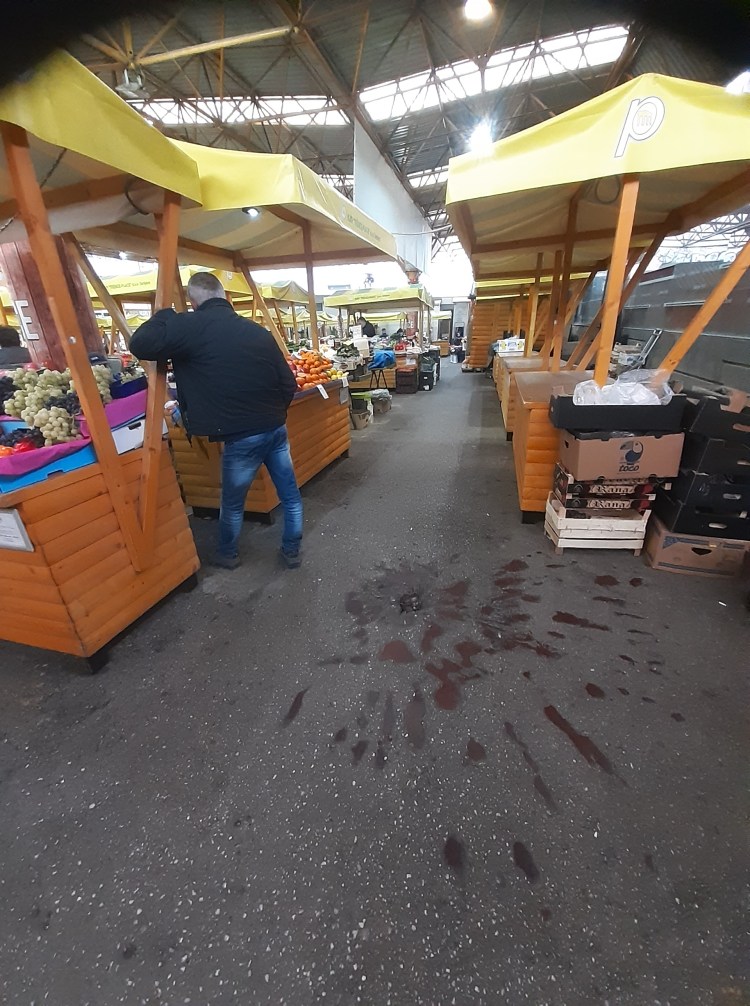
Around our neighborhood and throughout Sarajevo, one can see the “Roses of Sarajevo.” The name suggests something pleasant but these are, in fact, horrendous mementos of the war. The “roses” are depressions in the pavement left by a mortar strike that killed or wounded anyone standing nearby. After the war, as a memorial to the victims, the depressions were filled with red resin and though some have been obscured over time as street repairs were made, many remain. The first one I saw was at a market and I was so shocked at its depth and width that I quickly turned away.

A “rose” at a market. Though the red streaks may appear to be a blood spray, they are actually holes in the pavement that have been filled with resin

With pockmarked buildings and roses to remind us daily of all the tragedy Sarajevo had suffered, we elected to avoid museums devoted to the war. The Museum of War Crimes and the War Childhood Museum would certainly have been too much for us and we stayed away. There were other museums and sights to see and wonderful restaurants serving good food to try so as we adjusted to what we were learning about the past, all that Sarajevo offers in the present began to attract us. The season of Christmas was only slightly noted in Sarajevo but our hosts gave us a bottle of their homemade rakia as a Christmas gift and while we found this “white lightening” overly powerful, the gesture was a positive to take us into the New Year. As the year 2020 dawned and with only two weeks left in the Balkans we began to expand our experience of Sarajevo, looking beyond the war and starting to enjoy its unique character before it was time to leave.

And Now, Sarajevo

Part I

Our Enlightenment

We had been in Novi Sad a month and now it was time to move on to our next, and last, month in exile. I had considered spending that time in Albania or Northern Macedonia at one point, but in the end we elected to go to Bosnia-Herzegovina for an entirely practical reason–the rabies titre test. See the PostScript below for information about the titre test.

Our flight from Belgrade had been delayed so we arrived in Sarajevo in the late afternoon, an hour later than scheduled. The corridor from the airport into the city took us by a multitude of anonymous apartment blocks, each with a scattering of windows lit as daylight faded; only the Olympic Symbol left from the games of 1984 signaled that we were in Sarajevo. When we arrived in the historic center, the taxi driver had to search for our apartment, driving around and around the neighborhood, before finally depositing us after dark at the right address. By now it was about two hours later than our anticipated arrival so with many apologies to our hosts we at last checked into our home for the next month. We entered our apartment to find a bottle of wine and two glasses sitting on the table to welcome us–a highly appreciated nicety after a long day.

That evening we walked to a nearby restaurant for our evening meal, crossing the Miljacka River at the foot of our street on the way. Once again, our first meal in a new town was served by a loquacious waiter, eager to talk with newcomers about his city. But instead of extolling its virtues, this young man told us he hated Bosnia and planned to leave as soon as it was feasible. His Ukrainian wife, he said, had been badly treated when she arrived, reinforcing his own animosity toward the country. Although his service was generally amiable, we went away with a sense of the acrimony that some lived with in this multi-cultural city.

The next morning when we saw Sarajevo in the light of day, it became clear how the geography of the city contributed to the situation endured by Sarajevans during the three years long Siege of Sarajevo. The city lies in a bowl surrounded by hills; the upward slope of our street ended less than half a block from our apartment, transforming abruptly into a steep grade rising into the hills. In the opposite direction and across a distance of perhaps five city blocks, hills circled the other side of the town. Our eyes were suddenly opened to the consequences of this landscape in wartime — Serbian snipers positioned in the hills, rifles and mortars trained on the citizens living below–a city without a chance.

We had not been unaware of the war in Bosnia as Serb factions fought to gain control of Serbian ethnic areas there. My own life had been affected when NATO sanctions against Serbia prevented returning to archaeological work at Ravna, and therefore my plans to base a dissertation on findings there. Still, far off wars, and other tragedies, don’t resonate greatly when one’s own life is stable and comfortable and I think few Americans fully grasped what was happening in Bosnia. Now, although the Siege had ended years before, we were stunned by the extent of the tragedy we had just begun to fathom. Not only was the physical evidence all around us, but we read and watched videos to learn more. As we delved into accounts of war time Sarajevo we became more and more deeply affected by it and for at least the first two weeks of our stay my voice was reduced to a quaver whenever we talked about it.

I had read the novel “The Cellist of Sarajevo” (Steven Galloway; Riverhead Books-May 15, 2008) at least a year, maybe two, before having any idea that we would spend a month in Sarajevo. At the time I found it a powerful story but although the author indicated that it was inspired by true events, I didn’t pursue that story then. Now I couldn’t ignore it, and it wasn’t long before I discovered a photo of the real cellist of Sarajevo, Vedran Smailovic.

Vedran Smailovic playing at the bombed library in Sarajevo
Wikipedia

Smailovic, a member of the Sarajevo Philharmonic Orchestra and other musical ensembles, performed across Sarajevo for twenty-two days as the war raged around him, to commemorate twenty-two victims killed while waiting in line to buy bread. The composition Smailovic played was the mournful but beautiful “Adagio in G Minor” by Albinoni; you can hear him play it at the link below.

http://www.youtube.com/watch?v=74weGNYbhYw&92s

Smailovic remained in Sarajevo through 1992 and part of 1993 before escaping to Northern Ireland where he has lived since. His story almost certainly could not have been imagined but a real, and sensitive, human being living in a real, and awful, situation offered his fellow citizens this gift, helping them to transcend their reality.

The rubble of the building in which Smailovic is playing in the photo above is the result of fire bombing the National Library. In spite of heroic efforts by library staff to save as many books as possible, thousands of books and manuscripts were lost, taking with them pieces of Bosnia’s history and culture. Fortunately, through foresight and considerable effort, many treasures were stored in alternate locations and ongoing work at digitizing the collection will preserve it for the future. The restored building stands next to the river Miljacka, very near our apartment and we passed by it on a daily basis.

Restored National Library in Sarajevo
photo credit Lamiya B 2014


After we arrived in Sarajevo, Terry had purchased another book describing the experience of the Siege, “Black Soul” (Ahmet M Rahmanovic; Xlibris Corp, Feb 5, 2010) The fictional story is brutal but, Rahmanovic wrote, ‘the reality was worse.’ Terry found it so searing that he warned me not to read it, and I didn’t. He did relay to me though, the author’s view that Bill Clinton’s decision not to arm Sarajevans so that they could protect themselves, (in Clinton’s view, to keep the war from expanding) was instrumental in prolonging the Siege at the cost of many lives and years of intolerable conditions.

Finally, there is the memoir written by Bill Carter, “Fools Rush In: A True Story of Love, War and Redemption” (Schaffner Press Inc. April 7 2019). I didn’t read Carter’s account until I had recovered somewhat from the initial shock of Sarajevo, several weeks into our stay. By that time I could appreciate that Sarajevo’s story was indeed one of not only war but also love and redemption and was glad to have saved it for last. Carter arrived early in the war with a group bringing humanitarian aid to the trapped Sarajevans and stayed in the city for extended periods of time. During those times he made friends, experienced all the harsh conditions of the situation and continued to go in and out of Bosnia to collect more food, medicine and other difficult to find goods. From Carter’s story I learned of people making a meal of an onion, taking a bath with a liter of water, learning how to run across the deadly Sniper Alley without being killed or wounded–all while trying to maintain as normal a life as possible.

But Carter was not simply another actor experiencing the war. His association with TV production led him to contact Bono to request a TV interview and Bono responded by offering to play a concert in Sarajevo. Rather than endangering the musicians as well as the audience, Carter set up a satellite link so that the concert could be viewed in safety from wherever one could find a TV monitor to watch.

Inspired by the circumstances, Bono wrote the song, “Miss Sarajevo,” which was to become well known throughout Europe but was relatively obscure in the U S. The title refers to the beauty contest held annually in Sarajevo, improbably managing to go on in 1993 in spite of war conditions. Out of concerns for safety, the competition took place in a basement room.

Miss Sarajevo Contest, 1993
photo credit Pintrest

Bill Carter made a documentary of the concert accompanied by clips of war time scenes; to watch on YouTube and hear the song performed by U2 and Placido Domingo go to:

http://www.youtube.com/watch?v=Zlmg0yzxKvQ&list=RDZlmg0yzxKvQ&start_radio=1

There is also on YouTube a short video (made 2 yrs ago) with Bono recalling the film and concert and talking about the need to continue to be aware of tragic circumstances around the world and the ability of people to cope and survive.

We were learning a lot in our first weeks in Sarajevo and would continue to learn as we walked around the neighborhood and city. Not all would be related to the war, in fact there was much to be enjoyed and appreciated in late 2019 and early 2020. I feel quite certain that the citizens of Sarajevo have little interest in living in the deep shade of the tragedy they experienced–its residue is all around them, so there is no possibility to forget, but nevertheless a need to live in the present.

********************************************************************************************

Post Script-Rabies Titre Test

When we had been in Serbia for just a couple of weeks, I learned that Serbia was not considered a rabies controlled country. In reality, rabies has been controlled there for some time, but that had not been recognized by the EU. Pet Travel, our online source for information on traveling with pets, confirmed that Django would need the titre test, proving that he was rabies free, in order to leave Serbia and go into a rabies controlled country. Getting the test was no problem but a three month ban on traveling following the test was. If our challenge to the Italian Consulate succeeded and we were awarded a visa, the travel ban would mean staying an additional two and a half months beyond the time we could otherwise return to Italy. Or if we were denied a visa, it would mean staying a couple of extra weeks. But as we were still just in the earliest days of our sojourn, even that delay was unwelcome.

We hurried to a local veterinarian to get more information and have blood drawn for the titre test, if necessary. We were relieved to learn there that the requirement applied only to animals that had been in Serbia for three months or more. In the event that we were in Serbia for three months, the vet told us we would only need to dip across the somewhat laxly controlled border with Bosnia for a day then return to Serbia with a passport stamped with the new entry date, resetting the time spent in Serbia. Later, we checked further with a veterinarian in Novi Sad who told us that we could avoid the test if we elected to spend the last month in Bosnia, officially a rabies controlled country. He presumed, as the veterinarian in Belgrade had, that Bosnian border and passport control would be casual about the titre test requirement, and thankfully that turned out to be the case.

In the end, the rabies titre test requirement, and our decision to avoid it, would complicate our travel plans until we returned to Italy. My advice to anyone traveling with a pet is to get the test as soon as you know you may be traveling beyond rabies controlled countries or even if you are not. One test is good for the lifetime of the animal and only updated rabies vaccinations are required afterward.

Beautiful Novi Sad

Part II

The heart and soul of Novi Sad is Dunavska Street, the very wide, very beautiful, and very active pedestrian area that extends several city blocks through downtown Novi Sad. Stores and restaurants with outdoor cafes line the street, interspersed with planters filled with greenery. When we first arrived, the weather was still quite mild and people lingered in the cafes over coffee and snacks; we even heard American voices on a couple of occasions. Most tourists in Novi Sad, however, were either from the Far East or other Balkan countries. But the streets of the pedestrian area are by no means limited to tourists, many locals rely on this area for clothes shopping, tech stores, and a surprising number of shoe stores and opticians that serve the community. We also saw a couple of large bookstores, happy to see them thriving, which is no longer so true in the U S. Passageways and small streets branch off Dunavska street, leading to more blocks of restaurants and shopping to explore.

Danavska Street
photo credit: Fliker

In spite of the balmy weather, the holiday season had already begun in Serbia. Christmas displays had started appearing on Belgrade’s streets by the end of October, and when we arrived in Novi Sad in mid-November, Dunavska street was fully, and I would say lavishly, decorated for the season.

Dunavska Street Novi Sad Christmas time
cafe on Dunavska Street Novi Sad
Christmas time

And at the end of Dunavska street a Christmas market occupying an entire block was already underway, offering small gifts, cafes, and, our favorite, a kiosk selling candied fruit, irresistible in its array of brilliant colors and flavors.

kiosks in Christmas Market-Novi Sad

In the late afternoon, there was always music on Dunavska Street. Sometimes singers, often an accordion player or two, and always a young man sitting in front of a corner bank, playing bongos to recorded music. One early evening two accordion players joined him and we stopped to listen, anticipating that this would be a bit livelier than his usual offering. A crowd had already gathered as the young accordionists heaved instruments onto their shoulders and began to warm up. Before they could start, though, they were approached by a man, apparently a bank employee, who was clearly telling them that they were impeding access to the bank and could not play there. The crowd, looking forward to the performance, began to boo this man, but he won the day and the three musicians began to pack up their instruments. Like everyone else, we were disappointed to be denied, but commerce reigned and the crowd began to leave.

The young bongo player had caught my attention from the time we arrived in Novi Sad and began to spend time on Dunavska street. Although I admired his tenacity in showing up every day, I wondered at his persistence since his performance was essentially comprised of recorded music and he simply kept the beat, only adding a few extra licks occasionally. However, the night his gig was broken up, I saw him stand to start packing his bongo drums and realized then that he was handicapped. One side of his body was weak and somewhat twisted so he stood and moved with difficulty. Whatever skepticism I had felt as to his musical skills was replaced by admiration for his drive to appear every day in order to entertain passersby and earn a few dinar. He reminded me of Felix, a similarly afflicted young man in our home town of Fernandina, who appears downtown regularly on his three wheeled bike, hauling fruit, vegetables and water to sell. Ambition in healthy people is admirable enough, but to see it in someone who lives with adversity takes admiration to a higher level.

We had spent much of the first two weeks or so in Novi Sad simply enjoying walks around the city, often on Dunavska Street. But as we approached the last half of our time in the city, we wanted to visit a museum or two and walk through the large city park. The Museum of Vojvodjena stands adjacent to Dunavska street and the city park, so its convenient proximity made it a natural place to start. The collection spans the pre-historic through medieval periods, but its proudest display is of several brass Roman helmets.

Roman helmet in Museum of Vojvodina, Novi Sad Serbia
Photo by Tekii-Own Work CCB4SA 4.0

No doubt the helmets are spectacular, but I was most attracted to artifacts unearthed in prehistoric archaeological excavations. The exhibits were arranged chronologically, beginning with ceramics and metal work of the neolithic period, and what treasures these were. I had never before seen such elegant early ceramics, unsurpassed in the execution of delicate body walls and intricate designs. The best, and best known, are associated with the Vucedol culture (3,000-2200 BC), which extended from Croatia through Serbia and further east into Romania. Though the three objects below are not in the Vojvodina Museum, they are of the Vucedol culture and represent the high quality of the ceramics I saw. The most famous of these is the Vucedol dove, a decanter or censor found at Grado, an archaeological site on the border between Croatia and Serbia.

Vucedol culture ceramics

Another day we walked in the city park located near the museum and just off Dunavska street. Because it was now late fall, any flower gardens were long gone, but the woods and paths made the park a pleasure at any season. And it is a park that serves the people of Novi Sad all year. When we were there, an ice skating course was being readied for the arrival of colder weather. The skating area was not an open rink, at least where we were, but rather a long and winding course seemingly set up for speed skating. It was easy to imagine young Novi Sadians racing along at top speed, looping around less adept and slower skaters. A kiosk selling freshly made popcorn stood just outside the entrance to the park so as we left, we bought a bagful to enjoy later while we watched reruns of cooking shows and ‘Househunters International,’ the two English language programs we found on Serbian television. Serbia is the only country I have visited where popcorn is as popular as in America and we would return to this handy kiosk regularly to replenish our supply.

Although we prepared and ate many meals in our apartment, we sometimes chose to eat out, knowing we could always expect a fine meal. One night in a search for traditional food, we came to a stairway just off Dunavska street and followed the arrow pointing up to a family owned Serbian restaurant. At the top of the stairs, we passed through a courtyard and into a plain restaurant where we were seated in the second of two rooms, next to the kitchen. The waiter spoke a bit of English as well as some Italian so by using both languages and a few gestures we managed to communicate moderately well. The menu, however, was written in Serbian so we made our choices not quite knowing what they might be. The waiter posed as a hunter shooting a gun to describe what I had ordered, and Terry managed, by good fortune or intuition, to select cabbage rolls.

Before long, the waiter reappeared carrying a big iron skillet filled with the plump cabbage rolls and held the pan first before Terry and then me so that we could smell the tantalizing aroma. Having shown off the cabbage rolls, he returned with our plates of food and dinner was underway. Even after tasting my dish I was not able to identify it but guessed it could be boar, a rather common food in Serbia, which might be shot by a hunter. Terry enjoyed the cabbage rolls immensely but for both of us the portions were larger than we could manage so we asked to have them wrapped to take home. To finish his service the waiter brought a large plate of fried pork bits explaining that on this day in Serbia, eating pork was a tradition. We had no idea what the basis of that tradition was but we each ate a piece of pork to honor it.

All during our dinner we had heard a group in the next room singing Serbian songs, and laughing and talking along with the music. Because they were having such fun, we indicated to the waiter that we would like to have an after dinner cordial in that room, just so we could enjoy their music and good spirits. As we entered, people in the group immediately pulled extra chairs to their table and waved us over. With the exception of one man of about our age, the group was much younger than we two septuagenarians. A couple of women in the group particularly attracted our attention as we sat down. Both were tall and beautiful, elegantly groomed and dressed…and bald–altogether the essence of hip fashion. Several of the young men and women spoke English in varying degrees so we could converse with them against the background of Serbian folk songs.

While most of the conversation was light, focused on just making acquaintances, one of the men, who had been a philosophy major at university, sat down by us to expound on the nature of Serbians. The Serbian people, he said, never hate, they love and always forgive when a wrong has been done them. And, true enough, we had never detected animosity toward us in spite of the fact that America led the NATO bombings of Novi Sad and Belgrade. But Serbians carried their own guilt for the decade of aggression and war across the 1990’s as their government pursued the goal of a Greater Serbia. So maybe there was a give and take when it came to living with a difficult and unsavory past.

Without exception, we found Serbians to be open and friendly. Their demeanor, sense of humor and willingness to engage struck me as very similar to the American character. I can think of no reason why that should be the case, but it is my impression, or perhaps I should say our impression; as we prepared to leave that evening, there were hugs all around, then Terry turned to the young philosopher and said, “We are brothers.”

Probably because darkness set in by 4:00 and the weather was rainy and cool, we didn’t make the most of Novi Sad though what we did see and do we had enjoyed immensely. Several days before our departure, we returned to the local veterinarian to get a required health certificate filled out for Django. When the young vet tech asked if we would be returning to Novi Sad, I told her that we hoped so–perhaps in a couple of years. There were still places to visit, and we had enjoyed the ambiance of the city so much that, if it were not for the language barrier, we felt we could live there. Surely that will never happen, but a return trip? Definitely a possibility.

Beautiful Novi Sad

Part One

Our first month in exile had ended; it was time to leave Belgrade and move on to the next month in Novi Sad. The city of just under 400,000 inhabitants is most well know for two things:–3×3 basketball and the Exit Festival. The Novi Sad 3×3 team (Al-wada) had won the World Championship just the night before we left Belgrade, alerting us to the fact that such a sport existed. The Exit festival is a major music event that brings people to Novi Sad to hear indie, rock and other music in mid-summer. The popular festival was started by the youth of Novi Sad who wanted to spirit away the horror of the 1990’s by creating something wonderful for the citizens of Novi Sad, while appealing as well to all of Europe and beyond. It is recognized as one of the best cultural events in Europe, winning the European Festival Award twice in its short history.

Neither basketball nor music prompted our decision to spend a month in Novi Sad, however. Instead, it seemed a rather obvious choice because it was the second largest city in Serbia located just an hour north of Belgrade, and we were intrigued by its reputation as the Athens of Serbia. As in Belgrade, the Danube flowed by the city and I looked forward to continued morning walks along the river. In fact, I never had that pleasure because the river was quite a distance from our apartment and any beauty spots along it were even further away.

After settling into our apartment, Terry and I, with Django in tow, took our first walk into the downtown area. That evening, we did not go so far as the main pedestrian street, Dunavska, but stopped when we saw the sign for Fontana restaurant. Peeking into the hotel and restaurant, we asked if we could bring our dog in with us and were told, “of course.” So in we went and were seated at a table with Django at our feet. Terry ordered the dependably delicious wienerschnitzel, while I chose a traditional dish, a deep fried roll filled with cheese. Before long, the manager came to our table to see if we were satisfied and stayed to chat a while in his excellent English, all of us enjoying the opportunity to connect. Before our meal was over he brought us a gratis pitcher of wine and presented me with a wooden spoon with “PECTOPAH OlO OHTYHA” printed on the handle, RESTAURANT FONTANA written in the Cyrillic alphabet.

Wooden spoon–a gift from Restaurant Fontana

The following morning Django and I set off for our morning walk, careful not to stray too far and risk getting lost on unfamiliar streets. Each day, though, led us further afield so I learned to look for a certain church spire to lead me home whenever I wandered into unknown areas. The buildings in our immediate vicinity had given just a hint of the many colorful houses we would see as our daily walks expanded. Before long we were walking regularly through older neighborhoods, enjoying the kalaidescope of colors that characterize Novi Sad.

This is just a small sample of the colorful Novi Sad architecture, both domestic and commercial; we never lost our pleasure in walking through these streets.

Not all was beautiful, however. Just meters from the door of our apartment building, a garbage bin seemed always to be overflowing and surrounded by debris. I often saw people going through these neighborhood bins to retrieve what others had tossed away, picking through the refuse to find the best items for resale or for their own use. Other people sorted through the trash to collect plastic bottles for recycling, presumably to turn them in for some small remuneration.

Just beyond the squalor of this bin stood the store that would supply us with most of our groceries during the month–the Shop and Go–yes, in English. This store was hardly larger than a convenience store in the U S but had fresh fruits and vegetables, meats, cheeses and eggs, and any other items we would need throughout our stay. Around the corner, a tiny take out restaurant featured rotisserie chickens revolving slowly in the front window, a source of a number of delicious meals for us and obviously enjoyed by locals as well. A pizza place not too far away was the greatest food disappointment we experienced in Serbia. As the cook took the pizza from the oven, she turned to me with a questioning look and made a shaking motion with her hand, which I interpreted as asking whether we would like the oily hot sauce common to pizzas in Europe. I nodded yes, but realized my mistake when we opened the pizza at home to find that it was thoroughly splattered with catsup. This dinner went into the messy bin, perhaps to became someone else’s meal.

As Terry and I were walking through our neighborhood one day, admiring all the charm and taking snapshots, I dropped my phone, leaving it inoperable and with a splintered screen. Our landlord gave us the name of a shop that sold and repaired phones so we were soon off to see what could be done. The location of the mobile phone store took us beyond areas familiar to us, past the pedestrian zone and into a commercial district we had not seen before. When we arrived at the shop we found that it had closed, a 2:00 Saturday afternoon prerogative we had not anticipated. Frustrated by the futility of the trip and the idea of not having a working phone for a few days, we turned back to return home.

We forgot our disappointment moments later as we approached a nearby corner and saw a crowd gathering in front of an Eastern Orthodox church. With our inevitable curiosity aroused, we stopped to see what might be happening. In a few minutes, a car pulled up carrying a bride and groom–so a wedding! The bride stepped from the car dressed in a long white gown, topped by a short, white fur jacket and a veil. The groom, no doubt, was well dressed too, but I have to admit I was captivated by the beauty of the bride and barely noticed him. The bridal couple climbed the stairs and entered the church followed by their friends and family. Terry and I, casting off any notions of propriety, quietly filed in behind them–wedding crashers. We stood in the back of the church hoping not to be noticed by the invited, who stood along the sides and back of the open nave. The church was small, giving us a good view of all that was happening.

The Eastern Orthodox wedding ceremony is much more intricate than the rites we are familiar with in the states. For one thing, there are simply more components. Further, the best man, koumbaros, is fully involved in the ceremony, standing with the priest and bridal couple and chanting responses to the priest’s litany throughout the course of the wedding. Each of the rituals is repeated three times in reference to the holy trinity, a continuous reminder that marriage is a religious sacrament in the eyes of the church.

To start the ceremony, the wedding party stood before the iconostasis at the front of the church where bride and groom were given candles to hold in their left hands for the duration of the ceremony. With the couple carrying their lit candles, the wedding party then moved to the back of the church, near where we stood, for the central act of the wedding. The priest presented the couple with crowns joined by a ribbon. Each crown was kissed by the priest before placing them on the heads of the bride and groom, then the crowns were exchanged between the couple three times to symbolize unity. These crowns traditionally are kept through their life together and some choose to be buried with them.

Eastern Orthodox Wedding Crowns
(photo credit: Dreamstime.com)

Once crowned, the couple received their rings, each one kissed by the priest before touching them to the foreheads of the bride and groom, a gesture the priest repeated three times. Then the priest exchanged the rings between the couple, again three times, before placing them on the third finger of the right. Finally, the bride and groom, priest and koumbaros circled the altar three times, symbolizing the first steps of the married couple in their new life together. That ritual signaled the end of the wedding ceremony and as everyone prepared to leave, Terry and I quickly exited before we could be recognized as the interlopers we were.

The bride was beautiful, the groom handsome, the ceremony an exotic melange of ritual neither Terry nor I had seen before. As we left the church, the afternoon light had changed to dusk and we walked home hand in hand, feeling privileged and moved to have witnessed the beginning of married life for this young couple.

Notification to followers and subscribers

I have found that the title I have been using has encountered some problems. Namely that when accessing the URL there is a message that the page is not safe–and FaceBook will not let me publish notices of posts any more. The latter may be part of a current glitch, but as I have discovered that the title Fantasia Italiana can be associated with porn sites, that could be the reason as well. As a result, I have changed the blog title to: Lurching towards Italy (subtitle–a drama in multiple acts)

Wrapping Up Belgrade

During our month in Belgrade we made sure to visit a few must see destinations but did not do or see all there was on offer. We never made it across the river to the highly recommended neighborhood of Zeman, once an independent town but now part of Belgrade. Nor did we visit the National Museum, which I am sure was a mistake. And there are many other sites and museums we passed by without being drawn in. Still, we felt we learned a great deal about the culture and history of Serbia from the places we did see and the people we met.

Anthropology enthusiast that I am, I was eager to visit the Ethnographic Museum and we went there early in our stay. The collection chronicles housing from the past, along with the utilitarian objects used in them, and clothing typical of various periods and areas in Serbia. It is an opportunity to see and appreciate the crafts of Serbia and, for those interested in fabric arts, the exhibits of clothing and household goods through time were a viewing feast. Those arts are associated with the female domain, but other parts of the collection focus on the provenance of male crafts with displays of fishing and farming implements. There were also full scale rooms filled with furnishings from different periods, complete with mannequins dressed for the times. Though I was the one who most looked forward to the visit, Terry enjoyed it too and both of us went away impressed with the curation of the museum as a whole.

It’s nearly impossible when in Belgrade to miss seeing Kalemegdan fortress and park, and one shouldn’t as the site marks the origins of settlement in Belgrade. The fortress itself, built during the Roman period, sits on a bluff overlooking the point where the Sava and Danube Rivers meet, an ideal location for a defensive structure. Kalemegdan park surrounds the fortress and was busy with strolling tourists when we were there. Kiosks set up along walkways offered souvenirs and snacks and benches provided seating for those needing a break. Set within the gardens of the park, we found an exhibit of outsize photographs showing the Russian liberation of Belgrade at the end of World War II, a reminder of the seeds of diverging paths between East and West that followed.

On another sunny day, we spent an afternoon in the city botanical garden to luxuriate in a shady walk through paths surrounded by woodlands. At the far end of the garden, we found a conservatory housing a collection of tropical and sub-tropical plants. These, we were a bit amused to see, were familiar, and even ordinary to us, having seen them grow wild on Amelia Island. We were about to leave, when a just married and still giddy couple arrived to have their pictures taken in the tropical setting. With their permission, Terry started snapping as well, captivated by their happiness and beauty.

One cannot, or at least should not, miss the Nikola Tesla museum. Tesla, who made significant contributions to the use of electrical power and the devices that provide it, is not particularly well known in the United States, but he is a hero in Serbia. Much of his work and most of his patents were accomplished during the time he lived in the states, but Thomas Edison’s status outshone Tesla’s both during their lives and in the annals of history, American history that is.

As we studied a map to find the Tesla museum’s exact location, a man approached and offered to help. A Serbian, who spoke English fluently, he seemed mostly interested in carrying on a conversation with us. He talked of the U S bombing of Belgrade, which still weighs heavily on Serbian minds. And he reiterated a view I had heard numbers of times, that is, that Serbia has given substantial aid to help former Jugoslavian republics but receives little or no gratitude in return. As we talked, an acquaintance of our street corner friend came along and the two spoke for a moment before the acquaintance walked off, reaching up to bend his ear and simultaneously stick out his tongue as he left. I had seen this puzzling gesture during my prior visit but didn’t know what it indicated then or now. An internet search failed to enlighten so I will probably never learn its meaning and perhaps that is good. As we were about to go our separate ways, I mentioned that Terry was Slovenian, prompting the man to nod and say, “all Slovenians are beautiful.” Yes, indeed.

After a lunch break, we found our way to the small Tesla museum and took a tour. I was somewhat disappointed that it focused on demonstrations of devices invented by the great Tesla but overlooked explanation of the way they contributed to the exploitation of electricity. Still, thanks to signage, we learned that Tesla held twenty-three patents for utilizing hydroelectricity based on its development at Niagara Falls alone. The last salon of the museum featured an urn holding the inventor’s ashes, a beautiful perfect orb of brass spotlighted in the center of the glass walled space. In its simplicity, isolation and beauty, this item alone attested to the respect and honor Tesla inspires in Serbia. Beyond that, everyone flying into Belgrade will pass through the Nikola Tesla airport.

Toward the end of our stay in Belgrade, we made our way across the river to New Belgrade and the Museum of Contemporary Art. Although Terry particularly likes non-representational, contemporary art, I had only recently developed an appreciation for it. But the exhibit we saw there was not the collection of abstract painting we both expected to see. Instead, we entered the lobby to the sound of gunshots echoing through the space; an announcement of sorts, that this experience would be something out of the ordinary.

The show featured Marina Abramovic, a performance artist native to Serbia (b. Nov 30 1946) but now a U S citizen and resident of New York City. I knew of performance art from having read about it but had never witnessed a live performance nor seen any videos of it. Until, that is, we came to the first video showing a man and a woman exchanging slaps to the face. Without visible expression or reaction, the two traded at a steadily increasing tempo, a series of what appeared to be significant strikes. To see this video go to:

http://www.youtube.com/watch?v=oKuDsFuV2lA

From there we turned to see another video showing same pair, both naked, standing in a narrow doorway through which people had to pass. At first hesitating, not surprisingly, ultimately the unwitting participants made their uneasy way through the door, passing between the nude bodies.

After seeing these two examples of Abramovic’s art, I now understood what lay ahead of us. But on the way to other videos, we passed through a salon that held a few of her paintings. Mostly skyscapes, Abramovic’s clouds looked to me like nothing so much as floating black potatoes, convincing me that her turn to an alternative art form saved her career. Now self identified as the “Grandmother” of performance art, Abramovic has subjected herself to various abuses and challenges throughout her long career in pursuit of the provocative. As part of her Rhythm series (1974), Abramovic provided a variety of objects, which attendees could use in any way they desired on the artist. Their choices included scissors, knives, and razors or soft objects like rope or feathers. As Abramovic stood unmoving in the middle of the room, a few of the participants began to shred her clothes and cut her body with the sharp utensils until others, alarmed by the assault, intervened. If the performance was intended to test the good and bad, or tender and aggressive, in human nature, surely no one left without having been shaken by witnessing and being a part the exposure.

Abramovic and her partner, Ulay, (Frank Uwe Laysiepen, b.Germany Nov 30, 1943) met in the Netherlands where Ulay lived at the time and they began a romantic and professional relationship that was to last a decade. After years of connection they decided to separate and their ending, perhaps inevitably, was executed as performance. Beginning at opposite ends of the wall of China, each walked to a central point where they bid good-bye and parted. Many years later, they met again at an Abramovic performance at MOMA, on November 30 2010. For a span of 716 hours, the artist sat in a chair at a table on stage and invited members of the audience to sit silently with her, staring into each other’s eyes. During the exhibition, Ulay climbed onto the stage to join her, covering her hands with his and engaging her in a long, fixed look. Moments of reflection and memories for them certainly, but also moving for the audience who shared their experience. Even the still photo below reveals the intensity of the encounter. Ulay died recently prompting news stories of their love and art and bringing the pair together again in the world of media.

Marina Abramovic and Ulay at MOMA in New York

Performance art intends to provoke and even disturb and there is no doubt that Abramovic succeeds in her mission. In spite of the often difficult nature of her work, I have to say that, of all the art I saw in Belgrade, I was most affected by this exhibit. Other museums and sites we visited informed us about the history, culture and arts of Serbia and we valued them for that; this one left us a little raw but with minds whirling, working to interpret what we had seen. I have since imagined the continued experience of participants through their memories and, perhaps, sharing accounts of the performance with others.

Serbia’s history is complicated and the people of modern Belgrade and Serbia wear that history in every way, including in their art. We felt privileged to gain insights to it all and to begin to understand and experience nuances of shadow and light as we walked through Belgrade into Serbia.

Eating and Shopping in Belgrade

Let me introduce you to my coffee pot

Turkish coffee pot (cezva or ibrik)

In our apartment in Belgrade this was my coffee maker. I had purchased such a pot, a cezva or ibrik, in a smaller more decorative version, during my previous trip to Serbia but never used it, having bought it simply as an interesting souvenir. It stayed in a cupboard for some years before disappearing, probably to a yard sale or contribution to a thrift store.

Now, my morning caffeine habit required that I actually prepare coffee in this unfamiliar alternative to a French Press or an automatic coffee maker. I purchased finely ground coffee, spooned it into the cesva, added hot water and let it brew for a few minutes before straining it into a cup. Straining was important because it eliminated the layer of foam that rose to the surface, which I regarded as the ruination of a good cup of coffee. When I finished drinking it, a residue of sludge remained at the bottom and that I simply threw away. Basically I was making a form of instant coffee, just not using Nescafe or Taster’s Choice.

Properly made Turkish coffee, though is by no means an instant production. One still starts with the finely ground coffee, adding about a teaspoon of it, and sugar if desired, to a cup of cold water in the cezva. This then goes onto the stove and heated very slowly to maximize flavor. When it reaches boiling point, foam will have accumulated on top and the bubbly froth is scooped off and slid into a serving cup. Coffee remaining in the cezva should sit for another minute or two before pouring it very carefully into the cup, preserving the foam that is considered an integral part of good Turkish coffee. When the coffee is finished, the aforementioned sludge lies at the bottom of the cup and this, as I mentioned, was discarded in my kitchen. But the cup can be turned over so that the residue drips onto a saucer forming patterns used, like tea leaves, to read fortunes. Jova, the all around helper at Ravna, once demonstrated this for us but either his lack of fortune telling skills or nearly non-existent English made his attempt at augury unintelligible. For me, neither foam nor fortunes appealed, but rather just the simple cup of coffee with which I liked to start my day.

The other food preparation challenge I faced in our apartment was lack of a real stove. Instead, there was a toaster oven with two burners on top. Although Terry at 6’2″ could manage the “stove” easily, I had to stand on a stool to use the burners because the little oven sat on top of the refrigerator. I could, however, reach the door of the toaster oven without aid, so we came to appreciate prepared food from the supermarket deli, which only had to be reheated.

In any case, our evening meal tended to be a light one because we were usually in central Belgrade at mid-day and ate a full meal there. Taking Bus 26 from our local bus stop to Republic Square, we could walk easily from there to most places we wanted to visit. With the weather still mild and sunny during our first weeks in Belgrade we enjoyed simply exploring downtown, looking at the architecture and sometimes having the good fortune to come across a performance of music or dance. We were pleasantly surprised by the number of trees thriving in this urban landscape–the wide pedestrian areas, in particular, were tree-lined, providing shade for outdoor cafes set along both sides of the street. Natives and tourists alike gathered here, stopping to rest and chat over a cup of coffee and a snack or lunch. Any of these small bistros would offer a good meal but we especially looked forward to lunch on the Bohemian Street, a popular destination for visitors to Belgrade. Originally settled by gypsies, the late nineteenth century saw an influx of artists of all persuasions, who established the area’s reputation as “Bohemian.” Today, the street is primarily given over to restaurants, all of them good, at least as far as our own experience could verify.

At our first meal in a Bohemian Street restaurant, Terry ordered cevapi, beef sausage, and, sausage lover that he is, found them delicious. My choice was broccoli soup, which came with a delicate pattern of creme fraiche swirled across the top. I debated whether to add a slice of gibeniza as a side but ultimately decided to pass it up. This savory treat, made of layers of phyllo dough and feta cheese, is a popular street food in Serbia and though skipping it that day, there was no lack of opportunities to indulge. As we finished our lunch and prepared to pay the bill, our waiter let us know that “service is not included.” We were a little puzzled since we thought it was and suspected he may have been angling for a bonus. But, when I checked online I found that, unlike western Europe, tips are customary in Serbia, though at about 10% of the bill, half what we Americans have learned to accept. Now we were deeply chagrined, knowing how meager waiters’ salaries are, and felt badly for those we had failed to tip. Apologies to all, and lesson learned.

We found the food in Belgrade to be generally excellent–better, even, than in Italy. Whether we had stopped for a quick lunch at a cafe or decided to enjoy an elegant dinner, the quality and presentation were always outstanding. Traditional Serbian cuisine leans to hearty dishes usually featuring meat. Wienerschnitzel, goulash, pork or veal stews and cevapi or cevapcici, the much loved Balkan sausage, are all popular dishes served throughout the region. But there are vegetarian and vegan restaurants in Belgrade as well and most restaurants offer meatless choices, so those who want to avoid meat can still find a multitude of Serbian dishes to enjoy. Vegetables, however served, are of such fresh, full flavor that every bite is a mouthful of delicious.

One Belgrade restaurant almost always mentioned on “ten best” lists is Manufaktura, where we ate several times. We liked to sit outside under the canopy of red umbrellas and, since Manufaktura is best known for its traditional dishes, always chose one of those for our meal.

Manufaktura ourdoor dining area

However good the food is and however much we enjoyed it, eating was not our primary objective in Belgrade. I have to admit that shopping claimed that place, not in a general way, but specifically for purchasing a chandelier and a rug or piece of needlework. A chandelier because we had discovered the beauty of Eastern European glass and its use in lighting and wanted to find a good fixture for our dining room. The rugs and needlework because Serbia, in particular southern Serbia, produces exceptional weaving and fabric arts, especially if one can find pieces made when needlework was still a highly valued craft.

Although the particular rug shop recommended by Igor was no longer in business, we stumbled onto another near the Bohemian Street. The owner, who spoke excellent English, showed us a variety of rugs, bringing each onto the street and laying them out to be admired. Although he spent a lot of time with us on our first visit, we bought nothing then and just enjoyed looking at the rugs and exploring his store crowded with stock ranging from the silly-a rubber duck, a plastic Mickey Mouse-to exquisite pieces of clothing and, of course, rugs.

We had no such restraint the day we passed the window of an antiques market and saw hanging there an Art Deco chandelier with marbled, faintly pink globes–perfect! We went in immediately, passing by booths selling hand painted bicycle bells, earrings and other tchotchkes, to find the stall where lighting was sold. Bojan, the owner, was happy to follow Terry outside to identify the chandelier we wanted, then climbed into the display window to take it down.

The perfect chandelier

Bojan, like the vintage shop owner, spoke excellent English and our discussion wandered from purchasing the chandelier to current issues, political views, and finally to war. Serbia’s reputation has been scarred by its attacks on other Jugoslavian republics during the early nineties, and especially for the long Siege of Sarajevo. However, the U S has its own blighted image in Serbia. U S sanctions imposed in the 1990’s, and the bombing of the Chinese Embassy in New Belgrade have not been forgotten. These were sensitive topics for such new acquaintances to touch upon but we all felt comfortable with the conversation and our mutual empathy led Bojan to say of the Siege, ” I was conscripted into the army and told to shoot at people I didn’t know.” Those who serve do not always do so willingly.

Returning to the point of our visit, Bojan offered to pack the chandelier for shipping back to Italy. He suggested we come back in a few days to pay him and he would then give us the globes, securely wrapped to carry home in a suitcase. The body of the chandelier he packed in a box and when we knew the date of our return to Italy, he would take us to the post office to mail it. Over the next several weeks we stopped by his booth several times, first to pay and pick up the globes, then to keep him apprised of our departure plans, which were still uncertain.

With one of the shopping goals satisfied, we returned to the vintage goods shop ready to get serious about a rug. We learned from the owner that his mother had started the business, traveling through southern Serbia to find locally produced textiles and other native treasures. Today he searches for those things on line, juxtaposing the age of technology with centuries old crafts. Although made in a traditional way, more recent rugs often incorporate brilliant colors made from chemical dyes and while they may appeal to some, we favored natural dyes and concentrated on rugs of less vivid hues. The one we chose in the end was attractive in its design and colors and we liked it in spite of its not being the more desirable and beautifully woven Pirot.

Happy to have this Serbian kilim for our home

As he noticed our interest in other exquisite but expensive textiles, the owner began to unload a shelf holding small objects to reveal a slightly damaged but still beautiful Pirot wall hanging lying underneath. Now he began to bargain, suggesting a price for both the rug and the hanging. We could not resist agreeing to buy both so after all were able to purchase an attractive and sturdy rug and a fine example of Pirot weaving.

Detail of the Pirot wall hanging

Though we were enjoying Belgrade and all it had to offer, we also kept track of the status of our case challenging the denial of long stay visas in Italy. The court date had been set for October 30, now not far away. Final communication with our lawyer in the last days before he pleaded our case assured us that all that could be done had been done. It was in the hands of the judges of the court to decide whether the Miami consulate had acted appropriately or not. Although our lawyer believed there had been a couple of significant failures, we could not assume the judges would agree.

Soon after our case was heard on the thirtieth, we received an email with the verdict. The Italian court upheld the denial of our visas and the lawyer told us to consider the case lost. Although it was not what we hoped to hear, the outcome was not a surprise. While there were some tenuous options left, pursuing them would be a lengthy process and unlikely to change our status. Moreover, our unpleasant experience with Italian bureaucracy left us with no enthusiasm to continue.

Looking for a positive in the verdict, I recognized that, had the finding been in our favor, that troublesome bureaucracy would have continued to tie knots in our lives. The next step would have been to secure the Permesso di Soggiorno giving us resident status. The process is not nearly as challenging as obtaining a visa, but still requires a series of steps to initiate and secure and has to be renewed every year. Once residents, we would be allowed to buy a car (residency is required) but in order to be legal drivers we would have to take an Italian course in driving and pass road and written tests. Residency provided greater privileges, but would also create problems of its own. I took some comfort in simply being a U S citizen, with the protections it gave us against the less pleasant aspects of Italian law.

Now that we knew that we could not return to Italy until mid-January, contingency plans and tentative reservations made for the next two months became a firm agenda and we began to modify our attitude to one of acceptance. Although simply flying to the states and spending the remaining two months there was an option, we never really considered doing that for a number of reasons and were committed to continuing our Balkan adventure.

Arriving in Belgrade

In considering where we would spend out first period of “exile” outside of Italy, in fact outside of any Schengen country, Northern Macedonia and Albania were both contenders. But when our lawyer mentioned that Serbia was an option, even though it was in the process of joining the EU, we quickly made the decision to go to Belgrade, or Beograd, (white city) as it is known in Serbia. I was somewhat familiar with Serbia, having worked on a dig there in the early nineties. In going to and coming from Ravna, site of the Roman fort we were excavating, I had a spent few days in Belgrade and knew it to be a city with much to offer. There were a number of good museums, a great park built around an ancient fort, and it occupied a strategic and scenic position on the confluence of the Danube and Sava Rivers. Belgrade and Serbia had experienced difficult times since I was last there, but those were now in the past and Belgrade was earning kudos as a great place to visit.

Our flight from Rome arrived just before noon and we took a taxi from Nikola Tesla airport to our apartment in the old part of Belgrade. The apartment we had booked there was in one of the many plain apartment blocks built along the Danube. Igor, the owner, greeted us and introduced us to the flat where we would spend the next month. With a few instructions for shopping, hiring a cab and sightseeing, he was off and we began to settle in.

In our apartment building, as in others nearby, small businesses occupied the ground level spaces. Below us was a tiny bar where neighborhood regulars gathered inside and out in the late afternoon, socializing to the beat of old American rock and roll standards. Across the way was a small store and fruit market, next door a beauty salon, and not far away tech shops, and a diving equipment business. While these businesses and the entrances to apartment buildings were neatly maintained, beyond them litter collected along streets and sidewalks, making the area look slightly tattered around the edges.

In the early evening of our first day we decided to eat out rather than cooking and set off to explore what our neighborhood had to offer. To reach the street beyond our building, we walked down a rocky slope then crossed several railroad tracks, along which sat an abandoned box car, sprayed with graffiti, and settled into place in the weedy landscape. Before our month was over this approach to the street would become as familiar to us as it was to the locals, all of us regularly choosing that route rather than climbing stairs to use the nearby overpass.

The closest street didn’t offer a full scale restaurant but we came upon a small bar where we hoped we would find some sort of food service. An all male crowd sitting at the few tables fell suddenly silent as we walked in, clearly strangers to the neighborhood. We were not certain whether food was served here, but after some initial confusion it seemed that a meal of sausage could be prepared, which satisfied Terry but held no appeal for me. In just a short time he was served a plateful of food holding two sausages, each the size of an American foot long hot dog, and generous sides of potatoes and sliced tomatoes. Although a much larger meal than Terry anticipated, good manners required that he dig in. Not very hungry myself, I slipped a tomato slice now and then from his plate, happy to call this dinner. Noticing what I was doing, one of the men, clearly a familiar in the bar, possibly the owner, brought me a plate and silverware. Then apparently deciding a few tomatoes did not constitute a meal, he retreated to the kitchen again and in a few minutes returned with a piece of meat he had cooked. He placed a portion on my plate, then sat down at the next table to enjoy his share. The first crusty bite tasted delicious; the second made me gag slightly and I realized then that the meat was liver, without a doubt my least favorite food. The remainder went, I hope discreetly, onto Terry’s plate. Now he had what remained of two large sausages plus the liver to eat and heroically downed it all.

Fortunately, Terry, true to his Slavic roots, thoroughly enjoyed his dinner and vigorously signaled his pleasure to the cook and everyone else in the bar. And with that, we were now all newly made friends. One of the men spoke good English, another was able to speak some, so communication, though a bit limited, was not only possible but enthusiastic, accompanied by a great deal of hand shaking and back patting. As we left, I said, “we’ll be back,” and one of the men responded “when?” flattering us with the idea that he looked forward to seeing the Americans return. Actually, we never ate there again and it was probably our loss.

The next morning Django and I headed for the nearby Danube, where he and I would walk every morning. This time, though, it was our first real walk without Grappelli. Once we reached the riverside, and I saw the number of dogs, some on leash, some not, I realized that had she been with us, the walk here would have been a challenge. Grappelli always reacted aggressively to the approach of another dog, lunging and barking whenever one came close. In these first days along the river, Django carried on in the same way, having learned the behavior from her, but in time he became more relaxed and even comfortable in the presence of other dogs.

No doubt any riverside walk is gratifying but this one offered even more than the usual pleasures. There was a bike trail, a pedestrian walk, playgrounds for children, exercise areas for adults and a number of sculptures, all adjacent to the river. Swans and other waterbirds floated by, occasionally turning tails into the air as they dived for fish. A number of houseboats parked at the river’s edge offered food and drink and sometimes, for the young and vigorous, a raucous evening of music and dance after dark. Across the river I could see thick forest, just beginning to show a change of color as fall approached. The great Serbian tennis player, Novak Djokovic, chose this spot to build his tennis center, a large compound of courts, restaurants and swimming pools. To see a bit of the area and Novak waving at you from the top of his building, go to:

http://www.youtube.com/watch?v=2jLD3QAgxq8

This cow is not the most elegant sculpture along the river but I loved it. Notice the mane

Our neighborhood was located on the edge of Dorcol, a district in Belgrade that is part of the original city, called Stari Grad or “old city.” The oldest house in Belgrade is there, a simple structure that would escape notice except for a sign identifying it. Dorcol is regarded as a highly desirable, vibrant area and its energy was evident as we walked deeper into the district. The stores, restaurants and services provided everything we would need during our month in the city and were only a short walk from our apartment. A restaurant there, the “Dorian Gray, became one of our favorites. Named for Oscar Wilde’s novel, it was an elegant pair of rooms on two open levels, decorated and furnished in the style of a late nineteenth century British dining room. We never really understood why its foreign literary theme was chosen, but returned several times to enjoy its outstanding food and ambiance.

Because central Belgrade was much more than a walk away, we learned to use the bus system, walking across the railroad tracks to the nearest stop. The tickets were inexpensive, and driving in Belgrade would have been a much greater challenge than we could manage. Besides the traffic and unfamiliarity with the city, all street signs were written in the Cyrillic alphabet so were unintelligible to us. The first order of business, and first bus ride after we arrived, was to get a SIM card in order to maintain telephone contact with friends and family. Being entirely ignorant of where to find SIM cards or even how to install one, we stopped at a mobile phone store to ask for help. Fortunately the young man there not only spoke English, but was happy to practice. He directed us to a nearby kiosk where we could buy a SIM card as well as a supply of minutes to use and offered to set us up with the service.

He not only did that, but spent quite a bit of time with us talking about Serbia’s history, its economy, whether it would be good to join the EU and generally helping us to understand more about the city and country we were in. Belgrade, he told us, had been leveled fifty-two times in its history and recovered each time to become the city it is today. He also talked about the plight of young adults and the difficult economy that kept them from advancing. Many were emigrating to Germany hoping to find work and establish a career there, possibly never to return. Like most other Serbians we came to know, he was completely opposed to joining the EU, citing the restrictions and costs, which he thought were onerous and primarily advantageous to the EU not Serbia. Much of what he said may be true, but we became aware during our time in the Balkans that these countries exist behind a barrier erected by European Union policy and are disadvantaged in a number of ways by the exclusion.

In our first days in Belgrade we were astonished by the graffiti found everywhere–on older and newer buildings and in almost every section of the city. I was captivated by this street art, but also wondered why it was tolerated. It is, after all, a form of vandalism. Still, much of it is beautiful and so skillfully executed that it rises to the level of art. The artist Jean-Michel Basquiat, as one example, first made his mark painting graffiti in the streets of New York before turning to canvas. In Belgrade, many of the works had a political message, though our inability to read Serbian made most of these obscure to us. We could, however, appreciate the skill of their execution and eventually came to recognize the works of specific individuals.

Beautifully painted graffiti such as this example is seen across the Balkan countries

Our first week in Belgrade was spent exploring and getting comfortable with this new environment. We began to use a few basic words of Serbian–dobro dan (hello, good day), molim (please or excuse me), hvala (thank you), and found that ciao works as well in Serbia as in Italy. Since the Serbian currency was the RSD or dinars, we also needed to learn how to calculate costs against the Euro or dollar. We still had much to learn and do in the time remaining and as the week passed we looked forward to taking advantage of more that this great city offered.

Grappelli

In Fall of 2012, a few months after losing my beloved Frenchy, I adopted another Boston Terrier, naming him Django after the great jazz guitarist Django Reinhardt. A friend suggested I should provide him with a companion and name him or her Grappelli, after Stephan Grappelli, violinist, who was for a time Django’s musical partner. Receptive to the suggestion since I already knew that two Bostons are even better than one, I soon brought Grappelli into our home, creating, as my friend called them, “the jazz duo.” Initially, Django resented sharing attention with a second dog, but eventually adjusted to Grappelli’s dominant personality and began to enjoy having an ever ready playmate.

Those who have been following my blog may remember that Grappelli was diagnosed with a mast cell tumor in April of 2019. The tumor, found to be both advanced and aggressive, was removed but Grappelli would need to be on chemotherapy for the rest of her life. A few months later we discovered a second tumor but this one was benign and we celebrated the good news, regarding it as a sign that the mast cell disease was under control. Not long after, we left for Italy with the two dogs in tow, both patiently adapting to the constantly shifting conditions that had become our life.

Unless there was rain, they were always eager to set out for a morning walk through the steep streets of Anghiari, discovering new paths to explore and new smells to be enjoyed along the way. Late in the day, the dogs joined Terry and me while we enjoyed a glass of wine on our tiny terrace. Grappelli, in particular, was entranced by the scene below, watching the activity from her perch on my lap until it was Django’s turn to take her place. By night, they settled into their beds in front of the fireplace, with Django wanting his blanket to cover him completely while Grappelli was content to have one tucked around her.

Grappelli was doing fairly well on Palladia, the medicine that is the standard for treatment of mast cell tumors. However, it is a difficult chemical requiring many precautions in its use, and had a number of dire warnings attached to it. Moreover, its efficacy is minimal–only about 40% of the dogs who take it respond positively. Though Grappelli remained her usual active self, she drooled continuously and vomited occasionally. Interpreting those symptoms as indicating more or less constant nausea, I decided to cut the weekly dose of Palladia from three times to two times to lessen the side affects. Not without concern, of course, since the reduced dosage could result in less resistance to mast cell tumor metastasis.

The weeks went on, though, with no sign that altering her medication had led to further development of mast cell disease. She remained the playful, curious, sometimes aggressive little dog she had always been. But one morning, just a few days before we were to leave Italy for Serbia, we received a warning sign that things might not be going as well as it seemed. Grappelli had vomited in the living room leaving a deposit of such volume and bilious appearance that Terry and I both stood there dumbfounded while Grappelli watched us anxiously from her bed, worried that she had done something wrong. But vomiting was not really unusual for Grappelli and she seemed fine for the rest of the day, so we didn’t attach any particular significance to the episode.

That all changed two days later, the following Saturday morning. Grappelli was, as usual, still in her bed when I woke and went into the living room to drink a cup of coffee. But when I returned after checking the daily email, she had crawled from her bed and was lying on the floor, inert except for an occasional movement of her hind legs. Another hour passed while she continued to lie very still in the same spot, even as she vomited. As soon as Terry woke, I let him know of her condition and we got ready to rush to the veterinarian’s office as soon as it opened.

With Grappelli wrapped in her favorite blanket we arrived at Dr. Sorro’s office, thankfully empty that morning so he could tend to her right away. He examined her and began to install the port for intravenous fluids laced with an antibiotic and vitamins. When we told him we had to depart the next day, driving to Rome to catch a Monday morning flight to Belgrade, he shook his head and told us absolutely no, Grappelli would not be well enough to go with us. He also wanted to administer an ultrasound on Monday to determine whether her condition was caused by mast cell disease, or something else. Of course, like it or not, convenient or not, and regardless of any personal issues, we had no choice but to leave. It would be a violation of Italian and EU law to overstay our allotted ninety days. The vet suggested we arrange to board her in Italy during our absence, but we regarded that as unworkable since weren’t sure then whether we would be gone for one month or three. That would depend on the outcome of our challenge to the visa denial.

With Dr. Sorro’s ministrations finished, we wrapped Grappelli again in her blanket, and placed her in a crate where she would spend the day, receiving fluids and warmed by a heat lamp. While Terry talked with the vet, I returned to the back room to see how she was faring, more than ever aware of how terribly sick she was when she didn’t respond to my presence. Her head was up, her eyes open, but otherwise she remained still, her usual expressiveness absent. After we left her in the vet’s care for the day, Terry and I had to figure out how to handle this sudden, sad, complication. Boarding our very ill little dog for an unknown length of time was out of the question. When Elga learned of the situation, she offered to care for Grappelli, but I very much wanted to be with her during what I now had to presume would be her final illness. I emailed our lawyer to see what would happen to us if we delayed our departure, not surprised when he advised against it. In the end we decided that, regardless of her condition, Grappelli would go to Belgrade with us.

At the end of the day we returned to the clinic to pick up Grappelli. Dr. Sorro thought she seemed somewhat better, but we did not see the improvement. Once home, I placed her, bed and all, onto the living room couch where I sat stroking and talking to her. She remained mostly still, but seemed to react slightly to my attention with an occasional turn of her head. I would like to have stayed with her but with refrigerator and pantry empty we needed to head out to a restaurant to eat. Before leaving, Terry carried her down to the kitchen, still in her bed, and laid her on the floor, where any accidents could be easily cleaned.

Frustratingly, we found the first restaurant we tried was full and in the second we had to wait for a table so our outing for dinner was unusually long. Hurrying home as soon as we could, I went into the kitchen to see how Grappelli was doing and saw her lying partly out of her bed, her head resting on the floor. As soon as I touched her, I realized from the slight stiffness that she had died in our absence. Devastated that her life had ended while she lay alone on a cold kitchen floor rather than by my side, I hated to leave her now. But I had to tell Terry who was just walking up the steps to our door and he was as shocked as I had been at the speed of her demise. As he verified her vital signs, he saw that she was lying exactly as he had placed her on the kitchen floor and suggested that she may have already been gone as we left the house. Perhaps.

We carried her upstairs and I knelt by her usual spot in front of the fireplace to bathe her and then laid her on a clean pad. She would spend her last night in our home lying next to Django as if all was as it should be–though it wasn’t. In the morning, we returned to the vet’s office as had been scheduled, but now that visit was not for a check of her condition, but to arrange for her cremation. As we prepared her to leave, the doctor turned to me and said, “It is life.” Though he was not an Anglophone, he managed to give me this short message urging acceptance in English.

In spite of all that had happened, we still had to finish packing and leave for Rome. Shortly after noon, we closed and locked the front door, leaving our new home for an unknown period away. Django, without his companion and upset by the commotion, howled for the entire distance from our house to the car, drawing shocked stares from people on the street. A prolonged wail seemed an absolutely appropriate reaction to the situation and though Terry and I walked in silence, Django spoke for us all.

Grappelli In Memoriam
Design a site like this with WordPress.com
Get started