
This summer has brought exceptionally high temperatures to much of the world. Photos of dry, cracked earth and diminishing lakes and reservoirs provide visual evidence of the severity of the weather. Although it is hot in many parts of the U S, notably Texas, the greatest impact has been in Europe, Asia and Africa. where drought and fires ravage the landscape. In Portugal one area reached 147 degrees Farenheit in mid-July. Terms like Heat Dome, Heat Bulb and Anti-Cyclone are making the news. (See Addendum for definitions of these phenomena.)
Italy is not likely to experience a Heat Bulb, just unrelenting hot weather as daily temperatures reach into the low nineties on a relatively cool day and up to 100 degrees on not so cool days. My usual afternoon walk with Django through the village centre has been replaced by a short trip down to the end of our street, taking advantage of the shade we find there. But even in shady areas the pavement is too hot for the pads on a dog’s foot and and ambient temperatures make even slight exertion uncomfortable and possibly dangerous for my ageing dog.
Most Italians have learned to cope with heat, at least up to now, without air conditioning. Instead, shutter control is the common way to try to keep a house from heating up too much during the hottest part of the day. I think of those evocative scenes in Italian movies where a shaft of light penetrates a darkened room through the opening between the shutters; now I see this in my own home as I close the shutters in mid-morning.
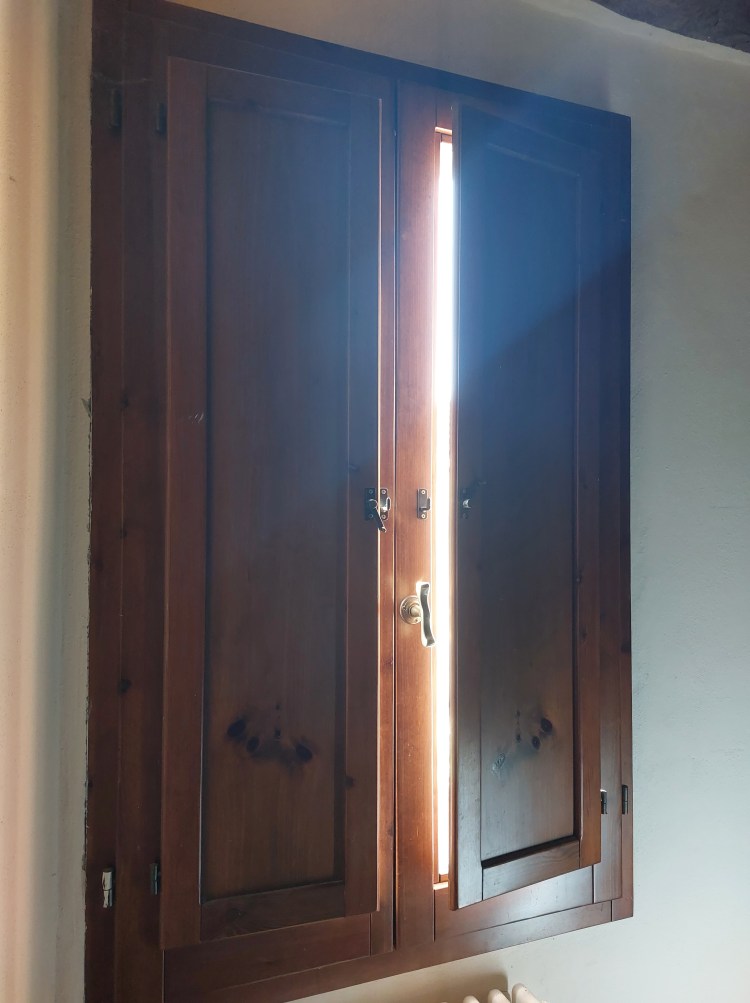
The shutters keep the room cooler and the narrow slash of light allows one to walk through the room without bumping into things.
In early summer I left the windows open a crack at night to let cool air in and hoped it would be too narrow to be found by bats and mosquitoes. No bat found its way through but the mosquitoes were undaunted. Italian houses normally do not have screened windows in spite of the fact that mosquitoes are plentiful and vicious here. Perhaps because they are different variety than those my body had become used to in the U S, their bites swelled to large, itchy welts that crusted over after a day or two. At the beginning of warm weather I told Terry we should have screens made but he resisted due to the cost, maybe because this was our last summer here.
Eventually he did relent though not until mid-summer by which time the cost-benefit ratio was in decline and worsening daily. Terry contacted a neighbour about building screens for us and though too busy himself, he promised to contact a friend who could do the work. A week later they arrived to measure the windows in our living room and bedroom, unfortunately on a day I was in bed suffering a flare of a chronic condition. Both men entered the bedroom with a friendly “ciao” and proceeded to measure the window while I laid flattened and embarrassed in the bed. And also too sick to join any conversation about the construction of the screen, which I later came to regret. Still it was a first step toward the all important screens that would allow cool night air in while keeping mosquitoes out.
In the meantime, I tried to capture some of the early morning coolness by opening the door and window in our living room as soon as I got up, flies and mosquitoes be damned. Nights in our Tuscan hill top town bring temperatures down to the high 60’s or low 70’s Fahrenheit, which feels glorious as cool outside air replaces that of our warm interior.
As mentioned, air conditioning is pretty rare in Italy so most people rely on fans for cooling. We use one in the living room, which runs during the day and one in the bedroom mostly relegated to nighttime use. Air blown across the body cools by speeding up moisture evaporation on our skin, our bodies’ natural cooling system. As long as the temperature is no higher than 95 degrees, fans provide some comfort and we’re grateful for any benefit they offer.
Air conditioning is much more effective, of course, cooling a larger space and reducing ambient humidity, but the cost is high in both monthly bills and impact on the environment. Moreover, relying on the comfort of AC prevents acclimation both physically and behaviourally. If, as some say, this summer is cooler than we will ever experience again, we will be forced to learn of new and better ways to live in a warmer world.
While most of us cope with heat simply in pursuit of personal comfort, lying below Anghiari there are large plots of land devoted to agriculture. We see irrigation spraying the fields in the valley with great wands of water and have wondered how long that can continue as the drought goes on. Terry asked a local how the farmers were faring during this heat wave and drought and was reassured that they were in reasonably good shape because of access to lake water and wells. Olive and chestnut trees though, which grow anywhere and everywhere in the hills around us, are suffering. Expect the price of your favorite olive oil to go up in the coming year as this season’s crop most certainly will be affected.
As day after day passed with the temperature steadily at ‘too hot’, and still no screens, my patience with the situation began to fade into near disappearance. Still, noting how widespread the heat wave was reminded my irritable self that others were suffering too, some much more than we. Then it was made personal for us as we learned that fires in Italy had spread to an area near Nova Vas, Slovenia where Terry’s great-grandfather was born and lived until his marriage to a Hudi Vhr bride. Nova Vas residents have been forced to evacuate, including one of Terry’s relatives who fled to Trieste, Italy. I hope cooling breezes from the Adriatic offer some comfort as he waits to return home.
Italians’ penchant for nighttime events might be seen as a means of beating the heat. Nothing begins before 9:00 when lower temperatures draw men, women and children from their homes to enjoy whatever happens to be going on that evening. Though the heat currently is greater than normal, Mediterranean summer days have always been quite warm, leading to the custom of an after lunch siesta and nighttime socialising. Having grown up in the north I had not developed that routine, instead climbing into bed with a book at about the same time the Italians head out for the evening. But tonight Terry and I will join neighbors for a light meal followed by an outdoor concert of Verdi and Mozart. For this evening at least, I will be more Italian than Michigander, basking in the cooler air and beautiful music.
ADDENDUM
An Anti-Cyclone is wind circulating around a high pressure atmosphere, whereas in a regular cyclone the centre is a low pressure system.
A Heat Dome occurs when the high pressure of earth’s atmosphere pushes warm air down, forming a dome that traps air in a smaller area where it inevitably gets hotter. Both North America and Europe have sweltered under the effect of this weather pattern and, so far, there is little hope of the pattern changing before summer wanes in the latter days of August.
A Heat Bulb combines high temperature with high humidity, a much more dangerous situation. When outdoor temperatures rise to the mid 90’s and is combined with moist air, the body loses its ability to cool itself through perspiring and body temperature to rises to dangerous levels. A mere 3 or 4 degree rise in body temperature causes changes in circulation as blood vessels dilate. With continued or rising body temperatures, the brain and other organs slow down; thirst is no longer evident. In as little as six hours without treatment coma and likely death follow. India and Pakistan are vulnerable to the heat bulb phenomenon with thousands of lives having been lost as our climate grew hotter. India is the setting for The Ministry of the Future a novel by Kim Stanley Robinson, which describes the consequences and resolutions for a Heat Bulb event.(published 2020: Orbit\Hatchett Book Group\New York NY) Though a work of fiction, the novel is based on sound research, well worth a read.
 Lurching towards Italy