In the small town in which I grew up, there may have been pigeons but I was unaware of them. We certainly lacked the kind of presence seen in larger cities where flocks, or ‘kits’ gather in parks, public squares or on the ledges of buildings to either charm or dismay the population. Now though, having settled in Anghiari, I see pigeons throughout the town, cooing, strutting along the building tops and yes, pooping everywhere. Occasionally I hear gunshots as crews attempt to eliminate some of them and later see the clusters of feathers that are all that remain of the birds.
I had no particular prejudice against pigeons and, in fact, recall being quite intrigued by their behavior as I sat once in a park in Arezzo. It was courting time and the males were doing there best to attract a mate. Eager to impress the females, male pigeons fluffed up their feathers and spread their tails to exaggerate their size, and then walked in circles before the intended love mate. Utterly unimpressed, the females usually walked away, soon to be approached by another suiter repeating the courting ritual. I saw, as I watched, that colors and patterns do vary among pigeons, though the majority seem to be gray and black, often with an irridescent band around their neck.
And such was the pigeon who wanted to claim a spot in the facade of our house. There is high on our front wall a small window placed oddly about five feet above the level of my head. Because the wall is two feet or so thick, the window sits in a recess, leaving a nice cozy area in which a pigeon couple could set up housekeeping, protected from rain and wind. Since pigeons mate for life, and usually produce four clutches of eggs in a year’s time, we understood that the space was likely to become long term housing.
Had the pigeons not left the recess and window filthy we might not have been so inhospitable but for a number of reasons we decided they could not stay. Fortunately the window, a modern replacement for the original, actually opens so we were able to clean it and remove debris left by the pigeons. But it was clear that unless we took further steps they would be back, so Terry laid some aluminum foil and bubble wrap in the opening, hoping that the birds would find the changes offputting. When they didn’t, he added a motion light and that did frighten the pigeons away for a while but the batteries died before long and soon after the pigeons were back in their cozy nook.
For my part, whenever I saw one of the pigeons in their “penthouse,” I threw a light weight missle at the window, shooing the birds away for the moment. But I could not be on watch at all times, so they became quite comfortable in their chosen space. When we saw that they were building a nest, it was clear that we needed to find better pigeon-proofing solutions. Pigeon spikes, a series of thin aluminum rods, are the favored deterrant here and most buildings have a number of them set around the perimeter of their roofs and along window sills. The spikes do not injure birds, but make it difficult to access an area. So Terry went off to buy several sets of spikes along with a spray solution said to be obnoxious to pigeons. When I looked up one morning to see that one of the persistant pigeons had managed to get through the spikes , Terry added another set and since then, thankfully, the pigeons haven’t returned.
There was good reason to eliminate nesting spaces around our home. Virtually all birds are likely to be infested with mites, which can get into the house creating a significant problem for its occupants. When you see a pigeon grooming a mate, he/she is probably removing these biting pests, which live on the blood of its host. Moreover, the feces of pigeons carry a number of diseases, including salmonella and psittacosis. Beyond the health factor, guano is corrosive to surfaces and can damage building exteriors. Interesting though pigeons may be, living in close proximity is a problem for most people.
Pigeons do have their fans, however. There are numerous clubs of devotees throughout the world who race their homing pigeons. In order to compete, the pigeons must be transported to a destination far from their home and the distance carefully measured. A calculation of distance and time determine the speed of the pigeon’s flight, with the bird flying at the greatest speed the victor. The ability to navigate back to their homes, sometimes spanning distances of over a thousand miles, is not well understood, but is reliable–homing pigeons are unfailing in their ability to return to their base, barring any unfortunate mishaps. When needs dictate or it suits the purpose of the trainer, pigeons can be taught to have two homes, thus eliminating the need to transport the birds. Not surprisingly, food is the key; pigeons are enticed by food in both places to consider each their ‘home.’
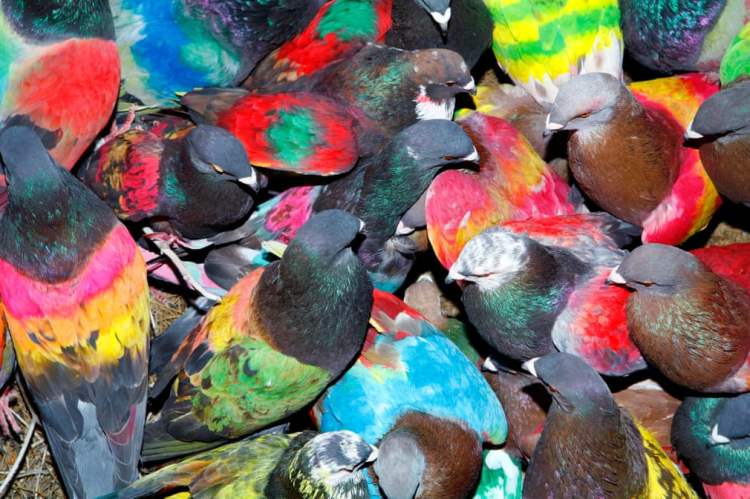
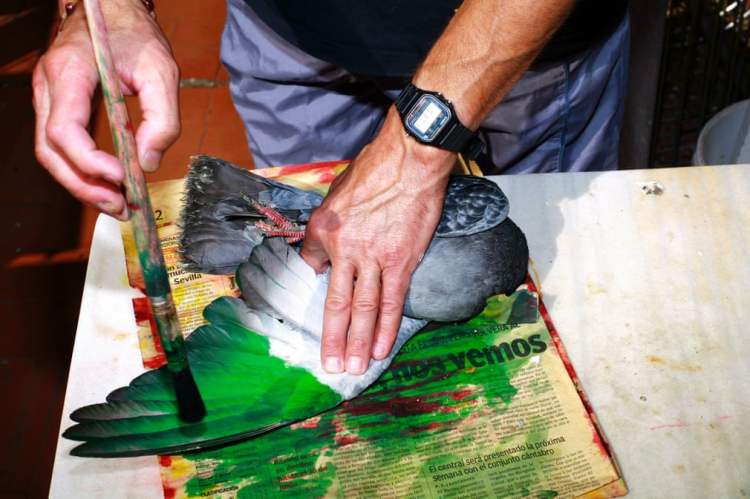
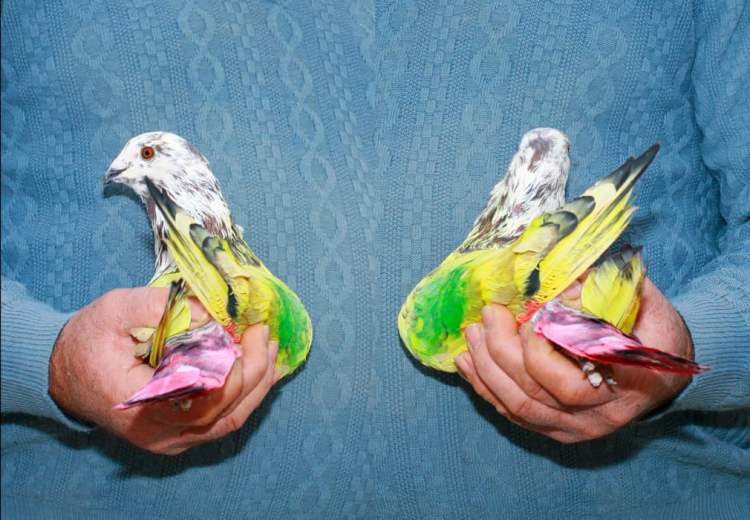
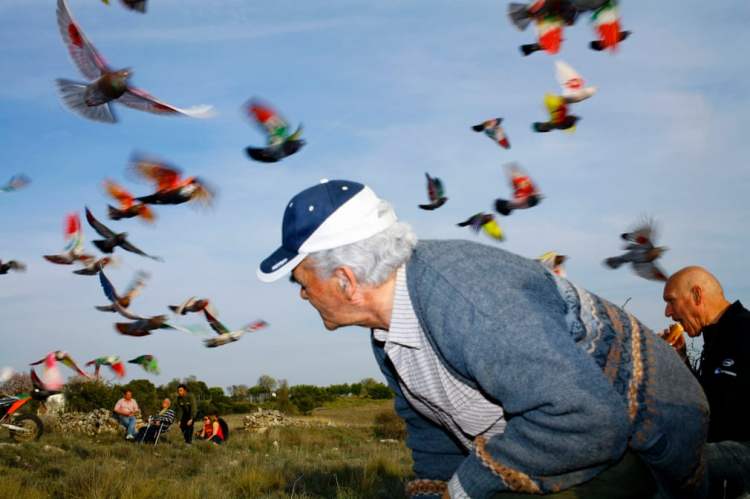
In the Spanish provinces of Valencia and Murcia some pigeon aficionadoes have developed the most unusual, and to my mind somewhat callous pigeon hobby. Enthusiasts of the sport paint their prize pigeons in bright colors, preparing them for a competition in which a bevy of males are released to pursue a single female pigeon. The male who succeeds in spending the greatest amount of time wooing the beleagured and probably very weary female is deemed the winner. 1

Though pigeons’ special skills attract hobbyists, they have also been put to much more serious and useful work. Before the advent of a regular postal service pigeons were a means of sending messages across the miles. The pigeon was outfitted with a small harness and the message inserted into a tube fastened under the pigeon’s wing. This method was also used to deliver medicines and other important items when more usual means were either unavailable or difficult.
Most impressive, though, was the wartime role of pigeons, utilized as recently as World War II. Sending informational and often critical messages via homing pigeons was more secure than other methods which could be subject to enemy interference or attack. Pigeons were also used for surveillance during World War I when they were outfitted with cameras set on a timer to photograph enemy positions and installations.
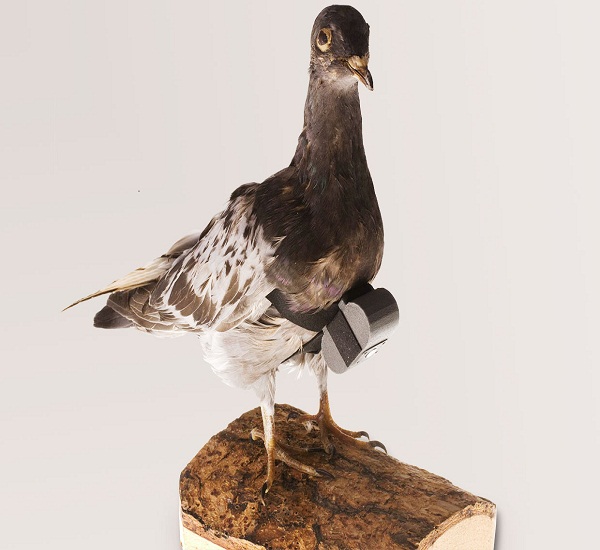
Pigeons have been credited with numerous incidences of saving soldiers’ lives in both WWI and WWII and have been honored by the British Dickens medal and Croix de Guerre in France for their heroism. Perhaps the most famous of these tiny heroes is the American pigeon, Cher Ami, who saved the “Lost Battalion” during WWI.
Having suffered heavy losses, the battalion had retreated to a defensive position in a ravine, which ultimately became a trap when they were surrounded by German forces. Throughout the day of October 3, 1918 they were assaulted by enemy firepower, losing still more men and depleting precious ammunition. The following morning the Commander wrote a message to home base advising them of the situation and asking for help but due to inaccurate co-ordinates, friendly troops began to assault the battalion. Commander Whittlesley prepared another message fitted into a tube attached to Cher Ami’s leg, signaling the authorities that his battalion was being bombarded by their own military.
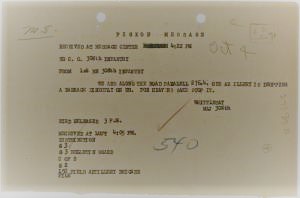
When Cher Ami was released to deliver the message she seemed reluctant to take flight and hovered in the nearby foliage. After a number of anxious prompts forced her to leave her safe perch she was immediately fired upon by the German troops, who no doubt surmised she was carrying a message. Cher Ami fell to the ground injured, but astonishingly rose back into the air and began to fly toward headquarters. When she arrived a half hour later the leg holding the messsage was dangling by a tendon, she had lost one eye, and there was a bullet hole in her body. Medics performed surgery on her, repairing the wounds and she was later outfitted with an artificial leg to replace her own severely damaged one.2
Cher Ami was awarded the French Croix de Guerre and today her stuffed and mounted, one legged form is held in the Smithsonian collection in Washington, D.C.
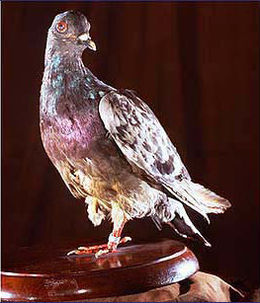
Cher Ami
Few of us have had any experience with heroic pigeons, but many of us have eaten the now inglorious bird –I have and found it delicious. It is not uncommon in Europe but by the twentieth century, pigeon was not normally found on most dining tables in the United States. Prior to that, though, it was enjoyed by many and often served at Christmas dinner. The beautiful Passenger Pigeon is now extinct due to its popularity both for food and sport. Still, in a quick search of the internet, I found many recipes for pigeon, usually identified as Wood pigeon, though these are essentially the same birds as those roosting in cities.
If describing pigeon as coming from the woods is intended to distinguish it from the too familiar city bird, the word ‘squab’ is similarly selective. But, if you have enjoyed a dinner of squab, you have eaten pigeon. These are nothing more than very young pigeons, often little more than four weeks old, and very small. For those who like the tender, dark meat of squab a recipe follows:
Roasted Squab
Ingredients
- 1 Cup chopped celery
- 1/2 Cup chopped onion
- 3 T butter
- 1-1/2 Cup cooked rice
- 1-1/2 Cup chopped mushrooms
- 1/3-1/2 Cup raisins
- 6 T orange juice concentrate, divided
- 1 T fresh minced parsley
- 1-1/2 tsp salt, divided
- 3/4 tsp marjoram
- 6 dressed squab, ca 1 lb each
- 3/4 cup of oil
Saute celery and onion in butter; add rice, mushrooms, raisins, 3T of the orange juice, parsley, 3/4 tsp of salt & marjoram. Stuff the squab and bake at 375 degrees for about an hour. Internal temperature should be 165 degrees
+++++
During Anghiari’s recent Artisan sale, Terry passed by a restaurant advertising, “pigeon pasta, one day only,” and though he didn’t take advantage of the special, the following recipe may be similar. It was posted on the website of The Shooting Club of England and its rather casual language invites you to substitute ingredients if you like.
Pigeon and Wild Mushroom Pasta
Ingredients
- 4-6 pigeon breasts
- butter, flour
- grilled dark mushrooms
- pack of dried ceps (porcini mushrooms) soaked in water
- mug of chicken, game or beef stock
- slug of red wine
- seasoning
- bunch of parsley, chopped
- pasta, such as tagliatelle
Coat pigeon breasts in flour then pan fry in butter. Chop and fry mushrooms in the same butter then add the reconsituted dried mushrooms. Pour in the stock and red wine, or whatever is at hand and let cook until it is reduced to increase flavor. Here a tablespoon of rich cream can be added if desired. Add the sliced pigeon and leave to “bubble softly” while pasta cooks. When the pasta is ready, throw in the chopped parsley and a dash of lemon juice.
+++++
The pigeons’ special qualities and versatility can counter their less positive characteristics and there is one more useful contribution to consider: Guano. Many who have access to pigeon feces swear by its use as fertilizer, though skeptics caution against the prospect of disease if not carefully handled. The effort of gathering and spreading guano for individual use is, however, a minuscule effort in comparison to harvesting guano as a business.
Peru probably counts as the world’s leader in utilizing the product as an economic source. The Incas used guano to fertilize their land so it was a product long familiar in the country. But in the mid-19th century when Peru was suffering economic collapse following its release from colonial rule, guano saved the day. Piles of it stood in great mounds on the Chinca Islands off the coast. Between 1840 and 1870 the country sold at least twelve million tons of it to North America and Britain earning some five hundred million dollars for the product. Unfortunately, supplies decreased over time and the guano boom came to an end, leaving Peru in economic shambles again.3
I have found the investigation into pigeons both fascinating and entertaining and for that I credit the pigeon pair who led me into the subject. They have relocated to a drain pipe attached to the house across the street, forced to exchange their penthouse for cramped housing without a view. I see them walking in and out of the small opening and suppose that soon chicks will hatch who will be fed and cared for by both parents. It seems like a relatively harmless place to settle, so I have avoided alerting our neighbors to their new tenants. The pigeon couple occupy an unobtrusive space not open to the interior of the house so I presume are no threat to health or well being. For the time being, they can be left in peace to live quietly in place and raise their squabs.
End Notes
1Paloma al Aire (Dove Into the Air) Ricardo Cases 1911; now included in Martin Paar & Gerry Bager’s The Photobook, Vol 3
2The men of the “Lost Battalion” eventually did receive help though the cost of lives lost in battle was significant
3 “The Great Peruvian Guano Bonanza: Rise, Fall and Legacy” Council on Hemispheric Affairs July 13, 2011.
 Lurching towards Italy
thank you for the article
LikeLike