
I mentioned in an earlier post that the day following our arrival in Italy we rested our weary selves by turning on the TV and watching cooking shows for an afternoon. We have since discovered that there is a plethora of them on Italian TV. Italians love to cook and eat–no surprise as Italy is known for its hearty, good food ranging well beyond the popular spaghetti, ravioli or lasagne so familiar in the U S, though these are popular in their homeland as well.
Watching Italian TV shows is supposed to be helpful when learning the language so I see cooking shows as mini language lessons. The particular benefit of this genre is its combined oral and visual reinforcement; we hear the cook name the ingredients as we see them added to the dish of the day. Further, the pace of the commentary is slower and more deliberate than the normal breakneck speed of Italian speech. True, the vocabulary is limited to a small compartment of my life, but it is helpful when buying or preparing food to know how to say or read words such as uovo (egg), zucchero (sugar) or farina (flour).
One of the most omni-present productions is a straight out how-to-cook offering by Benedette Rossi whose show, Fatta in Casa Per Voi (made at home for you) monopolizes late afternoon television. Once a waitress, she parlayed her interest in food into a successful career as a cooking show hostess and cookbook author along with distributing a line of food products sold in grocerty stores.

Ms Rossi is, in fact, Italy’s Martha Stewart. She not only offers step by step instruction for cooking Italian favorites, but also occasionally demonstrates how to make handicrafts or offers bits of homemaking wisdom while sitting on a bench outside her country home in the province of Le Marche.
Fatta in Casa Per Voi was only a beginning of our food show exploration, though, and Benadette lost me as a regular viewer the day she roasted and sliced a beef brisket, then smothered it with a tuna/mayonaise sauce poured over the top. In my view this taste combination was unappealing, but I saw the same dish in the prepared food section of a local supermarket and recipes for it online, so it may be popular with Italians looking for an alternative to the many pasta or soup dishes of Italian cuisine.
We next discovered 4 Ristauranti, a show hosted by the shaggy haired and ebulliant Alessandro Borghese.

Although born in San Francisco, he eventually embraced his father’s Italian roots, working primarily in Italy as a chef, food connoiseur and TV star. His current show, 4 Ristoranti is just one of a number Borghese has hosted. As the program opens, Alessandro loads four restauranteurs into his black, 4 Ristoranti van, transporting them to each of their restaurants in turn where their job will be to appraise and rate location, service, food and cost.
Once seated, the three visiting chefs and Alessandro order an array of appetizers, primo or first course, secondo, main course, and desserts, all to be passed around and shared so each particpant can form an opinion. Commonly, one of the group will be something of a curmudgeon, expressing dissatisfaction with a shake of his/her head or a dismissive push of the plate, sometimes accompanied by an emphatic “no!” On occasion, a plate will be returned to the kitchen and Alessandro himself may leave the table to question the kitchen staff about the source or freshness of one of the offerings. One has to wonder to what degree the competitive nature of the show plays a role in the reactions for there is a cash reward, and of course plaudits, for earning the greatest number of points.
Terry and I often judge the quality of the food by its presentation since we can only see and not taste. But we also look at some of the same criteria as the participants; are the walls burdened with tchotchkes? Is the table set with appropriate linen? Is there a view? Does the bill seem too high, or low? How was the service? As viewers, we see the scores through the course of the program, but the participants only learn how well or poorly they have done after all of the restaurants have been visited. Following the discovery of their sometimes disappointing results, they load back into the van, now with windows blackened so their route to the restaurant of the winner doesn’t give away the result. As the chosen restauranteur alights from the van he or she is greeted by happy employees throwing confetti and hugging everyone in sight. Alessandro beams and hands over a check for EU 5,000.00 and even the curmudgeons applaud.
Alessandro is also sometimes host to a program that pits cooks from Italy’s different regions against each other, Cuochi d’Italia ( Cooks of Italy). Chefs representing Italy’s various regions try to prove their culinary superiority in a series of challenges. They are sometimes required to prepare unfamiliar dishes, perhaps even work with unfamiliar foods, using a combination of ingredients chosen first by one then the other of the competitors. Each team races against time to complete a dish that will be judged by two prominent chefs, Gennaro Esposito and Christiano Tomei.
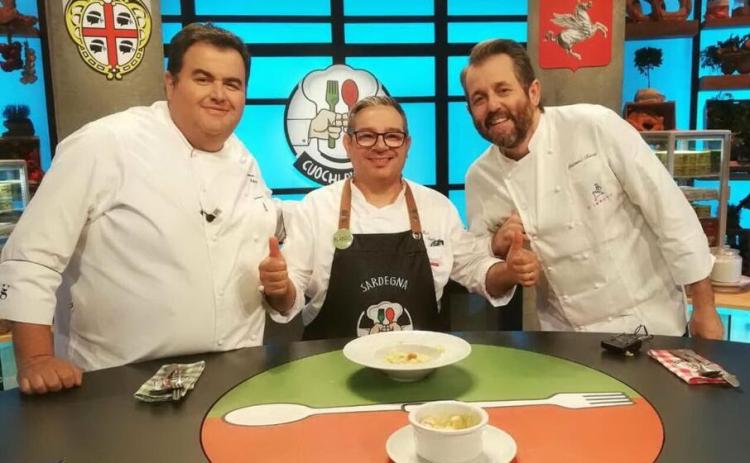
Esposito is a trained chef from the Naples area who has been awarded two Michelin stars at his acclaimed restaurants. Tomei, based in Tuscany, is self-taught but highly regarded and a bit less confrontational than Esposito. After tasting the offerings of each contestant or team, the judges award points for each to determine the winner, who will then go on to the next round of competition.
Because its emphasis is on regional cooking, this show is a lesson in specialties of each of the provinces of Italy. Esposito once asserted that Tuscany alone lacked a regional specialty. Why would Tuscany be an exception? Perhaps because it is such a popular destination for expats who have brought their own culinary preferences with them. However, one can disagree that Tuscany lacks regional distinction although it may be best represented in small pockets where food traditions have been maintained.
The most obvious variation in Italian regional specialties reflects proximity to the seas that surround the country. Not surprisingly, cuisine in coastal provinces focuses on frutta di mare and above all it seems to me, a taste for squid. Squid, squid, squid and more squid. In Italy squid is not limited to the breaded and deep fried rings of calamari that we Americans like to order as an appetizer, but rather the full body of this exotic sea creature. It seems that suctioned-cupped legs sprawling across a plate look as delicious to an Italian aficianado as they appear revolting to me. The squid mantle or body, too, is a popular dish, usually stuffed and baked then presented in slices as a main course. Although most often served in coastal regions, squid is appreciated all across Italy so whether it is Fatta in Casa por Voi, 4 Ristoranti or any of another of the popular food shows, squid plays a large role in Italian cooking.
The show, L’Italia a Morsi, ( Italy in little bites) also features regional variation but particularly emphasizes cooking in the home or preparation of specialties by small, independant businesses. The hostess, Chiara Maci, a tall and beautiful former lawyer, seeks out local food producers to learn how regional specialities are made, but spends the greater part of the show in the kitchen of a local homemaker.
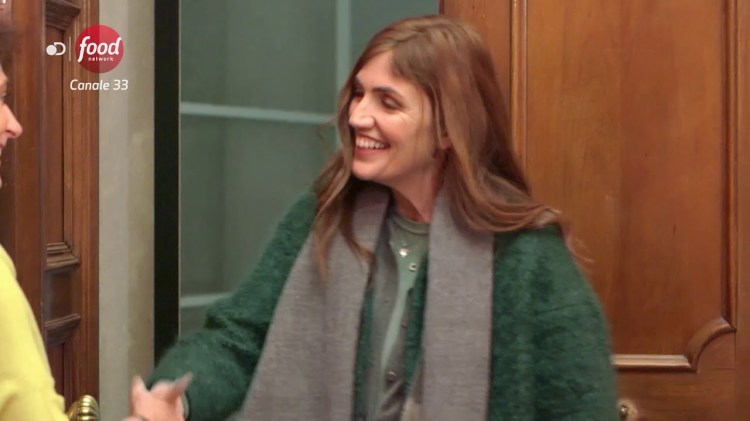
Chiara mostly assists with chopping, pouring or mixing but intermittantly tastes the food, nodding positively or rolling her eyes heavenward in appreciation for the tidbit, effectively sending the message of deliciousness across the ether to viewers. Ultimately, the hostess will have prepared a number of dishes comprising an entire dinner with Chiara’s help and observations. As dinner time approaches, an additional guest or two arrive to join the party and all sit down to enjoy the featured meal together.
My favorite show is one we watch in re-runs when we feel like relaxing in the mid-afternoon, Courtesie per gli Ospiti (Courtesies for Guests). This is a long running show, aired since 2005 and at one time included the inevitable Alessandro Borghese as a judge. It ranks as my favorite because it is broader in scope than most food shows with a trio of experts evaluating the notion of hospitality. Each of them bring their particular skills and talents to the show: Diego (Thomas), architect and interior designer, Csaba (dalla Zorza) a graduate of Cordon Bleu in Paris , writer and food show hostess, and Roberto (Valbuzzi), highly regarded chef of Crotto Valtellina, a restaurant in Lombady. For the show they join two pairs of contestants, who will each prepare and host a meal served not only to the experts but to the opposing team.

As the judges arrive at the hosting home, Diego excuses himself to walk through the house or apartment, evaluating its plan and decor as viewers follow. Csaba meanwhile examines the table setting. Is the cutlery misplaced or misused (is that really a coffee spoon substituting for a dessert spoon?) Has the floral centerpiece added to or detracted from overall appearance? Are the dishes and tablecloth too obtrusive or poorly co-ordinated? The third member of the team, Roberto, evaluates the food itself as the meal proceeds. Taste is not the only criteria–texture is important too so sticky spaghetti or limp salads don’t pass muster. Nor do foods that prove in some way difficult to eat with the available utensils.
Viewers watch as each team in turn prepares four courses to be served to the competing team and the experts. Viewers “join” the hosts and experts as the dinner proceeds to watch reactions, usually subtle as dictated by good manners, but not always. For more candid views, camera cut-aways let the viewers in on the private critiques made not only by the experts but by the opposing team. After both dinners, the experts gather to debate which team was better when all categories are considered, subsequently appearing before the contestants with a veiled trophy. After a “thank you” and “good-bye,” the experts disappear, leaving the contestants to uncover the trophy and discover the winner.
I like this show for its range but also because it doesn’t always default to the obvious. The homes of particpants chosen for the program are by no means always showcase dwellings; one may be a small apartment belonging to young adults on a limited budget, the other a quite fabulous home occupied by a more worldly couple. And Diego’s evaluation does not always favor the more expensive home, but rather focuses on the coherency and overall impact of the decor and plan. Csaba also sometimes counters expectations because, though viewers have watched as she finds flaws, in the end she may forgive shortcomings to give a positive rating to a table that did not perfectly meet her high standards. Roberto, though, either likes the food or not, although it may be an opinion that is relative based on the situation. Both Csaba and Diego share their reactions to the food as well, but Roberto holds sway in the category of rating the food quality and presentation.
Departing from the norm, the program Camionisti in Trattoria (Truckdrivers in Trattoria) features small restaurants patronized by truckdrivers, who, it is often said, know where to find good food at reasonable prices. The host Gabriele Rubini, popularly known as Chef Rubio, is a trained chef so able to bring a professional assessment to the food, but places importance on a friendly atmosphere and reasonable bills as well.
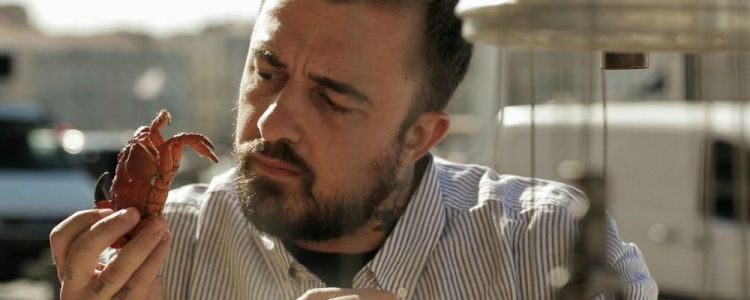
Chef Rubio travels to the favorite trattorias of three truck drivers in a given area, where they sit down for a meal, a very hearty one, as befits the truck driver image. Perhaps revealing my own bias, I found the program to be rather unsavory as the truck drivers and Chef Rubio shoveled large portions of food into their mouths and often eschewed a napkin in favor of the back of a hand to wipe away residue. I considered that the tenor of the show was a sort of “shtick” but it was simply not for me, especially as the camera zoomed in for closeups. Moreover, Chef Rubio often seemed to be bored or even insolent, which was offputting, expressing a certain disregard for both participants and viewers.
But, as I prowled the internet looking for information about Chef Rubio, I discovered that he is a complex individual and fairness required a broader scope. As a youth he showed talent as a rugby player (as did his brother, an acclaimed rugby player in Italy). Rubio played on a semi-professional team in New Zealand and it is there that he discovered his culinary interests while working in a restaurant to support himself. In time he decided to become a professional chef and attained a degree from the well known Alma International institute, where students focus on Italian cuisine.
Even as he became famous as a TV food show host, Rubini not only maintained an attachment to his sport but also found time to dedicate himself to humanitarian causes. He affiliated, for example, with the non-profit organization Never Give Up, which focuses on treatment of eating disorders, a somewhat ironic cause for a chef to embrace. He also collaborated with the State Institute for the Deaf, and served as cook for the 2016 Paralympics in Rio. For some time he volunteered his services to Amnesty International, but that association was suspended after Rubio publicly expressed some opinions unacceptable to the organization. Rubio has, in fact, earned a reputation for his outspoken and sometimes offensive remarks, so while he is dedicated to working for humanity at large, his regard for individuals and groups seems at times to be at odds with more laudable aspects of his nature.
Did I say he seemed bored in his role as guru of truckstop dining? It seems he was for he left the program after three seasons. By then Rubio’s negative view of Israel’s occupation of the Gaza Strip was well known so it wasn’t surprising when he joined the group Gaza in Freestyle to help bring some normalcy to Palestinian citizens by establishing sports and cultural opportunities in their limited territory. Utililizing an interest in photography, learned during his travels, he is documenting the difficult conditions he witnesses.
So although my initial reaction to the show was negative, and perhaps justifyably so, I have to acknowledge that in spite of some rough edges chef Rubio’s humanitarian interests provide a certain balance, even amelioration of his more abrasive qualities. There are numbers of attractive, competent and amiable cooking show stars in Italy, but the world would be a much worse place without the efforts of people like Gabriele Rubini. That he comes in a mixed package makes him a bit of a challenge, but those who benefit from his good works surely care little for the side they do not see
If you are interested in learning more about this many-faceted individual you can go to his website at: http://www.chefrubio.it/chef-rubio
 Lurching towards Italy