When Terry and I decided to better fill our time while “Lingering in Limbo,” painting on canvas was the first activity we turned to. For Terry, it was a resumption of his long dedication to the visual arts first explored while a medical student in Italy. Terry’s paintings today are large scale and abstract, vastly different from his long ago sketches of everyday scenes drawn while sitting at his kitchen table after a long day of classes. In time he discovered and fell in love with the works of Alberto Burri (1915-1995) who created abstract art in a variety of media. Influenced by the great Italian artist, Terry began to incorporate abstraction into his own works and has for many years now dedicated himself to abstract interpretations.
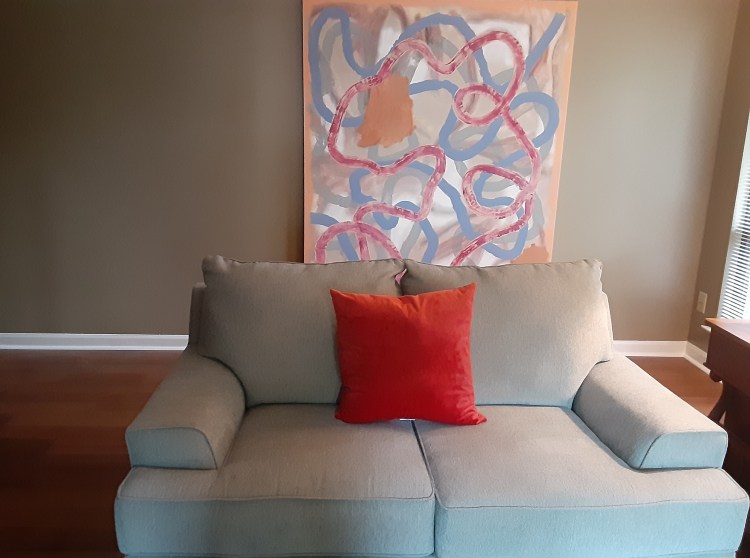
Below is his first painting done in Hickory and its place in our living room. Terry’s titles for paintings are as intriguing as the work itself; this one is called, “You might get in, but then what?” A friend suggested it could be titled, “Terry’s and Margaret’s life for the past eighteen months.”

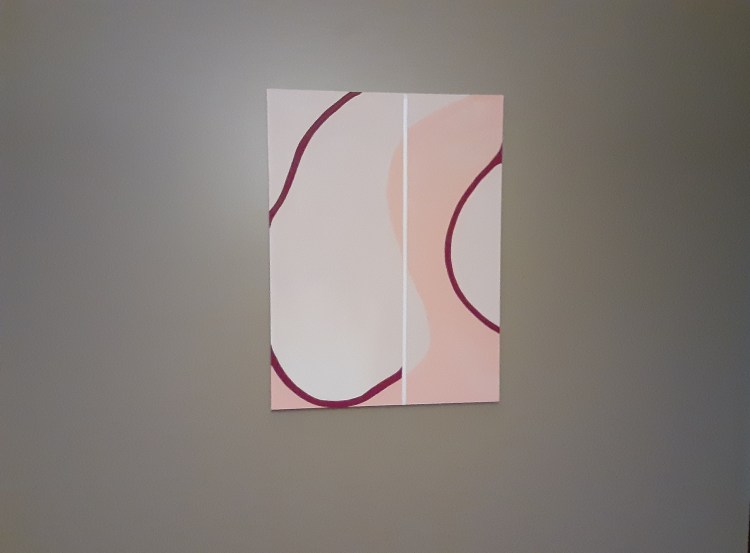
I had never been a fan of abstract art but that began to change as I learned of its possibilities from Terry. A trip to the Burri museum in Citta di Castello, Italy furthered my enthusiam as we toured the collection of Burri’s large and fabulous non-representational works there. In my initial foray into better using our lacuna of time in the States, I painted an abstract composition for the first time. It’s not really a stellar effort, but now hangs in the entrance of our Hickory townhouse, justifying its presence by providing a light, rectantular contrast against the expanse of brown walls.
Painting, though, no longer offered the experience I now wanted; I felt, my hands felt, the need for a more tactile creative form. I began thinking of collage–again.
I had recently read, at a friend’s recommendation, “On Paper: The Everything of its Two-Thousand-Year History,” ( Nicholas Basbane; Alfred A. Knopf/ New York, NY 2013) and, boy, was it everything. An exhaustive account of the manufacture and use of everything made of paper from blueprints to toilet paper to the beautiful hand made papers created by skilled artisans across the world. It was a particularly apt recommendation because for a short period a number of years ago I decided to experiment with paper making. I didn’t aspire to create the delicate and wonderful paper of experienced papermakers; rather I wanted to make a rather rough, thick product that I would use for collage. I spent a few months making if not reams of paper, then multiple batches of it, all the while planning its transformation into collage.
Although I drew constantly as a child and painted sporadically as an adult, I had never attempted collage; now I was drawn into it by papermaking. I imagined a series based on the theme of deconstruction of geometric shapes. Think of cutting a circle in half, quarters, strips or spirals–deconstruction. I was entranced with the idea, loved the process of bringing it to fruition, but in the end was disappointed with the result so buried it in a box stuffed at the back of a closet. And said good-bye to papermaking.
Collage came into being, or at least prominence, in the early 19th century as George Braque and Pablo Picasso expanded their Cubist ethos into creations that added dimension, however slight, to the works’ surface. Inspired by the new form, Dadaist artists began to utilize found objects in their collage–magazine photos and other two-dimensional representations but frequently three-dimensional objects as well. Today, collage encompasses both techniques and, like the early practioners of the art, today’s collage artists often add words or a splash of paint or ink to the compositions for added interest or personalization.
My own interest in collage completely eschewed the use of found objects whether two-dimensional or three. Inevitably there is an element of three dimensionality in collage due to the layering of materials, but trinkets, screws, book covers and other three- dimensional objects did not interest me nor did photographs or magazine advertisements even if shredded into unrecognizability. Really, what I was seeking was painting with paper.
To that end, we made another trip to Michael’s where I bought papers for the anticipated projects–the simple construction paper used for grade school projects as well as wrapping paper of various types. Nothing fancy, no expensive artisan papers, which would in any case have to be purchased on line. I added prestretched canvases, glue and a variety of brushes to the cart, and was ready to take on my new projects.
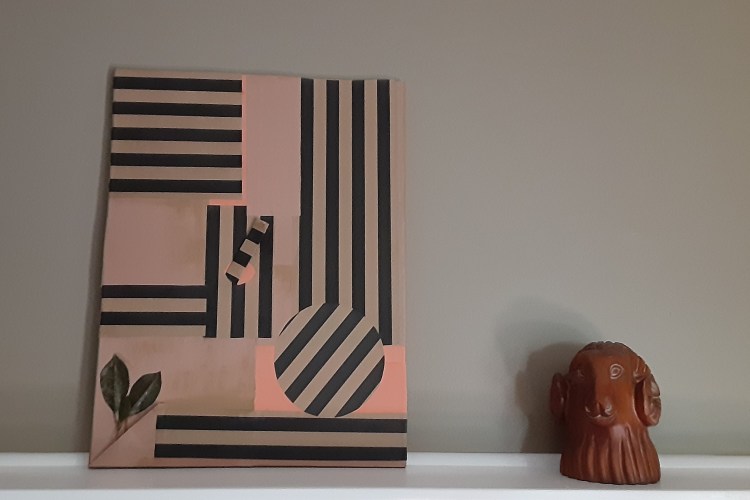
Rather quickly, I put together my first attempt using wrapping and construction paper with a few swipes of paint added. The leaves tucked into the paper pocket at the bottom of the collage are, I concede, found objects but I excuse them for their reference to the natural world. Placed on the mantle of our fireplace in the den, it passed muster, however simple, and seemed at home in this much used and casual room.
Nearly as soon as I finished my first effort, I began to plan the second. This one would be less spontaneous, more well thought out–a series based on the Hindu goddess, Lakshmi, a prominent goddess and probably the major female deity of Hindu cosmology. Lakshmi is rather like Venus or Aphrodite of the western Pantheon but much more exotic. She, for instance, has four arms and is typically shown with a variety of attributes including elephants, owls and the beautiful lotus flower. Like Venus, she is associated with love and prosperity; moreover, both were born from the sea, and both are consorts of major gods of their individual cultures–Mars in the case of Venus and Vishnu, the major god of Hindu mythology, for Lakshmi. Both goddesses also have additional but less prominent associations, probably added over time to adapt to the needs and beliefs of followers.
My goal was to include references to Lakshmi’s attributes in a more or less abstract composition, while maintaining a somewhat naturalistic appearance for each component. Again, I used simple papers and paint.
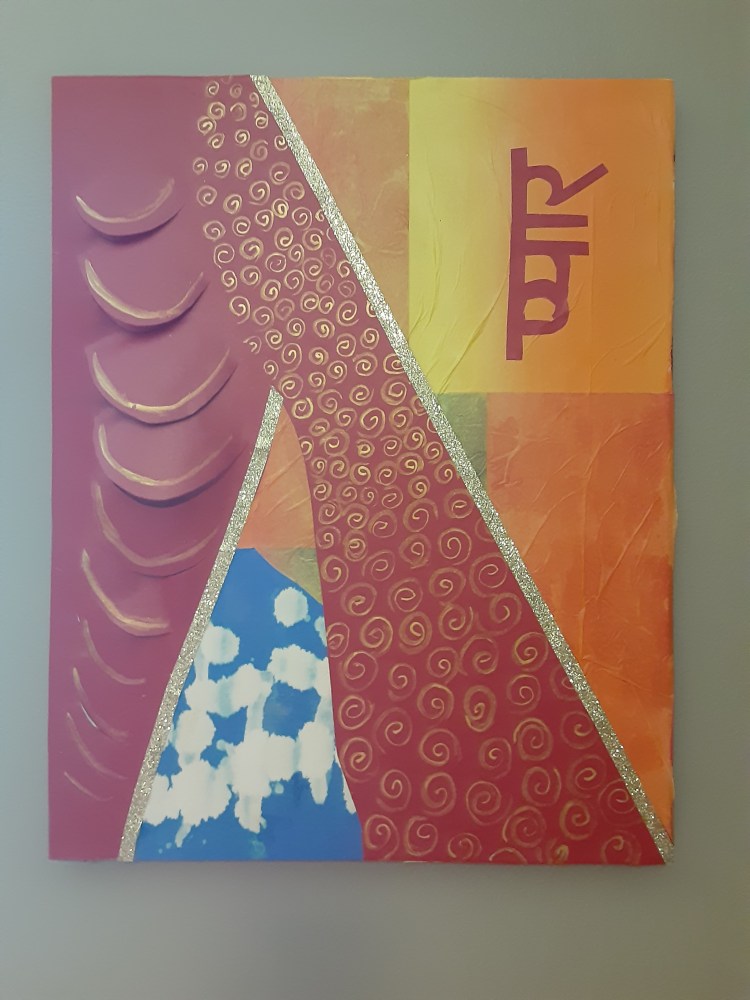
Above is the first Lakshmi collage. She is virtually always shown wearing a red sari, which is referenced here. The gold spirals on her sari signify material wealth in the form of gold coins. The blue and white section cites the ocean from which Laksmi was born and in the upper right hand corner, the all important word “love” in Hindi script.
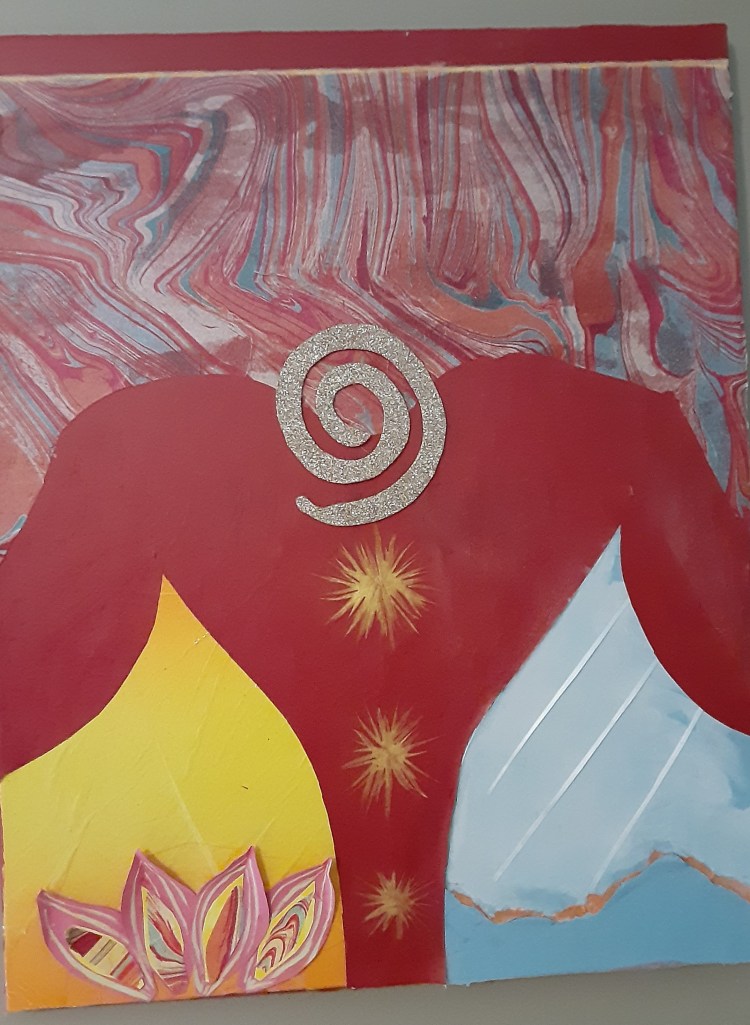
In the second of the series, focus is on the elephant, one of Lakshmi’s most prominent attributes. The petals in the lower left corner are a reference to the lotus, signifying Lakshmi’s purity and virtually always a feature of her representation. The segment on the lower right shows rain falling over the Himalyan mountains, promising a good crop and sustenance for a healthy life.

This is the last of the series to be done, and my favorite. It is, of course, a large depiction of a lotus, so large it has to extend beyond the borders of the canvas. Lakshmi’s four arms create the receptacle of the flower, centered by a glob of dried gold paint. The owls, representing wisdom, alternate with more lotus petals in the upper register.
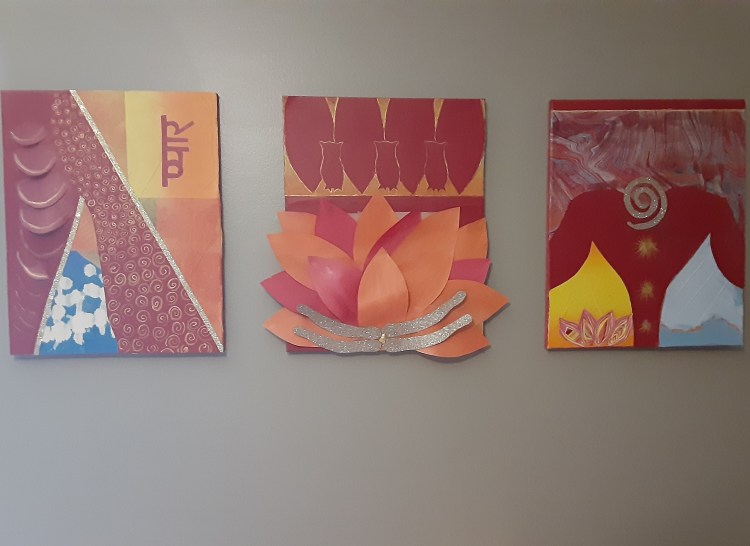
And finally, the three collages hung on the wall of our bedroom. The bedcover is a patchwork quilt of Indian sari fabric, and doubtless it inspired me to look to a theme from India. As I well know after a memorable trip there some years ago, India is an “assault on the senses,” as Judy Dench’s character exclaims in “The Best Exotic Marigold Hotel” (2011). Yes, it is, and without a doubt the most interesting, significant and most appreciated trip I have ever made. Now I have the Lakshmi series to pull me back, refreshing memories of India whenever I glance their way.
And so on to more adventures in collage. As the title to this post says, “Something New…Again.” I think of returning to the idea of geometric shapes and deconstruction, which perhaps I never completely abandoned. And equally, I look forward to Terry’s next painting. More than just a way to pass time in limbo, the pleasure of creating brings life to our lives.
 Lurching towards Italy