
Making the Most of Small Town Life
In previous posts, I have mentioned Valdese, NC primarily as a link to playing bocce ball. Valdese has an active group of players and in normal years hosts an annual tournament bringing competitors from a wide area to test their game against other aficionados. In early searches for housing in the Hickory area we checked what was available in Valdese but didn’t find a property that suited us. When we drove to Valdese several weeks after settling in Hickory we found a town much too small to offer what we were looking for and with a ‘whew’ agreed that it was good fortune not to have been enticed by an irresistible listing. However, a couple more trips to the tiny town of 4,500 and a few searches on the internet revealed that the community has a much more interesting character than we realized during our cursory first visit.
Valdese is distinguished by the celebration of its Italian heritage and in particular to settlers of the Waldensian sect. (Valdese is the Italian form of Waldensian) The Waldensians were a pre-Reformation Ur-Protestant sect living in the southwestern Alps, the Cottian Alps, between France and Italy. The group dates back to the 12th century and, until it was legitimized in the middle of the 19th century, followers were regularly persecuted and even murdered for the faith they practiced outside of the Roman Catholic Church. After centuries of suffering the wrath of those who opposed their faith, the Waldensians ultimately were forced by poverty rather than religion to seek a better life in the New World. The largest group of Waldensians settled in Valdese anticipating a more prosperous and peaceful life there and thus bequeathed the town with an identity unique in the North Carolina Piedmont. While the demographics may have altered over time – only 5.07 %, of Valdese residents are Italian – the town makes much of its origin as a settlement for the original Waldensian immigrants who arrived in 1893.
The heavy clay and rocky soil of the area was not conducive to farming so the late nineteenth century settlers turned to industry. Initially two commercial enterprises developed–the Hosiery Mill and a local bakery that delivered bread by horse and buggy or wheelbarrow to Valdese residents. Both businesses continue today with the Hosiery Mill weaving fabric for home furnishings and the small bakery evolving into Bimbo Bakeries U S A. If you have ever bitten into the buttery goodness of a Thomas or Bays English muffin, or chosen an Entenmanns doughnut over more fat and sugar laden alternatives, or used a Boboli as a pizza crust, you have enjoyed a product of Bimbo Bakeries. Along with these well known brands Bimbo’s produces and distributes other popular baked goods such as Sara Lee, Brownberry and Arnold breads to name a few.
It is no surprise if you find the name of the company, Bimbo Bakeries, somewhat amusing since in the U S at least, ‘bimbo’ is a word associated with a young woman who has crossed the line between proper and decidedly, perhaps flagrantly, improper. In Italian, though, the word simply means baby with ‘o’ at the end specifically referring to a male baby. However neither of these meanings has any relevance to the company name and its origin is hazy. Bimbo Bakeries is a Mexican company established by Bimbo Grupa in 1945 that eventually expanded to become the largest bakery company in the world. For a time the Mexican flag flew over the bakery in Valdese though in a nod to changing political attitudes this banner of foreign ownership has been removed.
Valdese also boasts a winery, Waldensian Winery, which specializes in sweet wines but offers a few dry table wines as well. The inspiration for producing wines in Valdese developed from the Peach Bellini, an Italian drink invented by Harry’s Bar owner, Giuseppi Cipriani in Venice. Originally white peach puree mixed with Prosecco, in Valdese the first iteration was a frozen slushy of peaches mixed with sparkling water, a perfect warm weather refresher. The Waldenisan Wineries website offers many variations such as the Peach Sangria below:
- 3 oz club soda
- 1 oz peach mix
- 1 crushed mint leaf
- 1 slice orange
- 1 slice lemon
- 2 oz sweet wine, red or white
The peach mix referred to is made and sold by Waldensian Wineries but a simple puree such as used in the Italian Peach Bellini should be wonderful as well when a slushy, peachy refresher appeals to your taste.
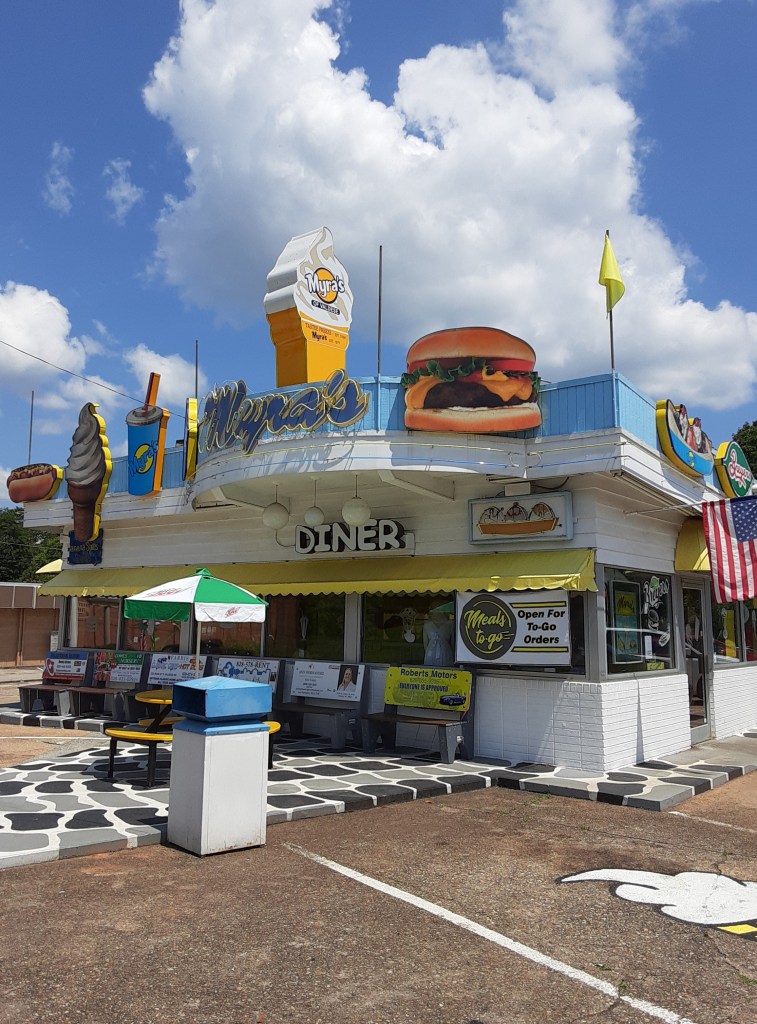
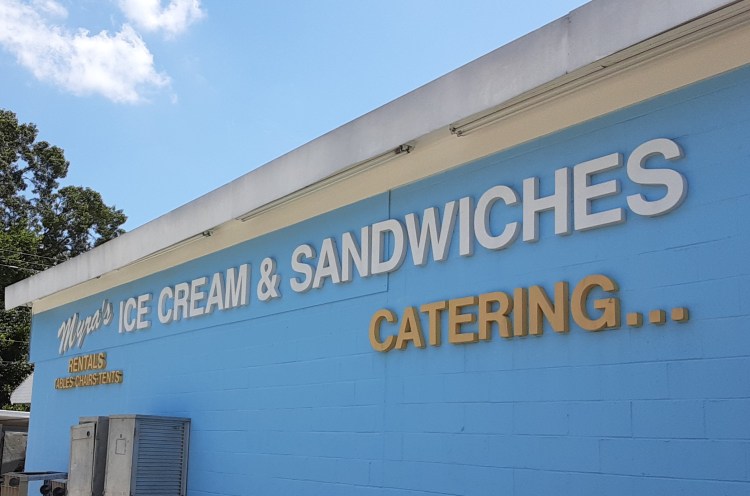
But the gustatory piece de resistance in Valdese has to be Myra’s. Myra’s cannot be missed as you drive down Valdese’s Main Street. A gaudy 50’s style conglomeration of diner plus a few loosely related enterprises, Myra’s felt like the center of town as we drove up and is, in fact, pretty much in the center, physically dominating Main Street.
Here is Myra’s–soft ice cream, sandwiches, drinks, french fries–all that you might expect from a diner resurrected from the 50’s.

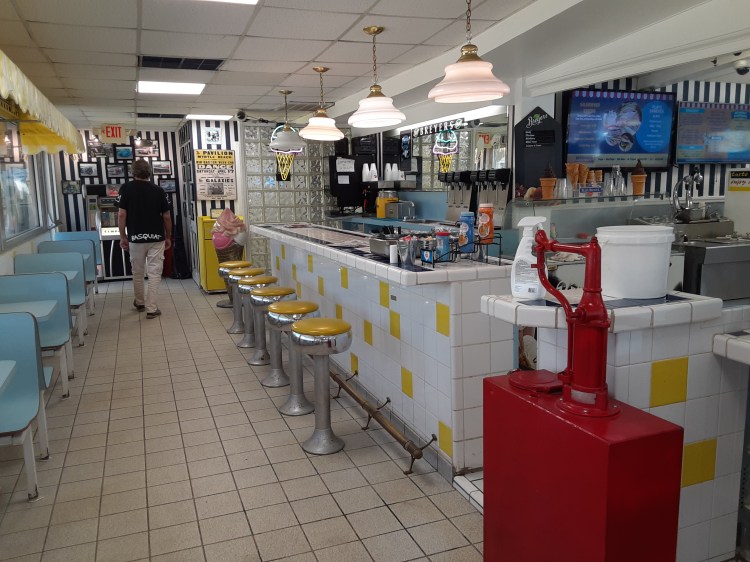
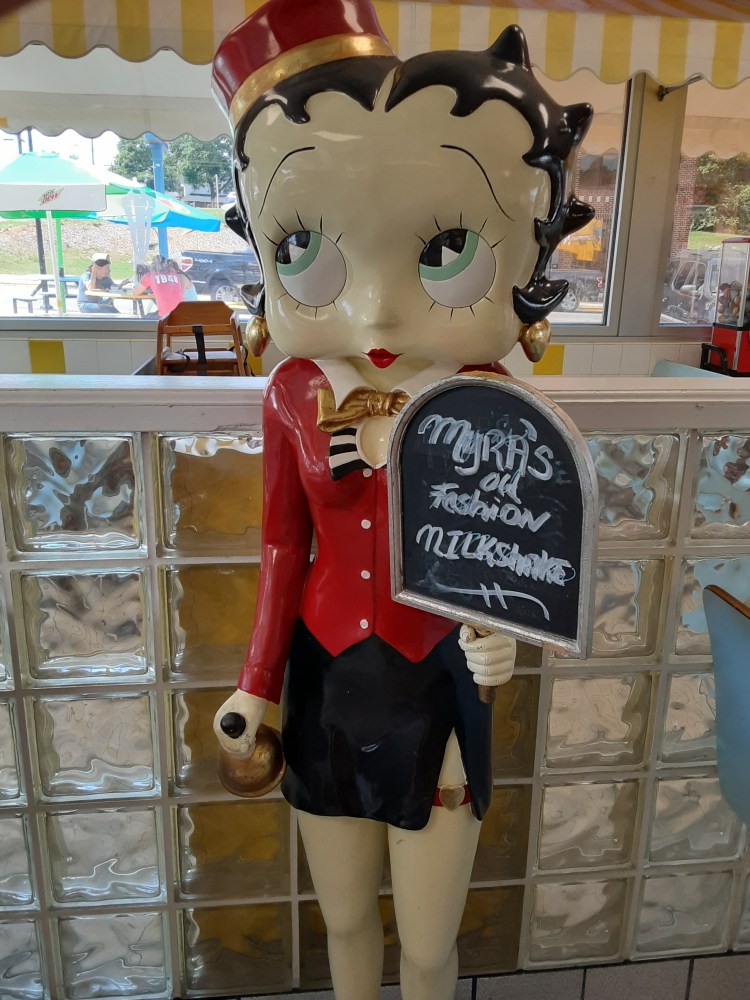
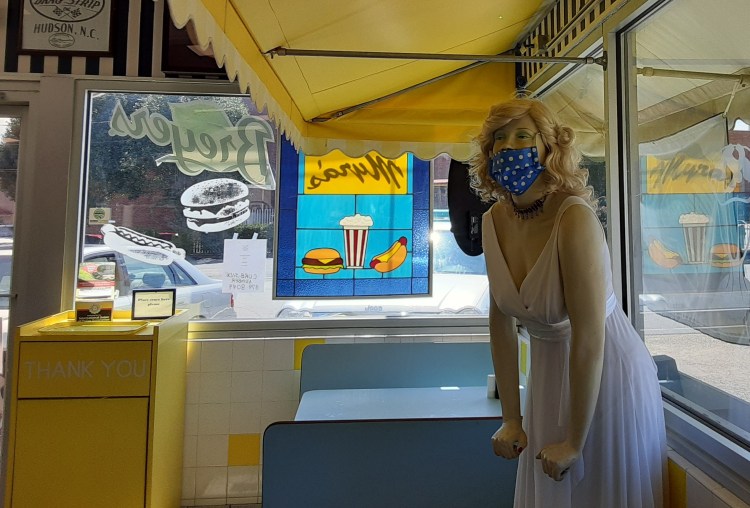
The interior of Myra’s diner maintains a fifties look with booths and stools, ready for a Happy Days crowd or perhaps a former Happy Days crowd of senior citizens. Near the rear stands a masked Marilyn Monroe atop a fan ready to blow her skirt up to emulate the famous photo of the 50’s sex symbol.
What you might not expect until you parked or walked around to the side is that Myra’s didn’t settle for just serving quick lunches or snacks.

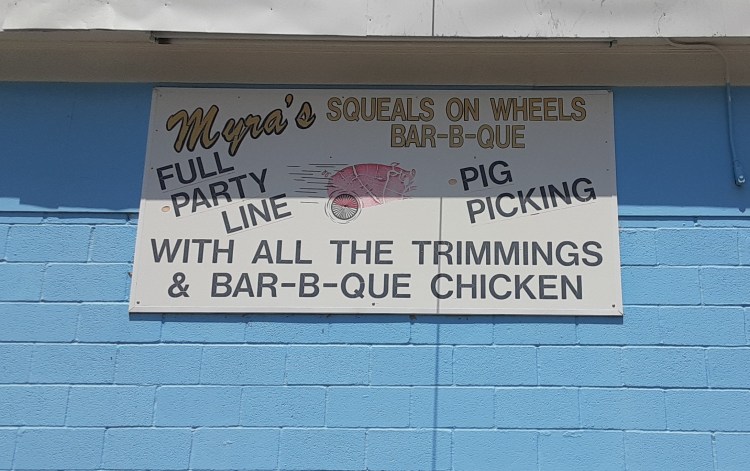
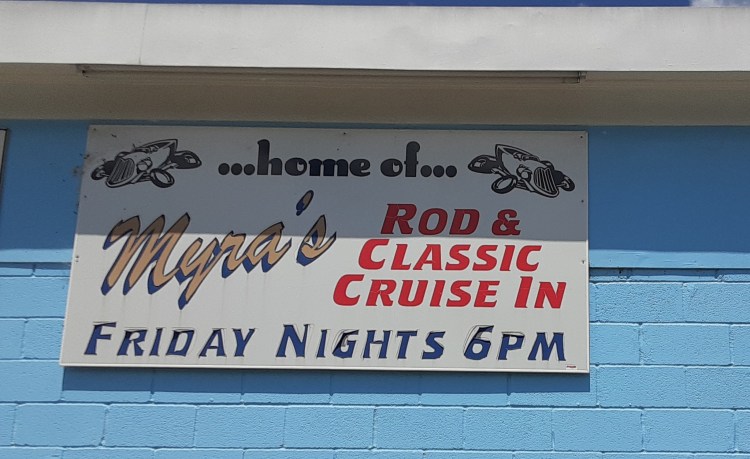
.”Myra’s Cruise In,” promoted in the sign on one side of the building, is a gathering of vintage and classic cars roaring, sputtering, or rumbling softly as they pull into Myra’s parking lot on Friday evenings during the summer. Owners and viewers alike arrive to admire, talk car talk, trade resources or simply to socialize. The link below will take you to the Cruise In of June 19, 2020.
http://www.youtube.com/watch?v=sJrVrgJZJaE
Across the way, walk past Myra’s Little Italy offering pizza and spaghetti, and you will find Myra’s Antiques, where we spent a half hour browsing the goods.
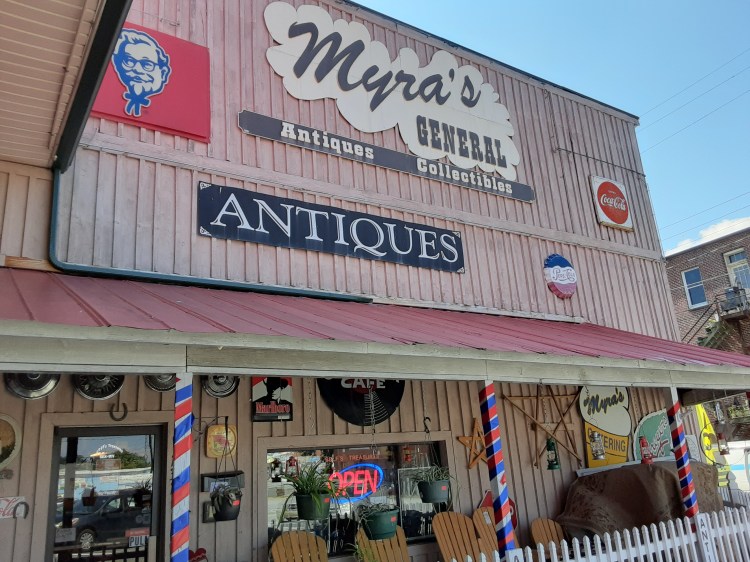
Inevitably one wonders–who is this imaginative and enterprising woman named Myra? But on asking I learned that Myra herself never owned any of these businesses. Rather she was the now deceased aunt of the current owner, memorialized in the commercial kaleidoscope that dominates downtown Valdese.
But Valdese has much more to celebrate that mere food and drink; for most months of the year, visitors can easily access the Trail of Faith near the center of Valdese and follow its curving path through various structures and monuments recounting the long and difficult journey of the the Waldensians that led eventually to their arrival in Valdese. A video can be seen at the Visitors Center before starting on either a guided or self-guided tour of fifteen structures and monuments replicating important sites and events associated with Waldensian history.
One of the most interesting of these, and an indicator of the early organization of the sect, is the Barbi College, an exact replica of the seminary attended by young men of the Cottian Alps who were taught to be evangelists spreading the faith, often suffering persecution and attack as a result. Their teachers were know as Barbas meaning Uncle in contrast to the Roman Catholic Father. Within the community, because reading and owning bibles was prohibited in Roman Catholic countries, each family was charged with memorizing a segment of the bible so that the community as a whole retained the full teachings of their holy book. Perhaps inspired by such long standing efforts to preserve the holy script, Waldensian adherent Pierre Robert Olivetan published the first translation into French of the Hebrew and Greek texts of the bible, known as the Olivetan Bible (pub. 1535).
In addition to The Trail of Faith the Old Colony Players of Valdese stage “From This Day Forward” in an outdoor amphiteater on Church Street, portraying the difficult history of the Waldensians. The play was written by Fred Cranford, a local talent, and is performed by residents of Valdese. First offered in 1967, the play runs Fridays and Saturdays during the last two weeks of July and first two weeks of August.
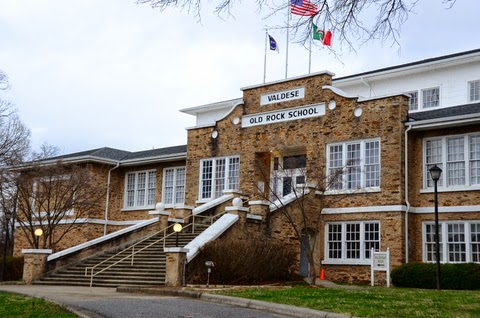
While “From This Day Forward” is staged annually, the Old Colony Players also present a variety of productions through the year and, if conditions permit, will offer “”Psych,” “Crucible,” and “Elf the Musical” in Fall of 2020. Many of its performances take place in the beautiful Old Rock School, a building included on the National Register of Historic Places. Active as a school until the 1970’s the building is now a community center with a 500 seat auditorium where concerts and plays can be performed. In addition, the center has two art galleries, rooms to rent for special occasions and is the home to a few non-profit organizations and businesses.
And then there is, of course, bocce ball. Valdese, with what might be considered a heavy dose of hubris, claims to be the “Bocce Capital of the World,” and in spirit it may be so. Originally the bocce ball club, Les Phare des Alpes, meaning “beacon of the Alps” was an organization providing insurance to local citizens, later developing into a service club. Inevitably perhaps, the men in the group were drawn to bocce, the boules game favored by Italians and the game, now also played by women, became a focus of the club’s activities. Over the years, members built a clubhouse, a communal bread oven made from native stone and a trio of covered bocce courts. Recently a marble slab, once used by the Waldensian Bakery to roll out dough for loaves of French bread, was donated to the club and converted to a sign inscribed with the club name, Les Phare des Alpes. Each summer during the Waldensian festival, the club hosts the Regional Bocce Tournament drawing players from around North Carolina, eager for the chance to compete and no doubt to enjoy a piece of bread baked in the communal oven.
As with petanque, we have yet to play bocce here. All things are on something of a hold as North Carolina’s COVID-19 cases continue to rise and we revert to a more strict interpretation of staying safe. Can we assume that life will return to normal before we forget what normal is? Or do we simply adjust to the “new normal?” Whatever and whenever that is, we do hope it will include bocce, petanque and Italy.
 Lurching towards Italy