And Why it is Important to Me

When we were looking at potential places to live whenever we weren’t in Italy, North Carolina was the first, and last, place we considered. Though there are a number of good reasons for that–the weather, the scenery and a number of desirable cities–the popularity of petanque there was a major draw. I have mentioned the game in a few previous posts, but why would this rather obscure game be a significant factor in deciding where to settle?
Petanque is a game of boules, like Italian bocce or the British Lawn Bowling. Petanque developed in the south of France and evolved into the game we know today when one aging player could no longer take a few running steps prior to releasing his boule. In order to accommodate his handicap, his fellow players established a new rule requiring that players throw with their feet planted and today a plastic circle is used to define the area in which to stand; stepping outside of the circle before completing the throw disqualifies that throw. While the game can be played on any surface, an official petanque court is a gravelly, flat area fifteen meters (49 feet) long and four meters (13 feet) wide.
I became aware of the game when it was brought to Amelia Island, FL by Phillipe Boets, a Belgian national who eventually settled in our little corner of the world. In a short time he had interested a few locals in the game and within a few years the Amelia Island Boules Club grew to be the largest in the country. The international Amelia Island Petanque Open, also initiated by Phillipe Boets, further established Amelia Island as one of the foremost locations in the U S for petanque. The annual tournament brings amateurs from around the world to Amelia along with many of the top professionals.
I first saw the game during the 2010 tournament when curiosity took me to the courts to see what the game was all about. I followed the play of a team from New York and saw that each member of the two person team had a particular role to play–a player known as the pointer rolls or tosses the steel boule toward a small, wooden target ball, the cochonnet, followed by a member of the opposing team trying to “outpoint” or leave their boule closer to the cochonnet thus claiming the point. When the opposing team holds the point with a well placed boule, Team I may point again trying for a better position or the team’s designated shooter will attempt to knock the offending boule out of place. When all players have thrown their boules a count of those closest to the cochennet determines the winner of that round or “end.” The first team to have accrued thirteen points wins the game and although this seems like a small number, closely matched teams may take an hour to reach a final score. Although Petanque can be a singles game (tete a tete) it tends to be more often played in teams of two or three players. Tournament play is always designated tete a tete (singles), doubles or triples exclusively, not a mix of the three.
Although simple at base, petanque fascinates because it incorporates a plethora of intricacies in both execution and strategy–the list of rules for the game is twelve pages long, describing play in all its details. There are many videos of professional petanque games on YouTube–you can see an example at:
http://www.youtube.com/watch?v=ZqBXX9B5y2E
After I was widowed one of the first activities I decided to pursue was the game I had so briefly seen a year and a half before. I showed up at the courts one Saturday morning to watch and when Phillipe saw my interest he handed me a set of boules and found a game for me to join. Beginner’s luck prevailed and I was able to place my boule much better than I had expected so my first experience left me pretty pleased with myself–maybe I could be good at this game, perhaps even really good. The following week, in my second game, I saw my points landing short, long or wide of the cochonnet more often than not and by the time I had played three times, the self-satisfaction of my first experience had disappeared. Now I understood that the “success” of my first day of play had more to do with low expectations than talent and knew that there was a long way to go before I could claim any expertise. But I was hooked and continued to play every week and more often if there was a game.
Along with discovering a new game, I met new friends, many of whom would become best friends. As time went on more players joined the group and my circle of friends expanded, becoming the core social group of my life. A few newly arrived residents quickly became highly motivated players who brought greater intensity to the games along with increased play so eventually a game could be found virtually any day of the week. We were all challenged to raise our skill level when Frosty Sabo, an experienced and talented player from Sonoma, California moved to Amelia, expressly because our little island offered some of the best opportunities to play in the United States.

A few years ago, I arrived early at the courts one day to practice a bit before others showed up to play. Before long, a tall, tousle-haired man rode up on a scooter, unloaded his boules and began to practice a few courts away. Since I didn’t recognize him, it was obvious he was a new player so I invited him to join us when play began. He thanked me and continued to practice alone for a while before approaching me to say, “Hi, I’m Terry.” And with that a new phase of my life began. Initially we saw each other only during petanque games but in a few months we were seeing each other regularly beyond the courts and now we are life partners. The path our lives has taken since that first meeting never fails to amaze us; we have purchased a home in Italy, spent three months in the Balkan countries, lived through coronavirus in Italy then returned to the states to become residents in a new city and state together.
Now that we are getting settled in Hickory, we want to resume the game and hope to play together in a few tournaments when these open up again. We both played competitively in the past but with other partners so competitive petanque is not new to us but we have yet to fine tune our play together. A few photos below from past tournaments celebrate good times with other partners:
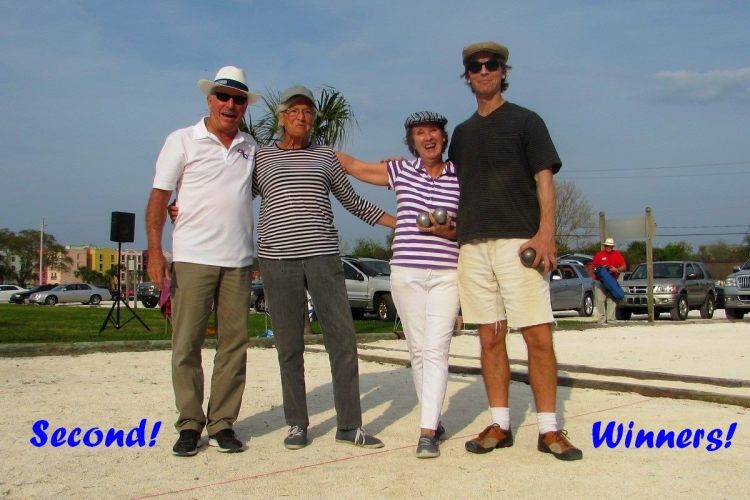
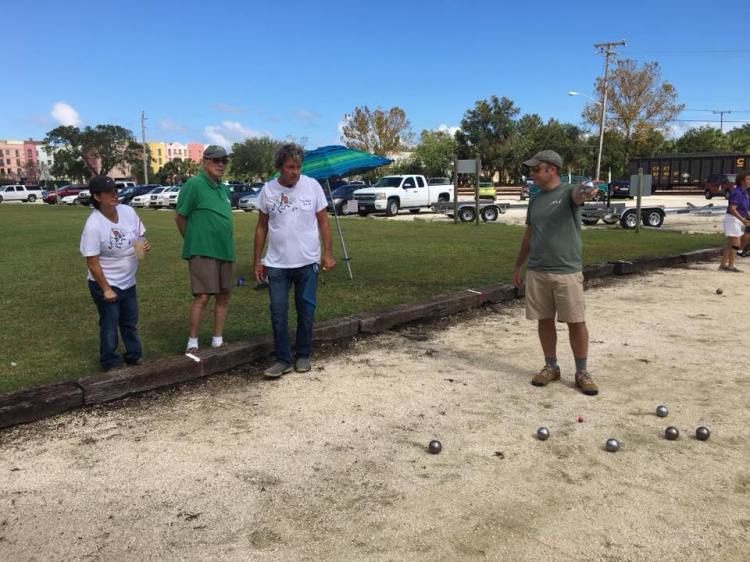
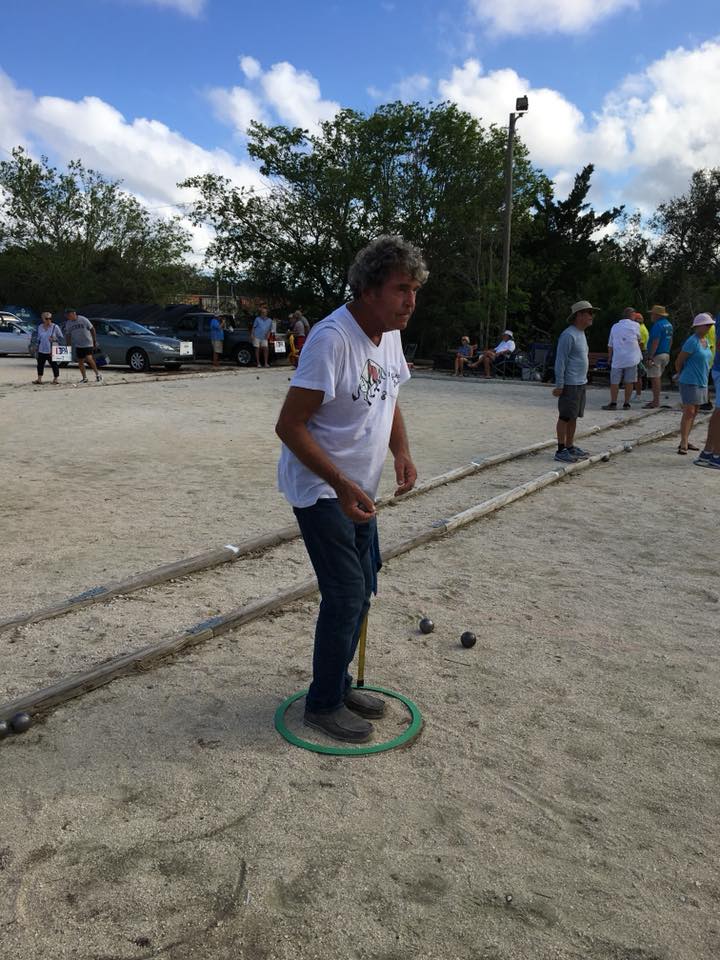
Happily, my partner, John, and Terry’s partner, Song, joined forces at the 2019 Amelia Island Open with great success, winning their division. They are a strong team and I hope they have many more wins in their future.
As for Terry and me, we have yet to see where petanque will lead us in this latest chapter of our peripatetic adventure. Surely with only part of the year in the States it won’t have the prominence in our lives that it had previously. Not only do we anticipate fewer opportunities to play in Hickory than we had enjoyed on Amelia, but there will be even less when we return to Italy. Bocce reigns there and we know of no petanque near Anghiari. We had a brief lesson in bocce last winter before COVID-19 struck and we hear that there are bocce players in Valdese, NC not far away. It appears that our lives may be split not only between two countries, but two games as well.
 Lurching towards Italy