When we realized that staying in Italy full time would not be an option since we hadn’t been awarded long stay visas, we began to consider the options available for a home in the States. We had good friends and a wonderful life in Fernandina Beach on the coast of Florida, but housing there is very expensive and our resources demanded a less costly alternative. We looked first to North Carolina because we knew of the active petanque clubs there and after studying a number of areas settled on the small city of Hickory.
We have been delighted with what we have seen as we drove through the city on our way to the many errands associated with settling into a new town. It is a wooded place reminding me of northern Michigan, my native state. In the distance we can see foothills of the Blue Ridge Mountains, part of the Appalachian chain that extends through western North Carolina. Just north of Hickory the Catawba River flows eastward from its source in the Blue Ridge Mountains crossing the Piedmont before continuing east and south to end in South Carolina. Named for the Catawba tribe who lived along the river, in their own language these Native Americans called themselves Kawahcatawbar, “people of the river” As a means of flood control the river has been managed into a series of reservoirs and forms part of Lake Hickory just a few minutes from our home. I lived next to the Atlantic Ocean for many years, was surrounded by the Great Lakes in Michigan, so it seems fitting that another kind of watery body is close by.
The practical requirements of the move have meant that the fun stuff, discovering what Hickory and the surrounding areas offered, had to be delayed. We are eager to play petanque and to meet others who enjoy the game. We would like to stand on the banks of Lake Hickory and take Django for a walk there. Normal summer activities of downtown Hickory have been suspended due to COVOID-19 but we were curious nevertheless to see the center of this old city. The “SaltBox,” a complex of science and art museums, the library and home of Hickory’s chorale group and symphony beckons but we haven’t found the time to visit. Though we walked through one of Hickory’s parks last week, there are still several more to see.
First on our agenda though, since our new home was entirely vacant, was to buy every single item a household required; from forks to beds, we had a lot of shopping to do and to do as quickly as possible. With big box stores easily supplying all the kitchen and bath equipment we needed, our major task was to buy furniture for our townhouse–fortunately easy to do in Hickory.
In the early twentieth century, Hickory became a center of furniture manufacture and remains a destination for people from all over the U S and beyond seeking to furnish their homes. The main draw for those coming from out of town is the Furniture Mart, a conglomeration of stores and outlets and filling four stories and taking up a million, yes a million. square feet. If that sounds daunting, you can connect with a design specialist to guide you through the process. The Furniture Mart is not for the budget minded, but Hickory has numerous other options including outstanding consignment stores where we purchased much of our furniture.
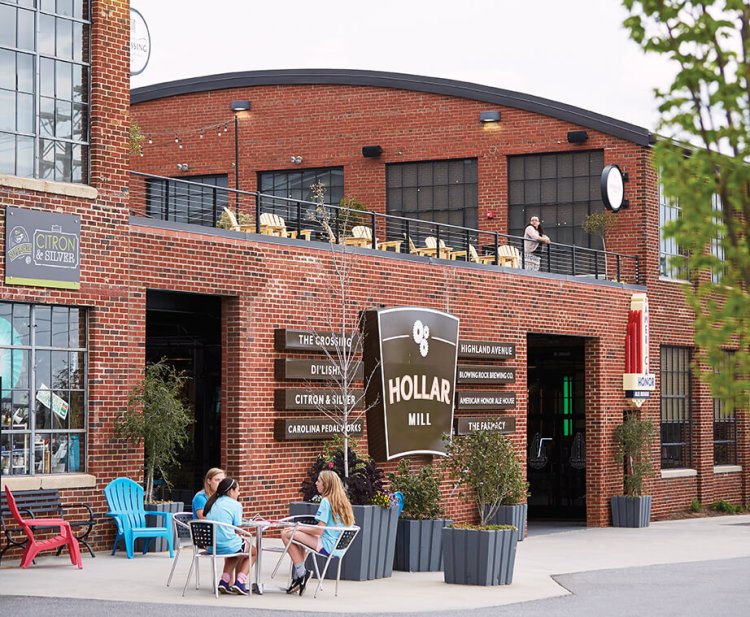
Along with the furniture industry, knitting mills based in Hickory flourished in the early part of the twentieth century before outsourcing brought them to a standstill. Today these now defunct mills have been converted to offices or other businesses, a great example of adaptive reuse. Their simple brick construction, cubes pierced by large windows, were designed to provide large spaces and good light for workers, but contemporary appreciation for industrial design gives these buildings a modern vibe. Every time we drove through the manufacturing area on the edge of downtown Hickory we were newly impressed that the mills were preserved for other uses and not simply bulldozed as so often happens.

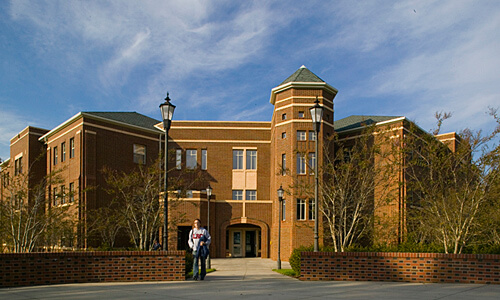
We often found ourselves driving by or through Lenoir Rhyne University as well. A small, private college, Lenoir Rhyne is also located near downtown providing an academic beat to central Hickory. The presence of an educational center is an advantage to any population fortunate enough to live close by. Like most colleges and universities Lenoir Rhyne benefits the community by offering year round activities such as concert and lecture series or athletic events open to the public.
Terry and I finally put essential but often tedious tasks aside after settling in for a couple of weeks and headed downtown to see what the center of Hickory offered. While still in Italy, we had seen photos of the pedestrian area online and now there it was before us, a long, paved area holding tables and chairs, including rocking chairs–perfect for this southern town. Laid out between the train depot, now a restaurant, and a street of retail stores, the pedestrian area hosts markets and musical events but is on a daily basis a gathering place where residents can enjoy a drink or meal with friends.
The town center was somewhat smaller than we had anticipated, with most of the stores circling around a two block area. The architecture was primarily in the quasi-Victorian style of many early 20th century towns, interspersed with later additions, but there were a few office buildings built in neo-classical and art deco designs. We were mostly curious, though, about what was inside these buildings and as we strolled the streets we came upon restaurants, clothing stores, a shoe store, a billiards parlor, law offices, a music store–clearly this was a town serving those who lived in Hickory, not just a tourist destination filled with shops designed to appeal to visitors passing through.
Best of all, we found a very good art gallery with plentiful space and a variety of media including glass collage, sculpture and jewelry. But we were most interested in the paintings, particularly the abstracts. While Terry wandered through the gallery to get an overview, I was captivated by an exhibit of small abstracts painted in brilliant colors by a pair of former art professors from nearby Piney Mountain. The volunteer on duty saw my interest and filled me in on the careers of the now elderly couple whose compelling works belie the affects of advancing age. The exhibits change regularly promising a new experience with each visit. There’s a lot of talent in this town and we expect to return often to see what the ever changing exhibitions have to offer.
We decided to have lunch while downtown and when we passed by a sandwich shop, the owner, who was delivering food to an outside table, assured us that the restaurant served delicious sandwiches, touting the always fresh ingredients. Easily persuaded, we went in to order a bar-b-que sandwich for myself and one made with brisket for Terry–our first sampling of these southern specialties. And both were, just as the owner promised, delicious, mine topped with spicy sauce and Terry’s with sweet, each with a scoop of coleslaw and a couple of pickle slices sitting atop the filling. We resisted the “best banana pudding you’ll ever taste” since we were more than satisfied by the hearty sandwiches.
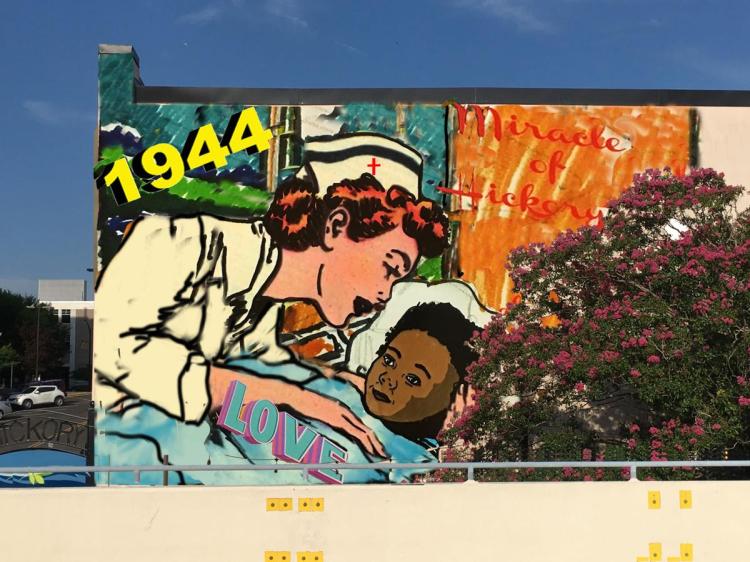
As we drove around the block on our way back home, we saw the mural our neighbor had described to me, depicting “The Miracle of Hickory.” Painted by local artist, Hunter Speagle, it is a scene drawn from a challenging period in Hickory. The town was especially hard hit by polio in 1944 when the first case on June 1 had become six within 24 hours and continued to increase rapidly. The hospital in Charlotte had no more beds for polio patients, so Hickory citizens quickly commandeered the Lake Hickory Health Camp to set up a treatment center. At first made up of tents, then wood huts, once an architectural plan was in place, a substantial hospital was built in fifty-four hours, ready to house the young victims. Four hundred and fifty-four patients were treated across the next nine months until the hospital in Charlotte could provide beds for polio patients. (see http://www.ourstate.com/the-miracle-of-hickory/ by Philip Gerard in “Our State” Decades Series for the complete story).
Hickory’s motto is “Life. Well Crafted,” a reference to its history of furniture manufacture and knitting mills, but with allusions to the quality of life here. Our brief time in this city has barely exposed us to all the ways the motto may apply to our own lives in this new, part-time home. While we are still in the throes of settling in here along with preparing to re-apply for Elective Residency visas, and, of course, limited by COVID-19 restrictions, we can only edge into life on this new and unfamiliar path. But what we have seen of Hickory confirms it to be a good choice as we adapt to the pleasant challenge of living in two countries separated by an ocean, a language, and a political system.
 Lurching towards Italy