
Part I
An Overview
We drove from Zagreb through Croatia, Slovenia and northern Italy in a day, arriving at our house in early evening, January 15, 2020. Home again, and excited to see the completed construction projects we had commissioned before leaving for Serbia. There were new shelves in the kitchen, all the cupboard doors now worked, a new sink and faucet had been installed and the old damaged counter top replaced with a new and more impervious butcher block surface. Upstairs we found our new closet/ armadio de mura extending across an entire wall of the dressing room so at last we could store our clothing in a convenient place. The specially made blanket from the fabulous Busatti company was waiting for us in their store a block away. Not only we were home at last, but in an improved and updated home.
After a month of settling in, again, we turned to perusing real estate sites, looking for a second home in the U S to use when we were not in Italy. Going through the process from a distance presented some challenges but our helpful realtor was willing to check on properties we identified as good prospects. Eventually we narrowed our search to a condo that Terry and I both liked and before long we were negotiating a price, arranging for inspections and completing all the tedious details of buying a house.
Our flight reservations had been made months before and we were to leave for the U S on April 14 at the end of the allowed ninety days. As anyone can by now surmise, that didn’t happen. I am sitting in my living room in Anghiari on April 20, suspended in time as so many in the world now are. Currently we have new flight plans, scheduled for May 19, but we cannot be certain that we will be able to fly even then; already our itinerary has been altered and our original non-stop flight Rome to Atlanta now has a layover in Paris.
So here we remain in Italy, one of the countries most afflicted with the coronavirus, COVID-19, (CoV-2,corona virus 2) a SARS virus. So what is this abominable entity that has paralyzed so much of the world?
First, let me say that viruses in general are microscopic monsters. They invade the body’s cells and convert them to function as agents of the virus’ DNA, or RNA in the case of the coronavirus. When they take over the cell completely, the cell dies or explodes, spreading the virus’ genetic material to adjacent cells. Think of the 1956 film, “Invasion of the Body Snatchers” but on the cellular level. Thankfully, unlike the film, the host body’s immune system normally fights off the attack and health is restored–sometimes immunity is the reward for having suffered, but it is often temporary.
The coronavirus that causes COVID-19 is an aggressive virus, covered with spikes that enhance its ability to take over a cell. Beyond that, it is a sneaky virus loaded with characteristics meant to insure that it fulfills its mission to survive and proliferate. Sneaky in that a person who is asymptomatic can spread the virus unwittingly as he/she continues to follow normal routines. Sneaky also in that some of those infected remain positive for the virus after symptoms abate and may still be contagious. Sneaky again as the virus can survive for extended periods in droplets of moisture distributed by an infected person. Sneaky, once more, though not unique to coronavirus, because many human habits create invasive opportunities for a virus–think of touching your face, where the virus gains access to mucous membranes or neglecting to wash hands thoroughly many times a day or of the normal practice, currently mostly avoided, of greeting people with a handshake or a hug. We are adjusting to altering or compensating for these habits, but in the early days of the pandemic, long held practices were hard to abandon.
Significantly, the cornavirus is a novel one so predicting its behavior is difficult. Researchers are still struggling to understand it fully and treatment is really just a matter of controlling symptoms. The scarcity of testing materials, flaws in the testing process itself, and a policy of not testing asymptomatic persons further complicate the problem as the true numbers of COVID-19 spread are unknown. Without that information, predicting the rise, duration and decline of the pandemic is exceedingly challenging so the medical community as well as policy makers have had to take a step by step approach based on current data, however flawed, as it becomes available.
The result, as we all well know, is that what is left to us is avoiding as far as possible the contact that would lead to contagion. So we wear masks and rubber gloves and practice social distancing, the latter being the most problematic and most difficult to enforce. The restrictions as to which businesses can continue to operate, and which can remain open but with limited access, have resulted in severe economic consequences for significant numbers of people and ultimately for the economy of their country. Moreover, too many people choose to simply violate government policy and although incurring penalties, have already done the damage meant to be avoided. And so contagion continues and by the nature of the beast, expands.
Part II
The Coronavirus Experience in Italy
Initially, the first cases of coronavirus in Italy were thought to have arrived with two tourists who had traveled from China in late January. Soon after, an asymptomatic but virus carrying Italian citizen returned from China and maintained an active schedule, infecting a number of people in the northern region of Lombardy. The latest information, however, suggests that the virus was already circulating in Italy earlier in January and hasn’t been connected to travel from China. In any case, Terry and I returned to Italy just as the epidemic was beginning here.
Italy, like most countries when COVID-19 first appears, hesitated before imposing restrictions stringent enough to effectively control contagion. Initially, authorities banned flights from China hoping that this would prevent spread of the virus but before long it became clear that contagion was being transmitted within the Italian population. On February 21 sixteen cases were diagnosed in the region of Lombardy primarily in the capital city of Milan. By the next day sixty people had contracted the virus and across the next two weeks numbers continued to grow and people were dying. Two weeks later on March 8th, desperate to contain the now rampant spread of the disease, Lombardy began a lock down. On March 7, in anticipation of the decree, hoards of Milanese packed their suitcases and fled to the south, many using public transportation, risking contagion among themselves and carrying the virus to southern regions. The following day, Italy’s prime minister, Giuseppe Conte, extended the lock down to the whole of Italy as it became clear that the virus was spreading throughout the Italian peninsula.
Lombardy and then Veneto with Venice as its capital, quickly became the “hot spots” for COVID-19 and remain the areas most affected. But in a short time, other cities were counting significant numbers of infected and virtually no place in Italy could be considered safe. Often a single case was first identified, then several, then hundreds and the virility of the virus could not be ignored. The restrictions imposed as the evidence mounted were defied by many but most Italians accepted that the country was in crisis and began to adjust to a new life style.
Being Italy, music became a means of expressing encouragement and solidarity. In a number of cities, the evening of March 13 brought musicians and music lovers to their balconies to sing, play instruments or just enjoy a few moments of entertainment in the face of a challenging situation. Songs ranged from the national anthem to popular folk music to opera and those who had no particular talent to share were encouraged to just bring spoons and pans to accompany the music. Fortunately, for those of us who could not participate in person, videos of some of the impromptu concerts played across the internet. There are many videos sharing the events on YouTube, one example below:
http://www.youtube.com/watch?v=EBByYjjvNzs
Music continued to provide respite from the drear of the virus even as spontaneous balcony performances began to dwindle. On Easter, the beloved Italian tenor Andrea Boccelli presented his “Music for Hope” concert from the nave of Milan Cathedral. Standing alone in front of the altar, facing rows of empty pews, Boccelli sang a number of sacred songs accompanied only by organist Emanuele Vianelle. Following that portion of the program, Boccelli stepped outside to stand at the cathedral entrance for his final offering. As a slight breeze ruffled his hair, Boccelli sang the beloved “Amazing Grace” with intermittent scenes of stricken cities around the world playing across the screen. When the hymn ended the camera panned away showing the barren forecourt of the enormous Milan Duomo and the small but big singer still standing before it.
In case you missed this moving event, you can hear Boccelli sing “Amazing Grace at the link below:
http://www.youtube.com/watch?v=bpXwOSHTwsY
Not long after his solo concert, Bocelli joined Lady GaGa, Celine Dion, John Legend, and pianist Lang Lang along along with scores of other musicians for the “One World Together at Home” video concert. Separated by oceans and continents but joining together in a concert of encouragement, it was in Lady GaGa’s words, a “love letter to the world”.
All over Italy, posters appeared depicting rainbows with the phrase, “Andra Tutto Bene” (Everything will be fine). Though some were professionally printed, many were drawings by children. Below are two I saw posted on a front door in our town, Anghiari.
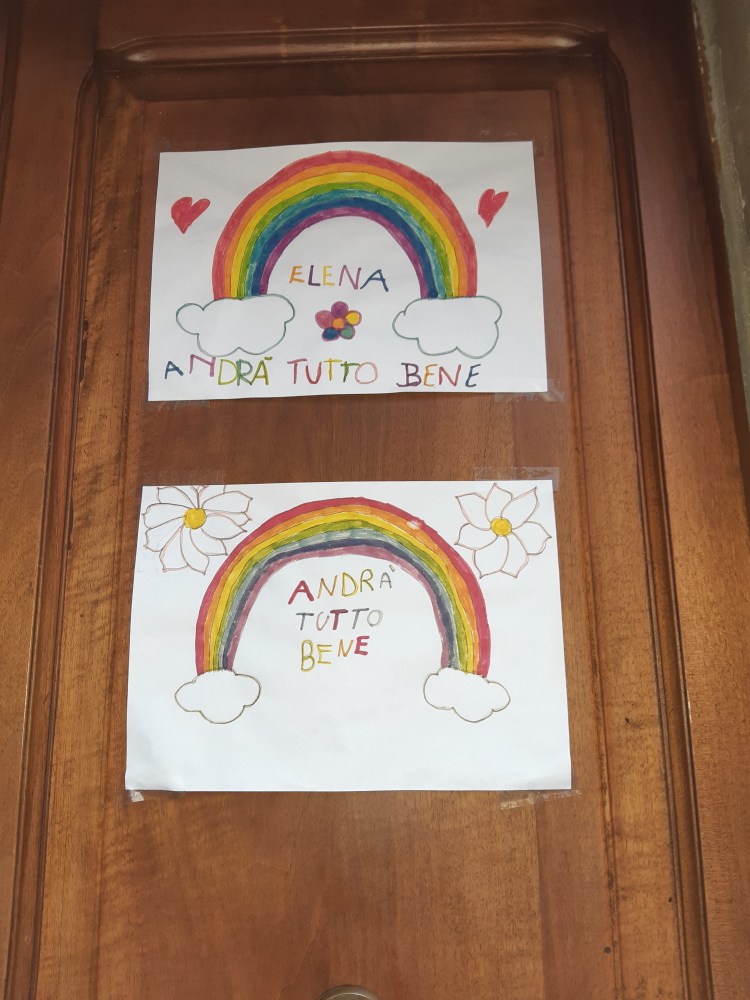
Below is another example of a local Andra Tutto Bene poster, this one having suffered from the elements in spite of its plastic covering. The young artist included the Italian flag, a picture of Anghiari and a hand print, presumably that of the artist. The Italian flag is red, white and green, though here green has faded to brown.

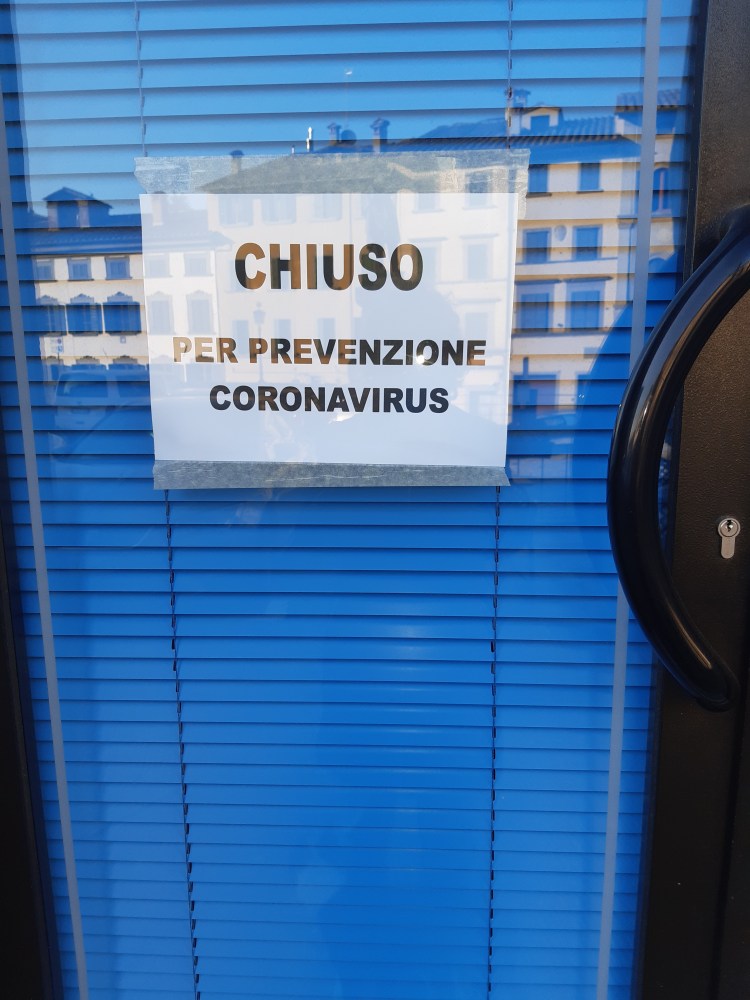
Not all of the signs were uplifting messages; the one below tells the story.
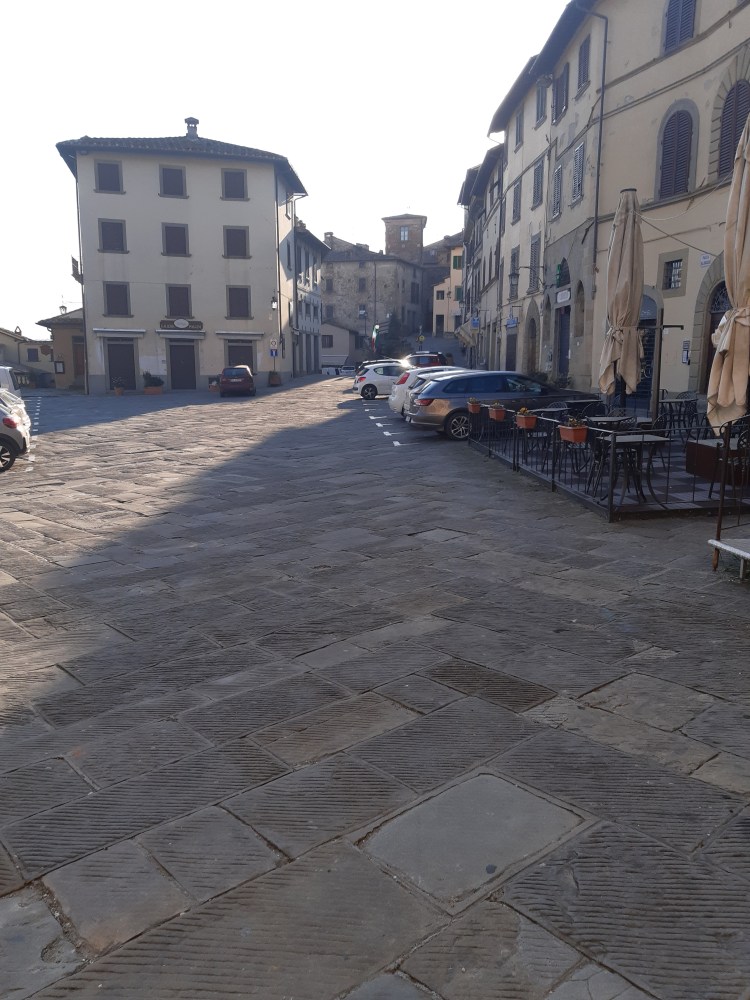
Anghiari’s main piazza, Baldaccio, was empty of people, as were all the piazzas in town–doors to businesses were shuttered, cars parked with no place to go, cafe tables and chairs without customers.
Though our town was very quiet with motor and foot traffic notably lighter than normal, we maintained contact with our neighbors. Across the street, Umberto and Graziella greeted us every day with ‘come va‘ (how’s it going?) and we were their audience as they dug and planted in their garden. Down the street our friends, Piero and Lela chatted with us from behind their fence when we walked by. Django always stopped at their gate, pushing his nose through an open space in hopes that Lela would offer him a treat–and she usually did, handing it to him through the bars. One person who had previously walked by our house multiple times a day completely disappeared. An older, very withdrawn man, he avoided speaking or acknowledging others, but I had begun to say hello to him, hoping for a ‘buon giorno‘ or ‘buona sera‘ in return. Initially he looked away when I spoke but in time he began to respond with a nod, and eventually spoke a mumbled greeting. I hope he is alright.
In part because Anghiari is a very small town, we feel safe from the threat of coronavirus here. Not only do we lack the pressing crowds of a larger city, but people in Anghiari take the restrictions seriously, maintaining a distance of at least six feet, and wearing masks even when just going for a walk. Everyone also puts on gloves in addition to a mask when going to stores and some grocery stores and pharmacies provide them along with hand sanitizer in the event a customer shows up unprepared. As if those precautions were not enough, I looked out the window one night to see a truck disinfecting our street. A few minutes later, I heard the noise of machinery outside and when I looked saw two individuals in haz-mat suits disinfecting the stairs, railings, and street in front of our house. The picture below shows one of them at the top of the stairs.
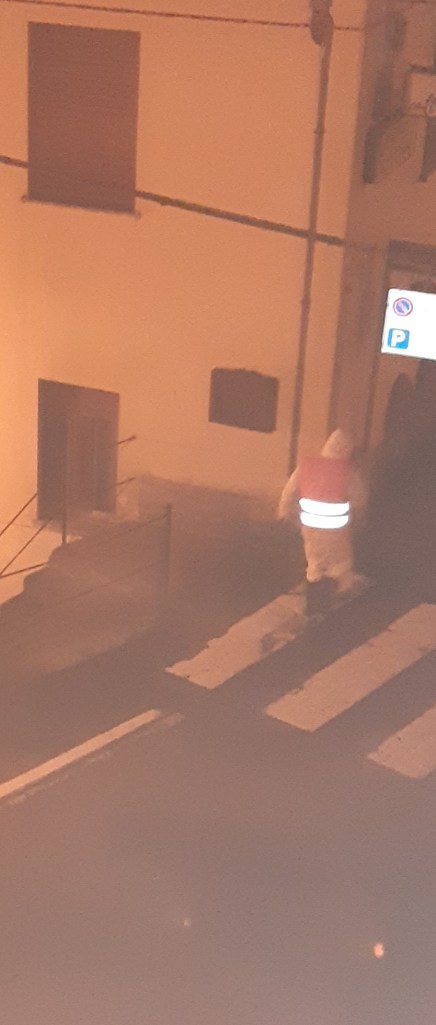
When I called Terry to see what was happening he immediately got the phone to take this picture and document the eery sight. Looking at each other in amazement, we both felt as if we were living in a science fiction novel. We have never seen the disinfections repeated, though it may have been going on in other parts of town, or deeper into the night.
For a long while we thought there were no cases of COVID-19 in Anghiari but yesterday learned that two nurses from our town had contracted the virus. Both have recovered.
Because of the course the virus had taken in Italy, I followed developments in the United States as the coronavirus began to take a toll there. My greatest interest was in our former home town, Fernandina Beach, and the places where our children live–New York, Nevada and Texas. One of my daughters is sure she had the coronavirus as did one of her daughters. Neither was tested but friends of theirs were and found to be positive. My son was ill in the very early phase of coronavirus in Houston, but is not sure whether it was a cold or the coronavirus. My other daughter seems to have been spared as has Terry’s daughter and her children who live in hard hit New York.
I emailed friends in Fernandina as soon as I knew that the virus had taken a foothold in Miami and other Florida cities, urging them to take precautions and particularly to practice social distancing. As I followed developments on FaceBook I was astounded to see that the primary topic seemed to be going out to eat–which restaurants people planned go to or had already visited, and what they had eaten or would eat when they got there. Having witnessed the pace of contagion in Italy, it was frustrating to watch the casual and even dismissive attitude, not just in Fernandina but in the states generally. There was a considerable body of evidence documenting the devastation in other countries and it was hard to understand why that was being ignored. Things there have changed somewhat as cases grow but still there is generally a much more cavalier attitude in the U S than in Italy–not, I should add, with everyone but with too many who risk their own health as well as that of others.
Having shared with Italians the experience of living with the concerns and inconveniences of coronavirus, I have developed a much greater appreciation for the culture than I had when we arrived last summer. The spirit, generosity and resilience with which Italians met the crisis has made me a great admirer of the country and the people. Terry and I had discussed a number of times whether we should apply for the long stay visa again; Terry was always convinced that we should but I was hesitant. Now I feel like a citizen of Italy, my ‘status’ conferred by shared experience, and we agree that applying again is the obvious thing to do.
As I write this, Italy is waiting word from Prime Minister, Giuseppe Conte announcing some relaxing of restrictions beginning May fourth. No one anticipates the current guidelines will be abandoned entirely, or even largely, but all are looking for any sign that life will return to normal.
ANDRA TUTTO BENE
 Lurching towards Italy
Great update, thank you! I’ve been wondering if you were locked down in Italy or elsewhere.
LikeLike
Thank you Dionnne, Yes, here we are! I hope you are safe and healthy somewhere!
LikeLike