Part III
Enjoying Sarajevo
We had been enjoying aspects of Sarajevo, even as we coped with all that we learned of its difficult history. Not a day went by that we didn’t pass through the old market, sometimes simply to take in the colorful scene, or on the way to an errand, and the morning walk with Django almost always took me there just as proprietors were setting up for the day. The market, Bascarsija, dating from the fifteenth century, is today a collection of kiosks, stores and restaurants covering several city blocks. Its varied collection of ethnic goods appeals to tourists, but locals frequent the area as well.
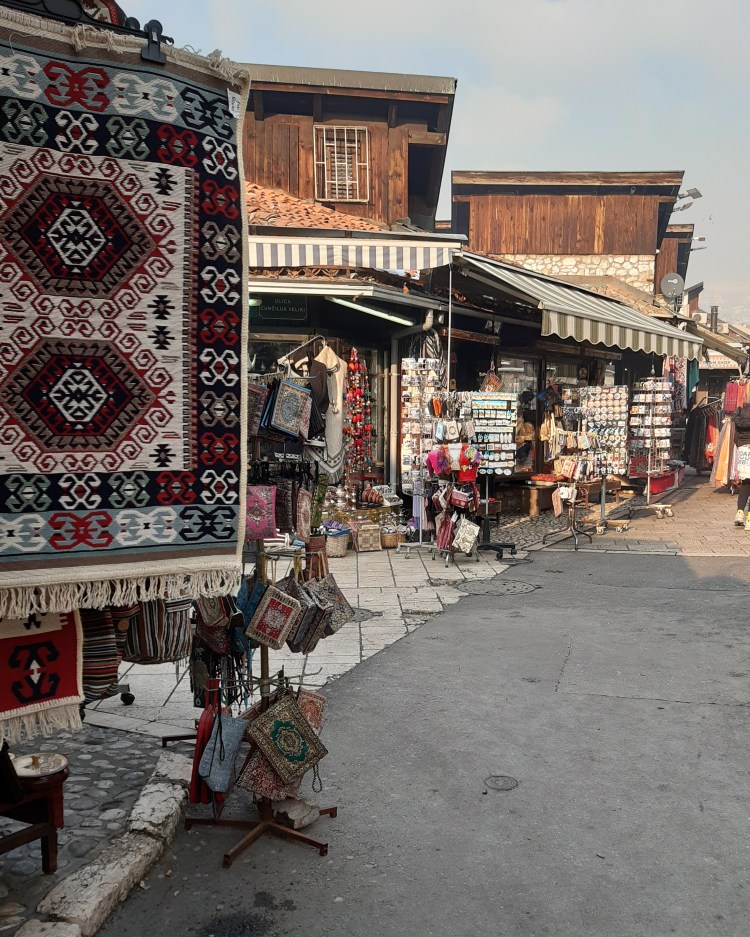
We were not interested in buying any of the exquisite purses, rugs or jewelry sold here but instead deferred to practical purchases–Terry bought a pair of slippers and we found a carry on bag we could use for our flight out of Bosnia. Candy stores tempted with their great variety and color so we indulged without caloric penalty by buying a gift box to give to our hosts.
What did not tempt us……………
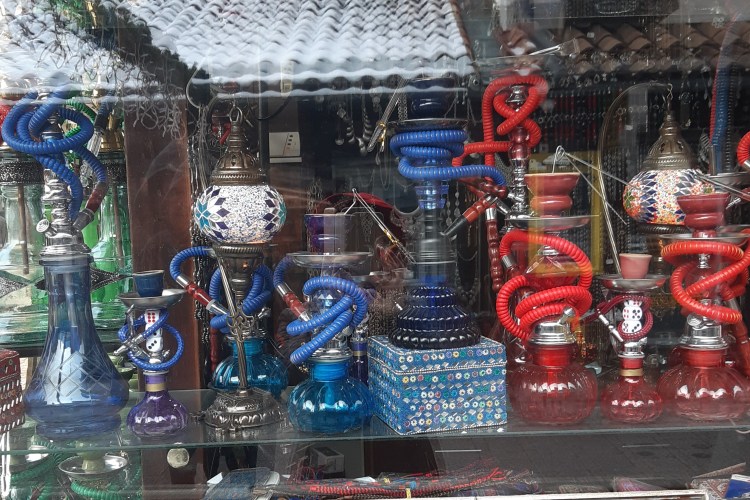
Hookah cafes could be found every few blocks around the market and, though interesting to see, we had no enthusiasm for experimenting. Hookah cafes have become rather popular in the U S and Canada, favored mostly by young adults who are attracted to this more exotic form of smoking and enjoy the social setting where people gather while indulging. The substance smoked might be either a flavored tobacco or an herbal mix, (shisha) which is filtered through water in the base of the hookah. Since we never went inside a hookah cafe I am not sure whether they serve a regular clientele or are simply a curiosity for visitors.
When we felt like eating out, the market area was usually our destination. Terry particularly liked a Chinese restaurant there and went so often, usually for take out, that the staff greeted him like an old friend when we appeared. Sometimes we grabbed a gyro from a tiny shop offering a choice of chicken or lamb topped with lettuce, onions or other veggies. And one chilly evening Terry and I both savored a traditional goulash in a cozy restaurant where artifacts covered the walls and a cat curled up next to me while we ate. My favorite restaurant, though, was one near the top of the market where I inevitably ordered spinach pie and Bey’s soup. This chicken based soup is a Bosnian specialty containing okra, a vegetable I had always associated with dishes of the American south.
Bey’s Soup Recipe
- 8 oz fresh okra
- juice of 1/2 lemon
- 8 cups water
- 3 chicken legs or thighs (or 2 breasts if you prefer white meat)
- 2 carrots
- 1 stalk celery
- 1 tsp salt
- pepper to taste
- 1 bay leaf
- 2-3 Tablespoons butter
- 1 egg yolk
- 1 Tablespoon sour cream
- 1-2 Tablespoons parsley
Dice the okra and place in pan with 2 cups water along with lemon juice. Cook for 50 minutes, then drain. Simultaneously, put chicken, carrots celery, salt and pepper, and bay leaf in a deep pot with 6-7 cups water and cook for 1 hour. Remove skin from chicken and dice. Return to pot with the okra and cook an additional 10 minutes.
Make a roux from the flour and butter and add to the soup. Mix the egg yolk with sour cream then add to the soup and cook for an additional 5 minutes. Sprinkle with the parsley and, if you want a little more lemon flavor, add a splash of lemon juice or a slice of lemon.
The result will be a slightly thick, lemony soup that is quite hearty and could suffice for a meal.

There were many museums in Sarajevo to choose from but we were naturally eager to see the museum at the Sarajevsko Pivara brewery near our house. Because of its role during the siege we expected descriptions of that period to be a significant part of the museum’s exhibit. That was not the case, however, and displays were dedicated primarily to such things as labels and bottles through time, phases of their production of beer and a big shout out to the Coca Cola company which began to utilize the brewery after the siege to produce soft drinks. It was a tiny museum and tours of the facility were not included as we had hoped, so our visit there was brief.
More interesting were the two house museums we visited. One, the Despic house (top photo below), stood on the street beside the river and had been owned by a wealthy Turkish businessman who eventually donated it to the city. The furniture shown in the photo is from the period when Austria-Hungary ruled Bosnia and sophisticated owners chose a decor reflecting the times. Throughout the Despic house, however, Turkish kilims, some of great size, covered the floors linking the decorative principles of two cultures.
The other (Surzo’s) house, lower photo) required a walk into the hills beyond the market, passing by “Pigeon Square,” where huge numbers of pigeons cooed and bobbed as they settled onto the cobblestones. Surzo’s house was more extensive than the Despic house, with various rooms, passageways, and porches rambling across a large courtyard. Both were beautiful, as the photos below attest, but the Despic house was a city house, while Surzo’s house was built in what would have been countryside at the time.
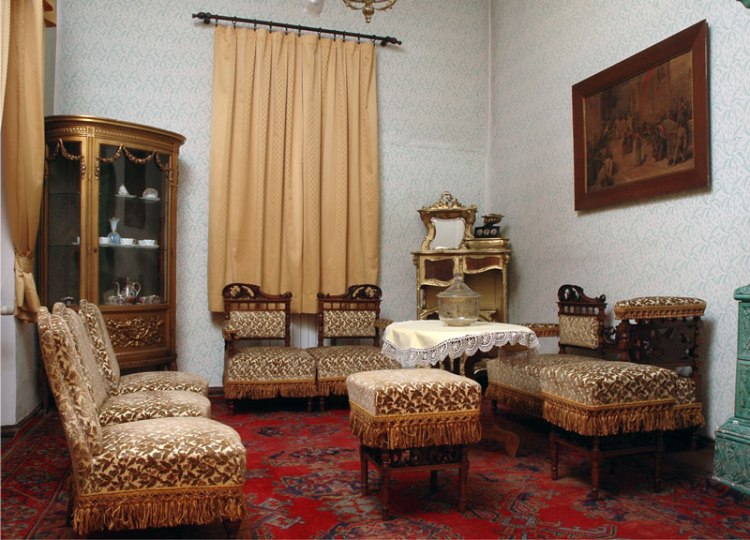
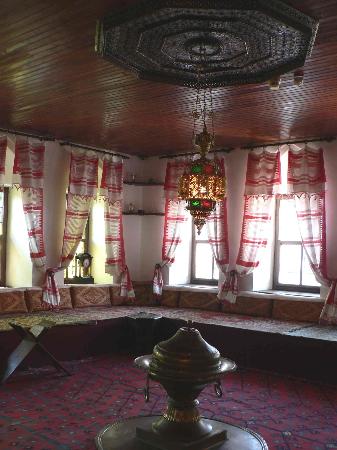
Surzo’s house, although contemporaneous with the Despic house and both owned by wealthy Turkish businessmen, showed greater affinity with its mid-eastern connection. It was divided into public and family spaces, and further into separate rooms for men and women. The Despic house, in spite of western decor in many areas, did have an assembly room similar to the one in the photo above. In both houses these were formal meeting places, presumably used for large gatherings as the banquettes lining the room suggest. The brazier in the center of the room provided heat during cold months of the year.
At the end of our visit to Surzo’s house the museum official, who had let us wander through the house on our own, approached to see if we had any questions. His English was fluent and he seemed eager to talk about the house and we, of course, were eager to listen. He described the house as having been abandoned and reduced to a “tumbled down,” state as a result of the Siege of Sarajevo. It was saved from declining into further ruin through the efforts of Sarajevan citizens who managed the restoration and opened it to the public as part of the city’s museum system.
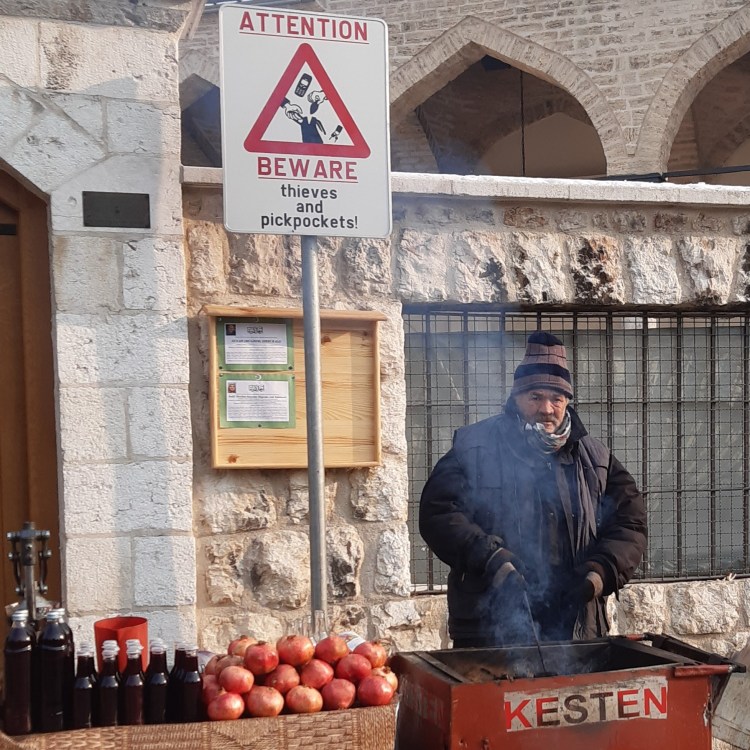
As we walked back home, we bought a bag of roasted chestnuts from a vendor braving the cold to offer a little refreshment. The chestnuts were tasty and no doubt the pomegranate juice would have been as well–we should have taken a bottle back to our apartment.
We had been living in our apartment for some time before we stopped to read a plaque on an outside wall. Although it was written in Bosnian, we could identify the name of the person, Augustin Tin Ujevic, and saw that he had lived in this house from 1930 to 1937.

A search on the internet told us that Tin, as he chose to be known, was a Croatian poet (1891-1955) revered by his home nation. He is considered one of the most significant poets of the twentieth century and without parallel in Croatia. Unfortunately, as respected as he is, not a lot of his poetry has not been translated into English. One of his most famous has been though, and I excerpt the first stanza below:
Daily Lament
“How hard it is not to be strong
how hard it is to be alone
and to be old, yet to be young
and to be weak and powerless,
alone, with no one anywhere
dissatisfied and desperate
And trudge bleak highways endlessly”
(translated by Richard Berengarten & Dasa Meric)
I read a few of the translated poems and found them to be generally morose, but lyrically very beautiful. We were intrigued that he had lived in our building and wrote many of his poems there–perhaps in front of the fireplace in the very rooms we occupied.
John Kruth, an American poet and musician, so deeply admired Tin Ujevic that he created an album devoted to Tin’s work–“the Drunken Wind of Life-The Poem/Songs of Tin Ujevic. You can hear it at:
https://johnkruth.bandcamp.com/album/the-drunken-wind-of-life
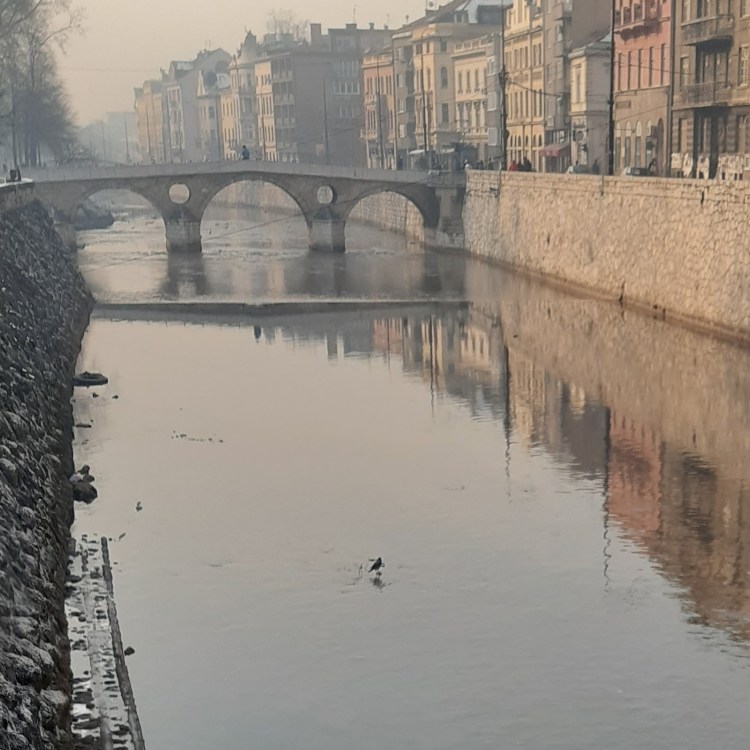
As our month in Sarajevo ended, our host offered to drive us to the airport to catch a plane for the short flight to Zagreb. We were happy at the prospect of returning to Italy, but nostalgic about leaving Sarajevo where we had learned so much. On our way out of the city we would cross the Miljackia River for the last time and pass through streets that had become familiar during the last month. We were leaving the Balkans behind, which, had we not been required to leave Italy we would not have visited, but where our lives and minds had been so expanded. Assuming that all would go smoothly, we would spend a night in Croatia, then drive through Slovenia, Terry’s ancestral home, and lastly into Italy, the place we now thought of as home.
Post Script
As the time approached for us to leave Sarajevo we had to take Django to a veterinarian to get a health certificate allowing him to travel to another country. This time we were flying into Croatia, the first EU country we would be in since leaving Italy in October and we had some trepidation that the lack of a rabies titre test might catch up with us there. The vet tech was dubious about our chances of clearing borders without a problem but we had already set our course and could only hope for the best. The ambiguous comments by veterinarians in Belgrade and Novi Sad had left us uncertain whether lacking the titre test should be an issue so we relied on luck and crossed fingers to take us through the various borders, hoping that we could slide Django past without a problem.
And we did pass through all border controls with no questions. The authorities at the Zagreb airport only wanted to certify that rabies vaccinations were up to date, and that his health certificate verified he had seen a veterinarian and had no health conditions that would prevent travel. Officials at the border crossings into Slovenia and Italy took no notice of a dog in the back seat.
 Lurching towards Italy