Part I
Our Enlightenment
We had been in Novi Sad a month and now it was time to move on to our next, and last, month in exile. I had considered spending that time in Albania or Northern Macedonia at one point, but in the end we elected to go to Bosnia-Herzegovina for an entirely practical reason–the rabies titre test. See the PostScript below for information about the titre test.
Our flight from Belgrade had been delayed so we arrived in Sarajevo in the late afternoon, an hour later than scheduled. The corridor from the airport into the city took us by a multitude of anonymous apartment blocks, each with a scattering of windows lit as daylight faded; only the Olympic Symbol left from the games of 1984 signaled that we were in Sarajevo. When we arrived in the historic center, the taxi driver had to search for our apartment, driving around and around the neighborhood, before finally depositing us after dark at the right address. By now it was about two hours later than our anticipated arrival so with many apologies to our hosts we at last checked into our home for the next month. We entered our apartment to find a bottle of wine and two glasses sitting on the table to welcome us–a highly appreciated nicety after a long day.
That evening we walked to a nearby restaurant for our evening meal, crossing the Miljacka River at the foot of our street on the way. Once again, our first meal in a new town was served by a loquacious waiter, eager to talk with newcomers about his city. But instead of extolling its virtues, this young man told us he hated Bosnia and planned to leave as soon as it was feasible. His Ukrainian wife, he said, had been badly treated when she arrived, reinforcing his own animosity toward the country. Although his service was generally amiable, we went away with a sense of the acrimony that some lived with in this multi-cultural city.
The next morning when we saw Sarajevo in the light of day, it became clear how the geography of the city contributed to the situation endured by Sarajevans during the three years long Siege of Sarajevo. The city lies in a bowl surrounded by hills; the upward slope of our street ended less than half a block from our apartment, transforming abruptly into a steep grade rising into the hills. In the opposite direction and across a distance of perhaps five city blocks, hills circled the other side of the town. Our eyes were suddenly opened to the consequences of this landscape in wartime — Serbian snipers positioned in the hills, rifles and mortars trained on the citizens living below–a city without a chance.
We had not been unaware of the war in Bosnia as Serb factions fought to gain control of Serbian ethnic areas there. My own life had been affected when NATO sanctions against Serbia prevented returning to archaeological work at Ravna, and therefore my plans to base a dissertation on findings there. Still, far off wars, and other tragedies, don’t resonate greatly when one’s own life is stable and comfortable and I think few Americans fully grasped what was happening in Bosnia. Now, although the Siege had ended years before, we were stunned by the extent of the tragedy we had just begun to fathom. Not only was the physical evidence all around us, but we read and watched videos to learn more. As we delved into accounts of war time Sarajevo we became more and more deeply affected by it and for at least the first two weeks of our stay my voice was reduced to a quaver whenever we talked about it.
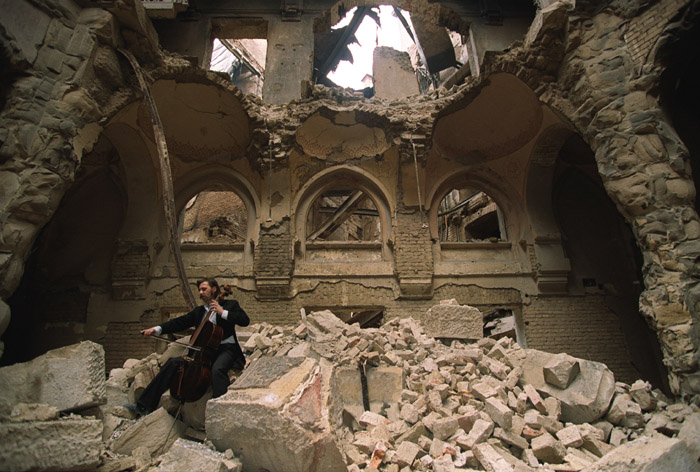
I had read the novel “The Cellist of Sarajevo” (Steven Galloway; Riverhead Books-May 15, 2008) at least a year, maybe two, before having any idea that we would spend a month in Sarajevo. At the time I found it a powerful story but although the author indicated that it was inspired by true events, I didn’t pursue that story then. Now I couldn’t ignore it, and it wasn’t long before I discovered a photo of the real cellist of Sarajevo, Vedran Smailovic.
Wikipedia
Smailovic, a member of the Sarajevo Philharmonic Orchestra and other musical ensembles, performed across Sarajevo for twenty-two days as the war raged around him, to commemorate twenty-two victims killed while waiting in line to buy bread. The composition Smailovic played was the mournful but beautiful “Adagio in G Minor” by Albinoni; you can hear him play it at the link below.
http://www.youtube.com/watch?v=74weGNYbhYw&92s
Smailovic remained in Sarajevo through 1992 and part of 1993 before escaping to Northern Ireland where he has lived since. His story almost certainly could not have been imagined but a real, and sensitive, human being living in a real, and awful, situation offered his fellow citizens this gift, helping them to transcend their reality.
The rubble of the building in which Smailovic is playing in the photo above is the result of fire bombing the National Library. In spite of heroic efforts by library staff to save as many books as possible, thousands of books and manuscripts were lost, taking with them pieces of Bosnia’s history and culture. Fortunately, through foresight and considerable effort, many treasures were stored in alternate locations and ongoing work at digitizing the collection will preserve it for the future. The restored building stands next to the river Miljacka, very near our apartment and we passed by it on a daily basis.
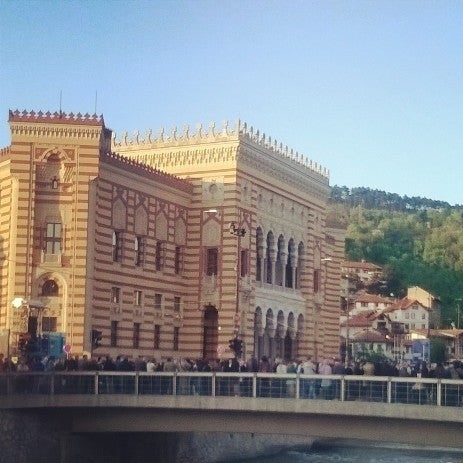
photo credit Lamiya B 2014
After we arrived in Sarajevo, Terry had purchased another book describing the experience of the Siege, “Black Soul” (Ahmet M Rahmanovic; Xlibris Corp, Feb 5, 2010) The fictional story is brutal but, Rahmanovic wrote, ‘the reality was worse.’ Terry found it so searing that he warned me not to read it, and I didn’t. He did relay to me though, the author’s view that Bill Clinton’s decision not to arm Sarajevans so that they could protect themselves, (in Clinton’s view, to keep the war from expanding) was instrumental in prolonging the Siege at the cost of many lives and years of intolerable conditions.
Finally, there is the memoir written by Bill Carter, “Fools Rush In: A True Story of Love, War and Redemption” (Schaffner Press Inc. April 7 2019). I didn’t read Carter’s account until I had recovered somewhat from the initial shock of Sarajevo, several weeks into our stay. By that time I could appreciate that Sarajevo’s story was indeed one of not only war but also love and redemption and was glad to have saved it for last. Carter arrived early in the war with a group bringing humanitarian aid to the trapped Sarajevans and stayed in the city for extended periods of time. During those times he made friends, experienced all the harsh conditions of the situation and continued to go in and out of Bosnia to collect more food, medicine and other difficult to find goods. From Carter’s story I learned of people making a meal of an onion, taking a bath with a liter of water, learning how to run across the deadly Sniper Alley without being killed or wounded–all while trying to maintain as normal a life as possible.
But Carter was not simply another actor experiencing the war. His association with TV production led him to contact Bono to request a TV interview and Bono responded by offering to play a concert in Sarajevo. Rather than endangering the musicians as well as the audience, Carter set up a satellite link so that the concert could be viewed in safety from wherever one could find a TV monitor to watch.
Inspired by the circumstances, Bono wrote the song, “Miss Sarajevo,” which was to become well known throughout Europe but was relatively obscure in the U S. The title refers to the beauty contest held annually in Sarajevo, improbably managing to go on in 1993 in spite of war conditions. Out of concerns for safety, the competition took place in a basement room.
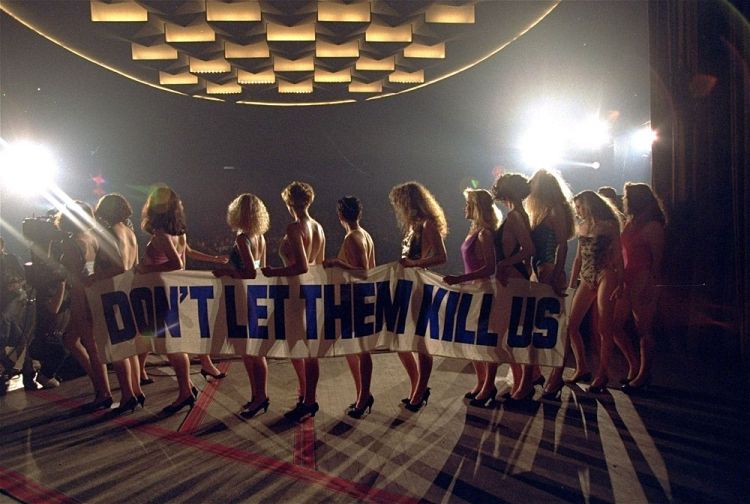
photo credit Pintrest
Bill Carter made a documentary of the concert accompanied by clips of war time scenes; to watch on YouTube and hear the song performed by U2 and Placido Domingo go to:
http://www.youtube.com/watch?v=Zlmg0yzxKvQ&list=RDZlmg0yzxKvQ&start_radio=1
There is also on YouTube a short video (made 2 yrs ago) with Bono recalling the film and concert and talking about the need to continue to be aware of tragic circumstances around the world and the ability of people to cope and survive.
We were learning a lot in our first weeks in Sarajevo and would continue to learn as we walked around the neighborhood and city. Not all would be related to the war, in fact there was much to be enjoyed and appreciated in late 2019 and early 2020. I feel quite certain that the citizens of Sarajevo have little interest in living in the deep shade of the tragedy they experienced–its residue is all around them, so there is no possibility to forget, but nevertheless a need to live in the present.
********************************************************************************************
Post Script-Rabies Titre Test
When we had been in Serbia for just a couple of weeks, I learned that Serbia was not considered a rabies controlled country. In reality, rabies has been controlled there for some time, but that had not been recognized by the EU. Pet Travel, our online source for information on traveling with pets, confirmed that Django would need the titre test, proving that he was rabies free, in order to leave Serbia and go into a rabies controlled country. Getting the test was no problem but a three month ban on traveling following the test was. If our challenge to the Italian Consulate succeeded and we were awarded a visa, the travel ban would mean staying an additional two and a half months beyond the time we could otherwise return to Italy. Or if we were denied a visa, it would mean staying a couple of extra weeks. But as we were still just in the earliest days of our sojourn, even that delay was unwelcome.
We hurried to a local veterinarian to get more information and have blood drawn for the titre test, if necessary. We were relieved to learn there that the requirement applied only to animals that had been in Serbia for three months or more. In the event that we were in Serbia for three months, the vet told us we would only need to dip across the somewhat laxly controlled border with Bosnia for a day then return to Serbia with a passport stamped with the new entry date, resetting the time spent in Serbia. Later, we checked further with a veterinarian in Novi Sad who told us that we could avoid the test if we elected to spend the last month in Bosnia, officially a rabies controlled country. He presumed, as the veterinarian in Belgrade had, that Bosnian border and passport control would be casual about the titre test requirement, and thankfully that turned out to be the case.
In the end, the rabies titre test requirement, and our decision to avoid it, would complicate our travel plans until we returned to Italy. My advice to anyone traveling with a pet is to get the test as soon as you know you may be traveling beyond rabies controlled countries or even if you are not. One test is good for the lifetime of the animal and only updated rabies vaccinations are required afterward.
 Lurching towards Italy