Part II
The heart and soul of Novi Sad is Dunavska Street, the very wide, very beautiful, and very active pedestrian area that extends several city blocks through downtown Novi Sad. Stores and restaurants with outdoor cafes line the street, interspersed with planters filled with greenery. When we first arrived, the weather was still quite mild and people lingered in the cafes over coffee and snacks; we even heard American voices on a couple of occasions. Most tourists in Novi Sad, however, were either from the Far East or other Balkan countries. But the streets of the pedestrian area are by no means limited to tourists, many locals rely on this area for clothes shopping, tech stores, and a surprising number of shoe stores and opticians that serve the community. We also saw a couple of large bookstores, happy to see them thriving, which is no longer so true in the U S. Passageways and small streets branch off Dunavska street, leading to more blocks of restaurants and shopping to explore.
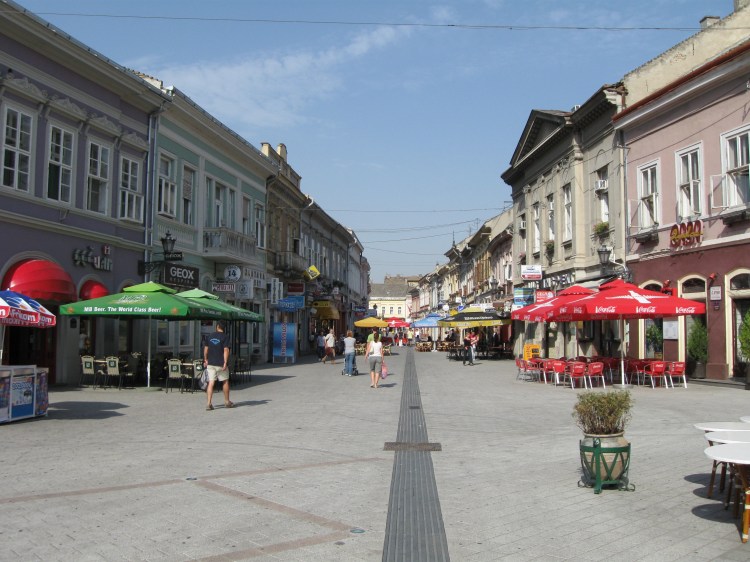
photo credit: Fliker
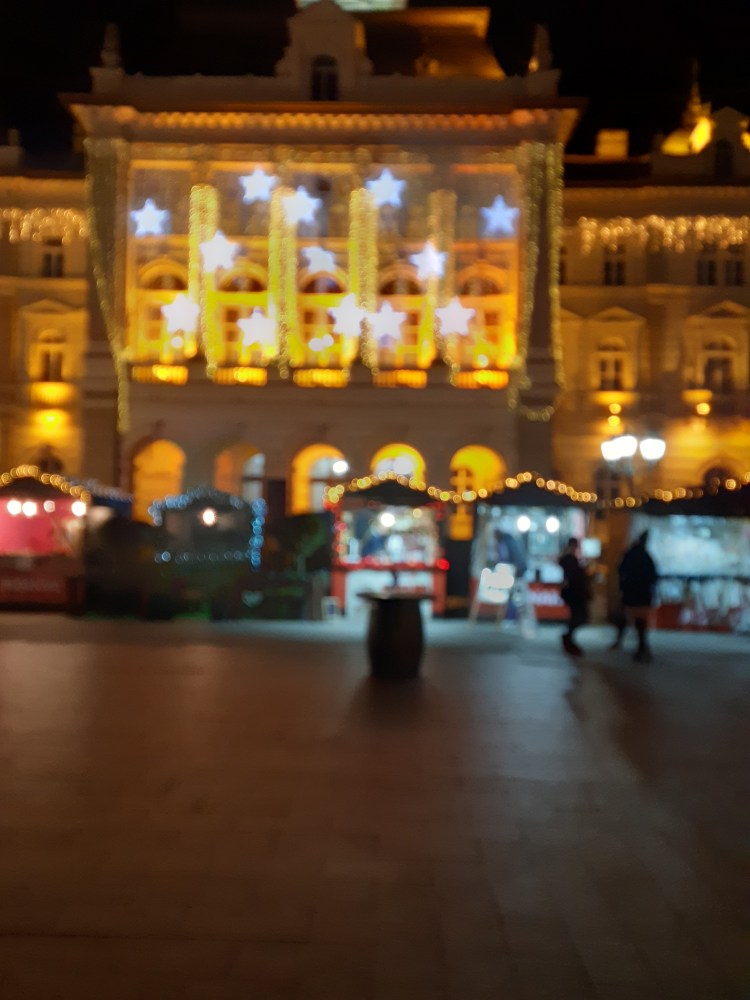
In spite of the balmy weather, the holiday season had already begun in Serbia. Christmas displays had started appearing on Belgrade’s streets by the end of October, and when we arrived in Novi Sad in mid-November, Dunavska street was fully, and I would say lavishly, decorated for the season.
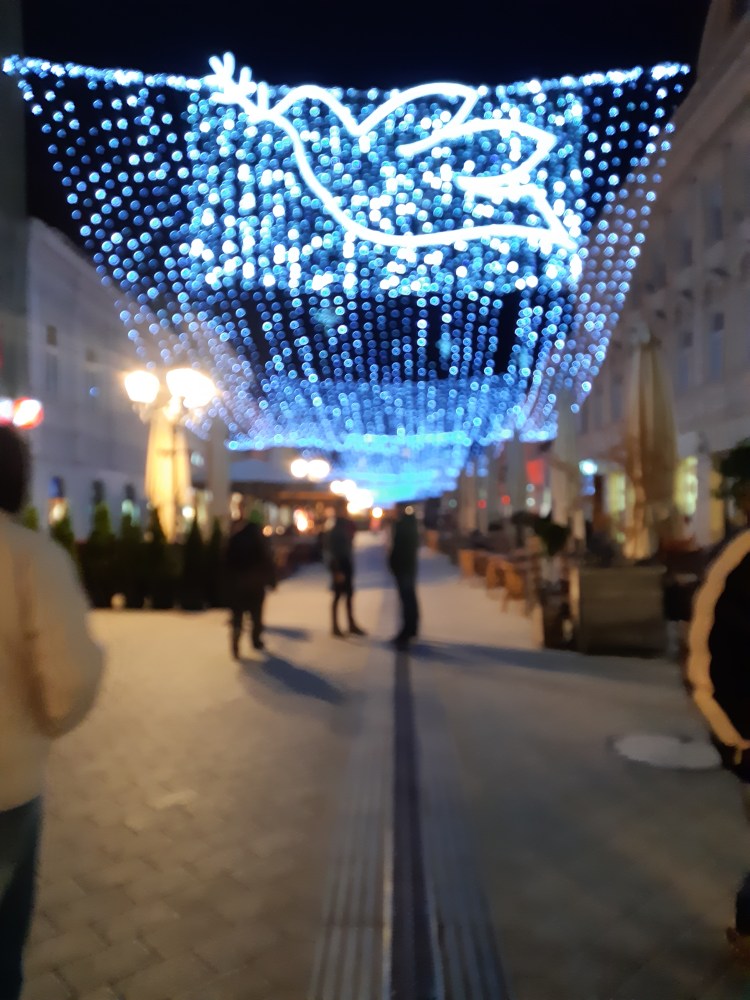
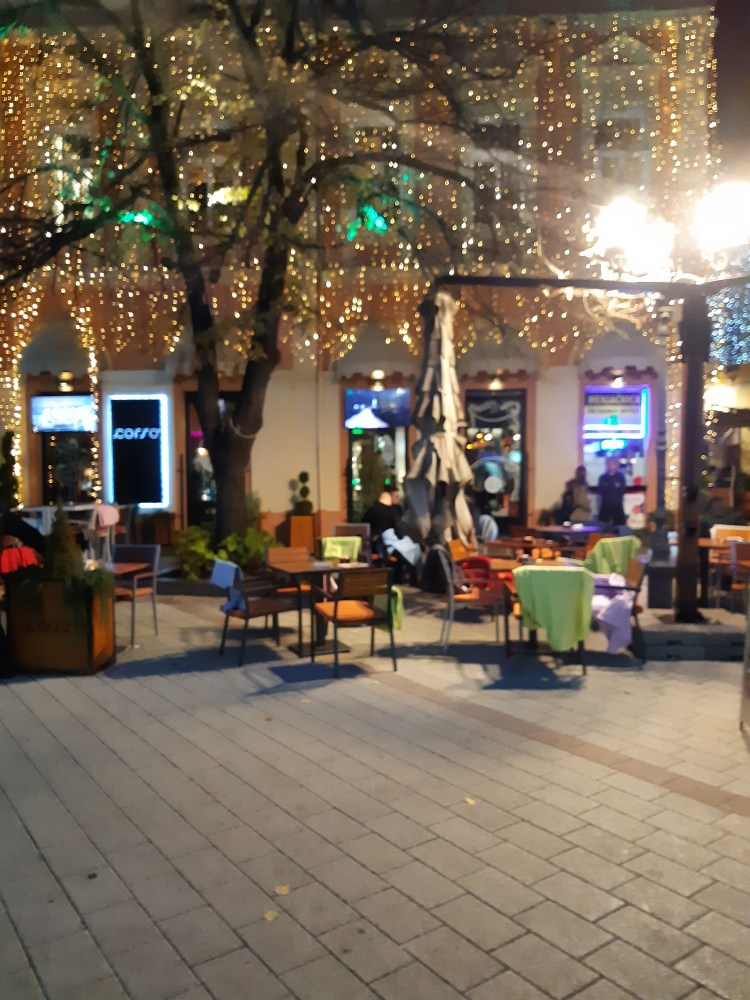
Christmas time
And at the end of Dunavska street a Christmas market occupying an entire block was already underway, offering small gifts, cafes, and, our favorite, a kiosk selling candied fruit, irresistible in its array of brilliant colors and flavors.
In the late afternoon, there was always music on Dunavska Street. Sometimes singers, often an accordion player or two, and always a young man sitting in front of a corner bank, playing bongos to recorded music. One early evening two accordion players joined him and we stopped to listen, anticipating that this would be a bit livelier than his usual offering. A crowd had already gathered as the young accordionists heaved instruments onto their shoulders and began to warm up. Before they could start, though, they were approached by a man, apparently a bank employee, who was clearly telling them that they were impeding access to the bank and could not play there. The crowd, looking forward to the performance, began to boo this man, but he won the day and the three musicians began to pack up their instruments. Like everyone else, we were disappointed to be denied, but commerce reigned and the crowd began to leave.
The young bongo player had caught my attention from the time we arrived in Novi Sad and began to spend time on Dunavska street. Although I admired his tenacity in showing up every day, I wondered at his persistence since his performance was essentially comprised of recorded music and he simply kept the beat, only adding a few extra licks occasionally. However, the night his gig was broken up, I saw him stand to start packing his bongo drums and realized then that he was handicapped. One side of his body was weak and somewhat twisted so he stood and moved with difficulty. Whatever skepticism I had felt as to his musical skills was replaced by admiration for his drive to appear every day in order to entertain passersby and earn a few dinar. He reminded me of Felix, a similarly afflicted young man in our home town of Fernandina, who appears downtown regularly on his three wheeled bike, hauling fruit, vegetables and water to sell. Ambition in healthy people is admirable enough, but to see it in someone who lives with adversity takes admiration to a higher level.
We had spent much of the first two weeks or so in Novi Sad simply enjoying walks around the city, often on Dunavska Street. But as we approached the last half of our time in the city, we wanted to visit a museum or two and walk through the large city park. The Museum of Vojvodjena stands adjacent to Dunavska street and the city park, so its convenient proximity made it a natural place to start. The collection spans the pre-historic through medieval periods, but its proudest display is of several brass Roman helmets.

Photo by Tekii-Own Work CCB4SA 4.0
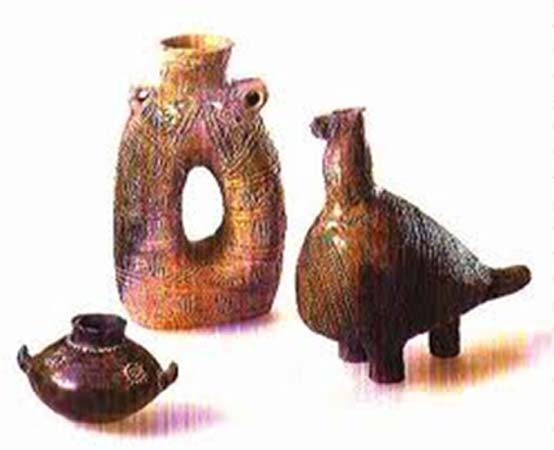
No doubt the helmets are spectacular, but I was most attracted to artifacts unearthed in prehistoric archaeological excavations. The exhibits were arranged chronologically, beginning with ceramics and metal work of the neolithic period, and what treasures these were. I had never before seen such elegant early ceramics, unsurpassed in the execution of delicate body walls and intricate designs. The best, and best known, are associated with the Vucedol culture (3,000-2200 BC), which extended from Croatia through Serbia and further east into Romania. Though the three objects below are not in the Vojvodina Museum, they are of the Vucedol culture and represent the high quality of the ceramics I saw. The most famous of these is the Vucedol dove, a decanter or censor found at Grado, an archaeological site on the border between Croatia and Serbia.
Another day we walked in the city park located near the museum and just off Dunavska street. Because it was now late fall, any flower gardens were long gone, but the woods and paths made the park a pleasure at any season. And it is a park that serves the people of Novi Sad all year. When we were there, an ice skating course was being readied for the arrival of colder weather. The skating area was not an open rink, at least where we were, but rather a long and winding course seemingly set up for speed skating. It was easy to imagine young Novi Sadians racing along at top speed, looping around less adept and slower skaters. A kiosk selling freshly made popcorn stood just outside the entrance to the park so as we left, we bought a bagful to enjoy later while we watched reruns of cooking shows and ‘Househunters International,’ the two English language programs we found on Serbian television. Serbia is the only country I have visited where popcorn is as popular as in America and we would return to this handy kiosk regularly to replenish our supply.
Although we prepared and ate many meals in our apartment, we sometimes chose to eat out, knowing we could always expect a fine meal. One night in a search for traditional food, we came to a stairway just off Dunavska street and followed the arrow pointing up to a family owned Serbian restaurant. At the top of the stairs, we passed through a courtyard and into a plain restaurant where we were seated in the second of two rooms, next to the kitchen. The waiter spoke a bit of English as well as some Italian so by using both languages and a few gestures we managed to communicate moderately well. The menu, however, was written in Serbian so we made our choices not quite knowing what they might be. The waiter posed as a hunter shooting a gun to describe what I had ordered, and Terry managed, by good fortune or intuition, to select cabbage rolls.
Before long, the waiter reappeared carrying a big iron skillet filled with the plump cabbage rolls and held the pan first before Terry and then me so that we could smell the tantalizing aroma. Having shown off the cabbage rolls, he returned with our plates of food and dinner was underway. Even after tasting my dish I was not able to identify it but guessed it could be boar, a rather common food in Serbia, which might be shot by a hunter. Terry enjoyed the cabbage rolls immensely but for both of us the portions were larger than we could manage so we asked to have them wrapped to take home. To finish his service the waiter brought a large plate of fried pork bits explaining that on this day in Serbia, eating pork was a tradition. We had no idea what the basis of that tradition was but we each ate a piece of pork to honor it.
All during our dinner we had heard a group in the next room singing Serbian songs, and laughing and talking along with the music. Because they were having such fun, we indicated to the waiter that we would like to have an after dinner cordial in that room, just so we could enjoy their music and good spirits. As we entered, people in the group immediately pulled extra chairs to their table and waved us over. With the exception of one man of about our age, the group was much younger than we two septuagenarians. A couple of women in the group particularly attracted our attention as we sat down. Both were tall and beautiful, elegantly groomed and dressed…and bald–altogether the essence of hip fashion. Several of the young men and women spoke English in varying degrees so we could converse with them against the background of Serbian folk songs.
While most of the conversation was light, focused on just making acquaintances, one of the men, who had been a philosophy major at university, sat down by us to expound on the nature of Serbians. The Serbian people, he said, never hate, they love and always forgive when a wrong has been done them. And, true enough, we had never detected animosity toward us in spite of the fact that America led the NATO bombings of Novi Sad and Belgrade. But Serbians carried their own guilt for the decade of aggression and war across the 1990’s as their government pursued the goal of a Greater Serbia. So maybe there was a give and take when it came to living with a difficult and unsavory past.
Without exception, we found Serbians to be open and friendly. Their demeanor, sense of humor and willingness to engage struck me as very similar to the American character. I can think of no reason why that should be the case, but it is my impression, or perhaps I should say our impression; as we prepared to leave that evening, there were hugs all around, then Terry turned to the young philosopher and said, “We are brothers.”
Probably because darkness set in by 4:00 and the weather was rainy and cool, we didn’t make the most of Novi Sad though what we did see and do we had enjoyed immensely. Several days before our departure, we returned to the local veterinarian to get a required health certificate filled out for Django. When the young vet tech asked if we would be returning to Novi Sad, I told her that we hoped so–perhaps in a couple of years. There were still places to visit, and we had enjoyed the ambiance of the city so much that, if it were not for the language barrier, we felt we could live there. Surely that will never happen, but a return trip? Definitely a possibility.
 Lurching towards Italy