Part One
Our first month in exile had ended; it was time to leave Belgrade and move on to the next month in Novi Sad. The city of just under 400,000 inhabitants is most well know for two things:–3×3 basketball and the Exit Festival. The Novi Sad 3×3 team (Al-wada) had won the World Championship just the night before we left Belgrade, alerting us to the fact that such a sport existed. The Exit festival is a major music event that brings people to Novi Sad to hear indie, rock and other music in mid-summer. The popular festival was started by the youth of Novi Sad who wanted to spirit away the horror of the 1990’s by creating something wonderful for the citizens of Novi Sad, while appealing as well to all of Europe and beyond. It is recognized as one of the best cultural events in Europe, winning the European Festival Award twice in its short history.
Neither basketball nor music prompted our decision to spend a month in Novi Sad, however. Instead, it seemed a rather obvious choice because it was the second largest city in Serbia located just an hour north of Belgrade, and we were intrigued by its reputation as the Athens of Serbia. As in Belgrade, the Danube flowed by the city and I looked forward to continued morning walks along the river. In fact, I never had that pleasure because the river was quite a distance from our apartment and any beauty spots along it were even further away.
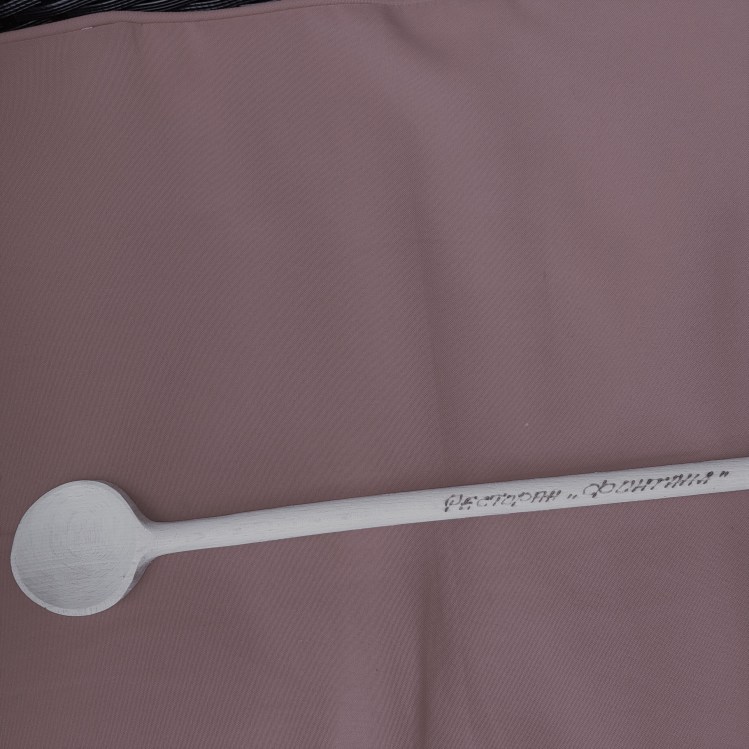
After settling into our apartment, Terry and I, with Django in tow, took our first walk into the downtown area. That evening, we did not go so far as the main pedestrian street, Dunavska, but stopped when we saw the sign for Fontana restaurant. Peeking into the hotel and restaurant, we asked if we could bring our dog in with us and were told, “of course.” So in we went and were seated at a table with Django at our feet. Terry ordered the dependably delicious wienerschnitzel, while I chose a traditional dish, a deep fried roll filled with cheese. Before long, the manager came to our table to see if we were satisfied and stayed to chat a while in his excellent English, all of us enjoying the opportunity to connect. Before our meal was over he brought us a gratis pitcher of wine and presented me with a wooden spoon with “PECTOPAH OlO OHTYHA” printed on the handle, RESTAURANT FONTANA written in the Cyrillic alphabet.
The following morning Django and I set off for our morning walk, careful not to stray too far and risk getting lost on unfamiliar streets. Each day, though, led us further afield so I learned to look for a certain church spire to lead me home whenever I wandered into unknown areas. The buildings in our immediate vicinity had given just a hint of the many colorful houses we would see as our daily walks expanded. Before long we were walking regularly through older neighborhoods, enjoying the kalaidescope of colors that characterize Novi Sad.

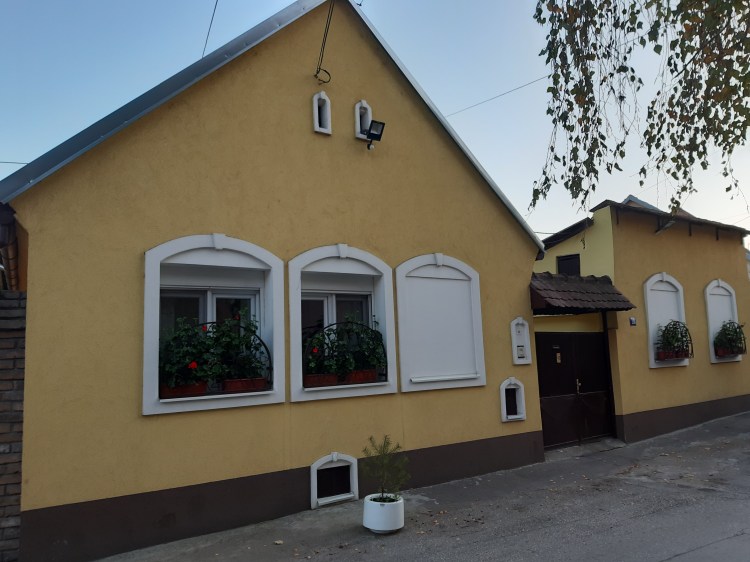
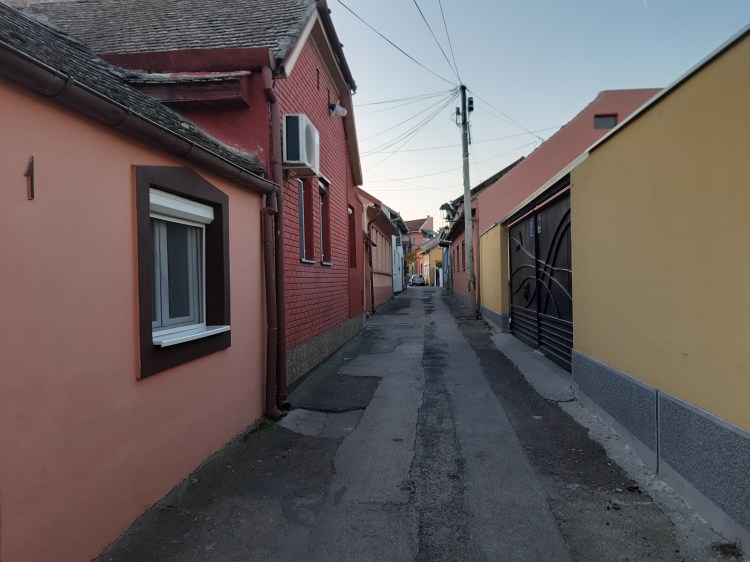
This is just a small sample of the colorful Novi Sad architecture, both domestic and commercial; we never lost our pleasure in walking through these streets.
Not all was beautiful, however. Just meters from the door of our apartment building, a garbage bin seemed always to be overflowing and surrounded by debris. I often saw people going through these neighborhood bins to retrieve what others had tossed away, picking through the refuse to find the best items for resale or for their own use. Other people sorted through the trash to collect plastic bottles for recycling, presumably to turn them in for some small remuneration.
Just beyond the squalor of this bin stood the store that would supply us with most of our groceries during the month–the Shop and Go–yes, in English. This store was hardly larger than a convenience store in the U S but had fresh fruits and vegetables, meats, cheeses and eggs, and any other items we would need throughout our stay. Around the corner, a tiny take out restaurant featured rotisserie chickens revolving slowly in the front window, a source of a number of delicious meals for us and obviously enjoyed by locals as well. A pizza place not too far away was the greatest food disappointment we experienced in Serbia. As the cook took the pizza from the oven, she turned to me with a questioning look and made a shaking motion with her hand, which I interpreted as asking whether we would like the oily hot sauce common to pizzas in Europe. I nodded yes, but realized my mistake when we opened the pizza at home to find that it was thoroughly splattered with catsup. This dinner went into the messy bin, perhaps to became someone else’s meal.
As Terry and I were walking through our neighborhood one day, admiring all the charm and taking snapshots, I dropped my phone, leaving it inoperable and with a splintered screen. Our landlord gave us the name of a shop that sold and repaired phones so we were soon off to see what could be done. The location of the mobile phone store took us beyond areas familiar to us, past the pedestrian zone and into a commercial district we had not seen before. When we arrived at the shop we found that it had closed, a 2:00 Saturday afternoon prerogative we had not anticipated. Frustrated by the futility of the trip and the idea of not having a working phone for a few days, we turned back to return home.
We forgot our disappointment moments later as we approached a nearby corner and saw a crowd gathering in front of an Eastern Orthodox church. With our inevitable curiosity aroused, we stopped to see what might be happening. In a few minutes, a car pulled up carrying a bride and groom–so a wedding! The bride stepped from the car dressed in a long white gown, topped by a short, white fur jacket and a veil. The groom, no doubt, was well dressed too, but I have to admit I was captivated by the beauty of the bride and barely noticed him. The bridal couple climbed the stairs and entered the church followed by their friends and family. Terry and I, casting off any notions of propriety, quietly filed in behind them–wedding crashers. We stood in the back of the church hoping not to be noticed by the invited, who stood along the sides and back of the open nave. The church was small, giving us a good view of all that was happening.
The Eastern Orthodox wedding ceremony is much more intricate than the rites we are familiar with in the states. For one thing, there are simply more components. Further, the best man, koumbaros, is fully involved in the ceremony, standing with the priest and bridal couple and chanting responses to the priest’s litany throughout the course of the wedding. Each of the rituals is repeated three times in reference to the holy trinity, a continuous reminder that marriage is a religious sacrament in the eyes of the church.
To start the ceremony, the wedding party stood before the iconostasis at the front of the church where bride and groom were given candles to hold in their left hands for the duration of the ceremony. With the couple carrying their lit candles, the wedding party then moved to the back of the church, near where we stood, for the central act of the wedding. The priest presented the couple with crowns joined by a ribbon. Each crown was kissed by the priest before placing them on the heads of the bride and groom, then the crowns were exchanged between the couple three times to symbolize unity. These crowns traditionally are kept through their life together and some choose to be buried with them.
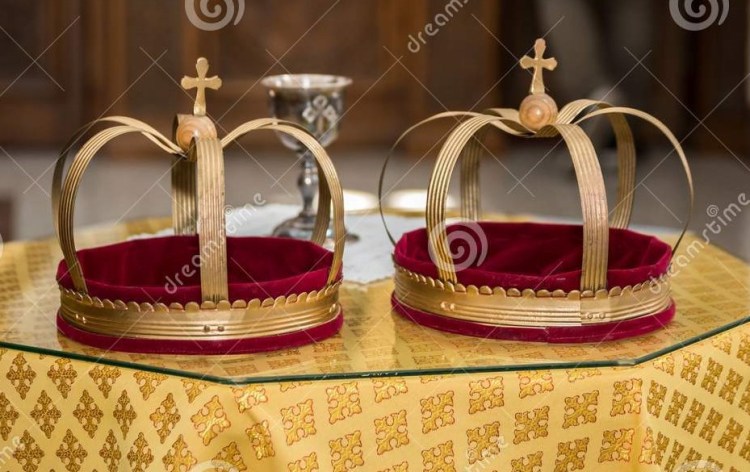
(photo credit: Dreamstime.com)
Once crowned, the couple received their rings, each one kissed by the priest before touching them to the foreheads of the bride and groom, a gesture the priest repeated three times. Then the priest exchanged the rings between the couple, again three times, before placing them on the third finger of the right. Finally, the bride and groom, priest and koumbaros circled the altar three times, symbolizing the first steps of the married couple in their new life together. That ritual signaled the end of the wedding ceremony and as everyone prepared to leave, Terry and I quickly exited before we could be recognized as the interlopers we were.
The bride was beautiful, the groom handsome, the ceremony an exotic melange of ritual neither Terry nor I had seen before. As we left the church, the afternoon light had changed to dusk and we walked home hand in hand, feeling privileged and moved to have witnessed the beginning of married life for this young couple.
 Lurching towards Italy