During our month in Belgrade we made sure to visit a few must see destinations but did not do or see all there was on offer. We never made it across the river to the highly recommended neighborhood of Zeman, once an independent town but now part of Belgrade. Nor did we visit the National Museum, which I am sure was a mistake. And there are many other sites and museums we passed by without being drawn in. Still, we felt we learned a great deal about the culture and history of Serbia from the places we did see and the people we met.
Anthropology enthusiast that I am, I was eager to visit the Ethnographic Museum and we went there early in our stay. The collection chronicles housing from the past, along with the utilitarian objects used in them, and clothing typical of various periods and areas in Serbia. It is an opportunity to see and appreciate the crafts of Serbia and, for those interested in fabric arts, the exhibits of clothing and household goods through time were a viewing feast. Those arts are associated with the female domain, but other parts of the collection focus on the provenance of male crafts with displays of fishing and farming implements. There were also full scale rooms filled with furnishings from different periods, complete with mannequins dressed for the times. Though I was the one who most looked forward to the visit, Terry enjoyed it too and both of us went away impressed with the curation of the museum as a whole.
It’s nearly impossible when in Belgrade to miss seeing Kalemegdan fortress and park, and one shouldn’t as the site marks the origins of settlement in Belgrade. The fortress itself, built during the Roman period, sits on a bluff overlooking the point where the Sava and Danube Rivers meet, an ideal location for a defensive structure. Kalemegdan park surrounds the fortress and was busy with strolling tourists when we were there. Kiosks set up along walkways offered souvenirs and snacks and benches provided seating for those needing a break. Set within the gardens of the park, we found an exhibit of outsize photographs showing the Russian liberation of Belgrade at the end of World War II, a reminder of the seeds of diverging paths between East and West that followed.
On another sunny day, we spent an afternoon in the city botanical garden to luxuriate in a shady walk through paths surrounded by woodlands. At the far end of the garden, we found a conservatory housing a collection of tropical and sub-tropical plants. These, we were a bit amused to see, were familiar, and even ordinary to us, having seen them grow wild on Amelia Island. We were about to leave, when a just married and still giddy couple arrived to have their pictures taken in the tropical setting. With their permission, Terry started snapping as well, captivated by their happiness and beauty.
One cannot, or at least should not, miss the Nikola Tesla museum. Tesla, who made significant contributions to the use of electrical power and the devices that provide it, is not particularly well known in the United States, but he is a hero in Serbia. Much of his work and most of his patents were accomplished during the time he lived in the states, but Thomas Edison’s status outshone Tesla’s both during their lives and in the annals of history, American history that is.
As we studied a map to find the Tesla museum’s exact location, a man approached and offered to help. A Serbian, who spoke English fluently, he seemed mostly interested in carrying on a conversation with us. He talked of the U S bombing of Belgrade, which still weighs heavily on Serbian minds. And he reiterated a view I had heard numbers of times, that is, that Serbia has given substantial aid to help former Jugoslavian republics but receives little or no gratitude in return. As we talked, an acquaintance of our street corner friend came along and the two spoke for a moment before the acquaintance walked off, reaching up to bend his ear and simultaneously stick out his tongue as he left. I had seen this puzzling gesture during my prior visit but didn’t know what it indicated then or now. An internet search failed to enlighten so I will probably never learn its meaning and perhaps that is good. As we were about to go our separate ways, I mentioned that Terry was Slovenian, prompting the man to nod and say, “all Slovenians are beautiful.” Yes, indeed.
After a lunch break, we found our way to the small Tesla museum and took a tour. I was somewhat disappointed that it focused on demonstrations of devices invented by the great Tesla but overlooked explanation of the way they contributed to the exploitation of electricity. Still, thanks to signage, we learned that Tesla held twenty-three patents for utilizing hydroelectricity based on its development at Niagara Falls alone. The last salon of the museum featured an urn holding the inventor’s ashes, a beautiful perfect orb of brass spotlighted in the center of the glass walled space. In its simplicity, isolation and beauty, this item alone attested to the respect and honor Tesla inspires in Serbia. Beyond that, everyone flying into Belgrade will pass through the Nikola Tesla airport.
Toward the end of our stay in Belgrade, we made our way across the river to New Belgrade and the Museum of Contemporary Art. Although Terry particularly likes non-representational, contemporary art, I had only recently developed an appreciation for it. But the exhibit we saw there was not the collection of abstract painting we both expected to see. Instead, we entered the lobby to the sound of gunshots echoing through the space; an announcement of sorts, that this experience would be something out of the ordinary.
The show featured Marina Abramovic, a performance artist native to Serbia (b. Nov 30 1946) but now a U S citizen and resident of New York City. I knew of performance art from having read about it but had never witnessed a live performance nor seen any videos of it. Until, that is, we came to the first video showing a man and a woman exchanging slaps to the face. Without visible expression or reaction, the two traded at a steadily increasing tempo, a series of what appeared to be significant strikes. To see this video go to:
http://www.youtube.com/watch?v=oKuDsFuV2lA
From there we turned to see another video showing same pair, both naked, standing in a narrow doorway through which people had to pass. At first hesitating, not surprisingly, ultimately the unwitting participants made their uneasy way through the door, passing between the nude bodies.
After seeing these two examples of Abramovic’s art, I now understood what lay ahead of us. But on the way to other videos, we passed through a salon that held a few of her paintings. Mostly skyscapes, Abramovic’s clouds looked to me like nothing so much as floating black potatoes, convincing me that her turn to an alternative art form saved her career. Now self identified as the “Grandmother” of performance art, Abramovic has subjected herself to various abuses and challenges throughout her long career in pursuit of the provocative. As part of her Rhythm series (1974), Abramovic provided a variety of objects, which attendees could use in any way they desired on the artist. Their choices included scissors, knives, and razors or soft objects like rope or feathers. As Abramovic stood unmoving in the middle of the room, a few of the participants began to shred her clothes and cut her body with the sharp utensils until others, alarmed by the assault, intervened. If the performance was intended to test the good and bad, or tender and aggressive, in human nature, surely no one left without having been shaken by witnessing and being a part the exposure.
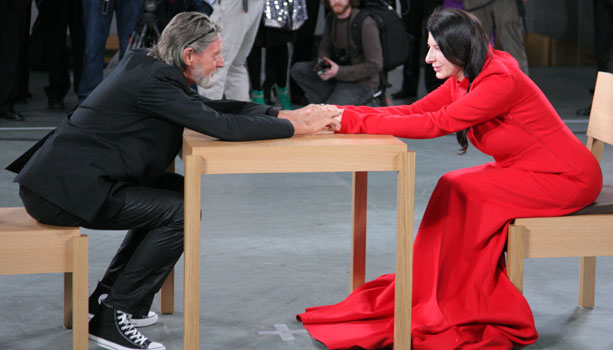
Abramovic and her partner, Ulay, (Frank Uwe Laysiepen, b.Germany Nov 30, 1943) met in the Netherlands where Ulay lived at the time and they began a romantic and professional relationship that was to last a decade. After years of connection they decided to separate and their ending, perhaps inevitably, was executed as performance. Beginning at opposite ends of the wall of China, each walked to a central point where they bid good-bye and parted. Many years later, they met again at an Abramovic performance at MOMA, on November 30 2010. For a span of 716 hours, the artist sat in a chair at a table on stage and invited members of the audience to sit silently with her, staring into each other’s eyes. During the exhibition, Ulay climbed onto the stage to join her, covering her hands with his and engaging her in a long, fixed look. Moments of reflection and memories for them certainly, but also moving for the audience who shared their experience. Even the still photo below reveals the intensity of the encounter. Ulay died recently prompting news stories of their love and art and bringing the pair together again in the world of media.
Performance art intends to provoke and even disturb and there is no doubt that Abramovic succeeds in her mission. In spite of the often difficult nature of her work, I have to say that, of all the art I saw in Belgrade, I was most affected by this exhibit. Other museums and sites we visited informed us about the history, culture and arts of Serbia and we valued them for that; this one left us a little raw but with minds whirling, working to interpret what we had seen. I have since imagined the continued experience of participants through their memories and, perhaps, sharing accounts of the performance with others.
Serbia’s history is complicated and the people of modern Belgrade and Serbia wear that history in every way, including in their art. We felt privileged to gain insights to it all and to begin to understand and experience nuances of shadow and light as we walked through Belgrade into Serbia.
 Lurching towards Italy