Let me introduce you to my coffee pot
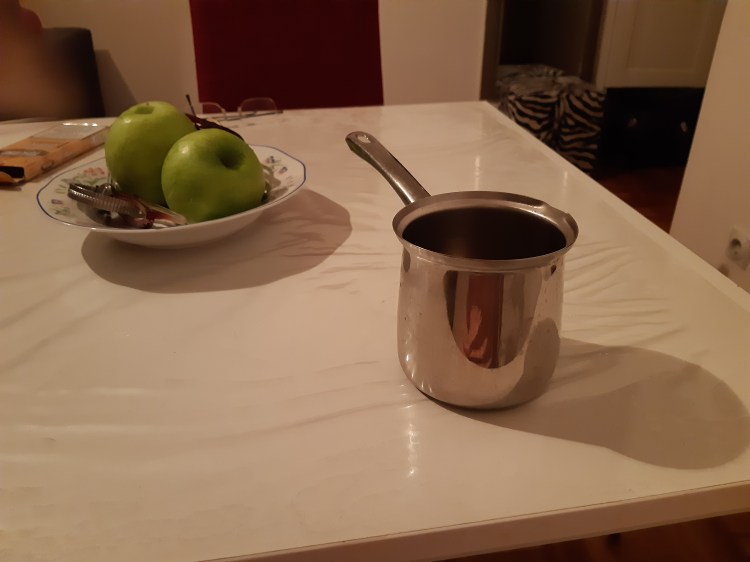
In our apartment in Belgrade this was my coffee maker. I had purchased such a pot, a cezva or ibrik, in a smaller more decorative version, during my previous trip to Serbia but never used it, having bought it simply as an interesting souvenir. It stayed in a cupboard for some years before disappearing, probably to a yard sale or contribution to a thrift store.
Now, my morning caffeine habit required that I actually prepare coffee in this unfamiliar alternative to a French Press or an automatic coffee maker. I purchased finely ground coffee, spooned it into the cesva, added hot water and let it brew for a few minutes before straining it into a cup. Straining was important because it eliminated the layer of foam that rose to the surface, which I regarded as the ruination of a good cup of coffee. When I finished drinking it, a residue of sludge remained at the bottom and that I simply threw away. Basically I was making a form of instant coffee, just not using Nescafe or Taster’s Choice.
Properly made Turkish coffee, though is by no means an instant production. One still starts with the finely ground coffee, adding about a teaspoon of it, and sugar if desired, to a cup of cold water in the cezva. This then goes onto the stove and heated very slowly to maximize flavor. When it reaches boiling point, foam will have accumulated on top and the bubbly froth is scooped off and slid into a serving cup. Coffee remaining in the cezva should sit for another minute or two before pouring it very carefully into the cup, preserving the foam that is considered an integral part of good Turkish coffee. When the coffee is finished, the aforementioned sludge lies at the bottom of the cup and this, as I mentioned, was discarded in my kitchen. But the cup can be turned over so that the residue drips onto a saucer forming patterns used, like tea leaves, to read fortunes. Jova, the all around helper at Ravna, once demonstrated this for us but either his lack of fortune telling skills or nearly non-existent English made his attempt at augury unintelligible. For me, neither foam nor fortunes appealed, but rather just the simple cup of coffee with which I liked to start my day.
The other food preparation challenge I faced in our apartment was lack of a real stove. Instead, there was a toaster oven with two burners on top. Although Terry at 6’2″ could manage the “stove” easily, I had to stand on a stool to use the burners because the little oven sat on top of the refrigerator. I could, however, reach the door of the toaster oven without aid, so we came to appreciate prepared food from the supermarket deli, which only had to be reheated.
In any case, our evening meal tended to be a light one because we were usually in central Belgrade at mid-day and ate a full meal there. Taking Bus 26 from our local bus stop to Republic Square, we could walk easily from there to most places we wanted to visit. With the weather still mild and sunny during our first weeks in Belgrade we enjoyed simply exploring downtown, looking at the architecture and sometimes having the good fortune to come across a performance of music or dance. We were pleasantly surprised by the number of trees thriving in this urban landscape–the wide pedestrian areas, in particular, were tree-lined, providing shade for outdoor cafes set along both sides of the street. Natives and tourists alike gathered here, stopping to rest and chat over a cup of coffee and a snack or lunch. Any of these small bistros would offer a good meal but we especially looked forward to lunch on the Bohemian Street, a popular destination for visitors to Belgrade. Originally settled by gypsies, the late nineteenth century saw an influx of artists of all persuasions, who established the area’s reputation as “Bohemian.” Today, the street is primarily given over to restaurants, all of them good, at least as far as our own experience could verify.
At our first meal in a Bohemian Street restaurant, Terry ordered cevapi, beef sausage, and, sausage lover that he is, found them delicious. My choice was broccoli soup, which came with a delicate pattern of creme fraiche swirled across the top. I debated whether to add a slice of gibeniza as a side but ultimately decided to pass it up. This savory treat, made of layers of phyllo dough and feta cheese, is a popular street food in Serbia and though skipping it that day, there was no lack of opportunities to indulge. As we finished our lunch and prepared to pay the bill, our waiter let us know that “service is not included.” We were a little puzzled since we thought it was and suspected he may have been angling for a bonus. But, when I checked online I found that, unlike western Europe, tips are customary in Serbia, though at about 10% of the bill, half what we Americans have learned to accept. Now we were deeply chagrined, knowing how meager waiters’ salaries are, and felt badly for those we had failed to tip. Apologies to all, and lesson learned.
We found the food in Belgrade to be generally excellent–better, even, than in Italy. Whether we had stopped for a quick lunch at a cafe or decided to enjoy an elegant dinner, the quality and presentation were always outstanding. Traditional Serbian cuisine leans to hearty dishes usually featuring meat. Wienerschnitzel, goulash, pork or veal stews and cevapi or cevapcici, the much loved Balkan sausage, are all popular dishes served throughout the region. But there are vegetarian and vegan restaurants in Belgrade as well and most restaurants offer meatless choices, so those who want to avoid meat can still find a multitude of Serbian dishes to enjoy. Vegetables, however served, are of such fresh, full flavor that every bite is a mouthful of delicious.
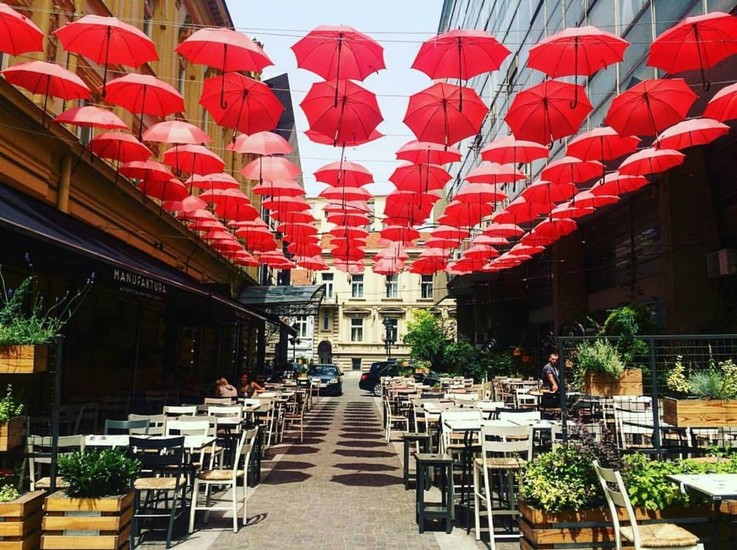
One Belgrade restaurant almost always mentioned on “ten best” lists is Manufaktura, where we ate several times. We liked to sit outside under the canopy of red umbrellas and, since Manufaktura is best known for its traditional dishes, always chose one of those for our meal.
However good the food is and however much we enjoyed it, eating was not our primary objective in Belgrade. I have to admit that shopping claimed that place, not in a general way, but specifically for purchasing a chandelier and a rug or piece of needlework. A chandelier because we had discovered the beauty of Eastern European glass and its use in lighting and wanted to find a good fixture for our dining room. The rugs and needlework because Serbia, in particular southern Serbia, produces exceptional weaving and fabric arts, especially if one can find pieces made when needlework was still a highly valued craft.
Although the particular rug shop recommended by Igor was no longer in business, we stumbled onto another near the Bohemian Street. The owner, who spoke excellent English, showed us a variety of rugs, bringing each onto the street and laying them out to be admired. Although he spent a lot of time with us on our first visit, we bought nothing then and just enjoyed looking at the rugs and exploring his store crowded with stock ranging from the silly-a rubber duck, a plastic Mickey Mouse-to exquisite pieces of clothing and, of course, rugs.
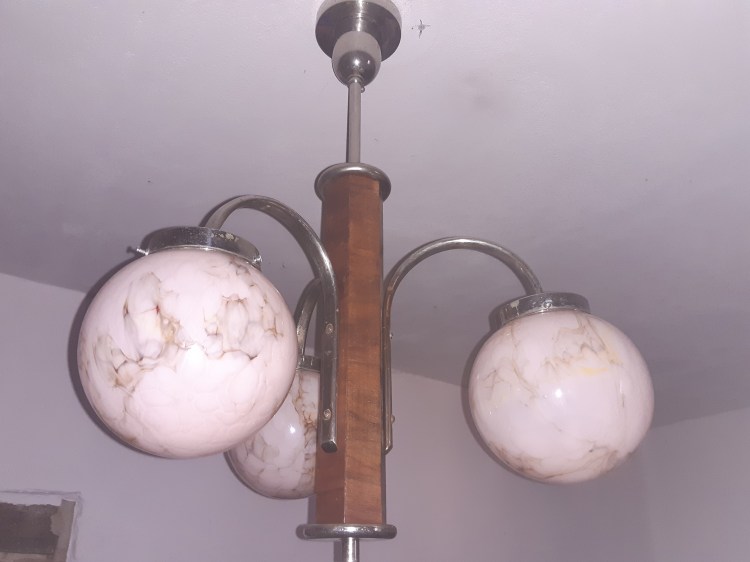
We had no such restraint the day we passed the window of an antiques market and saw hanging there an Art Deco chandelier with marbled, faintly pink globes–perfect! We went in immediately, passing by booths selling hand painted bicycle bells, earrings and other tchotchkes, to find the stall where lighting was sold. Bojan, the owner, was happy to follow Terry outside to identify the chandelier we wanted, then climbed into the display window to take it down.
Bojan, like the vintage shop owner, spoke excellent English and our discussion wandered from purchasing the chandelier to current issues, political views, and finally to war. Serbia’s reputation has been scarred by its attacks on other Jugoslavian republics during the early nineties, and especially for the long Siege of Sarajevo. However, the U S has its own blighted image in Serbia. U S sanctions imposed in the 1990’s, and the bombing of the Chinese Embassy in New Belgrade have not been forgotten. These were sensitive topics for such new acquaintances to touch upon but we all felt comfortable with the conversation and our mutual empathy led Bojan to say of the Siege, ” I was conscripted into the army and told to shoot at people I didn’t know.” Those who serve do not always do so willingly.
Returning to the point of our visit, Bojan offered to pack the chandelier for shipping back to Italy. He suggested we come back in a few days to pay him and he would then give us the globes, securely wrapped to carry home in a suitcase. The body of the chandelier he packed in a box and when we knew the date of our return to Italy, he would take us to the post office to mail it. Over the next several weeks we stopped by his booth several times, first to pay and pick up the globes, then to keep him apprised of our departure plans, which were still uncertain.
With one of the shopping goals satisfied, we returned to the vintage goods shop ready to get serious about a rug. We learned from the owner that his mother had started the business, traveling through southern Serbia to find locally produced textiles and other native treasures. Today he searches for those things on line, juxtaposing the age of technology with centuries old crafts. Although made in a traditional way, more recent rugs often incorporate brilliant colors made from chemical dyes and while they may appeal to some, we favored natural dyes and concentrated on rugs of less vivid hues. The one we chose in the end was attractive in its design and colors and we liked it in spite of its not being the more desirable and beautifully woven Pirot.
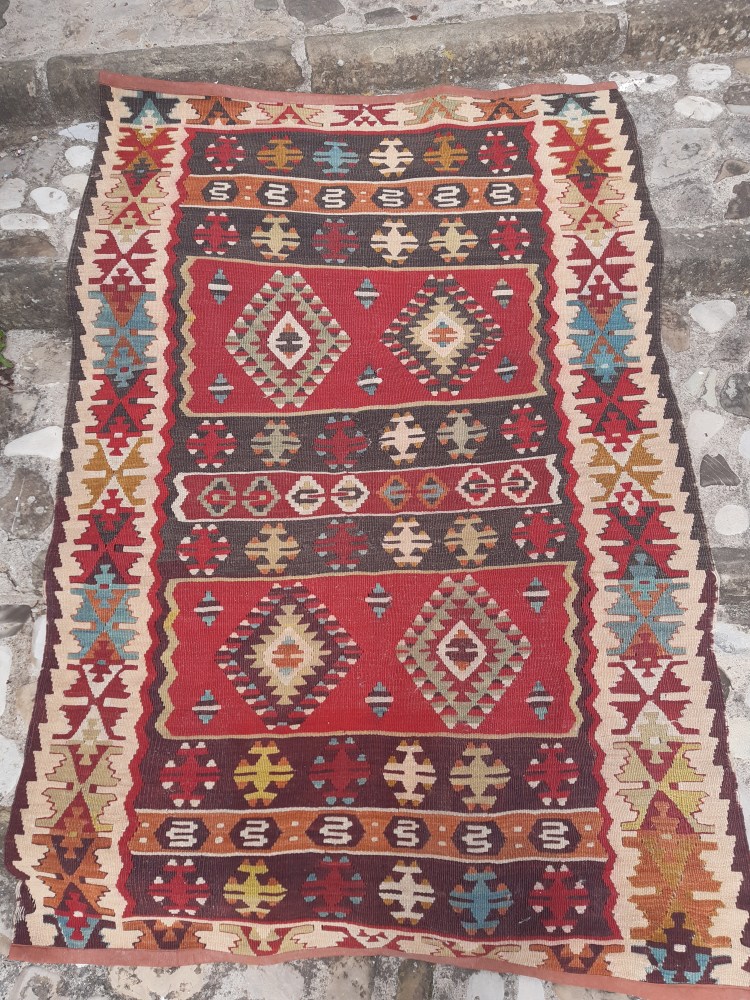
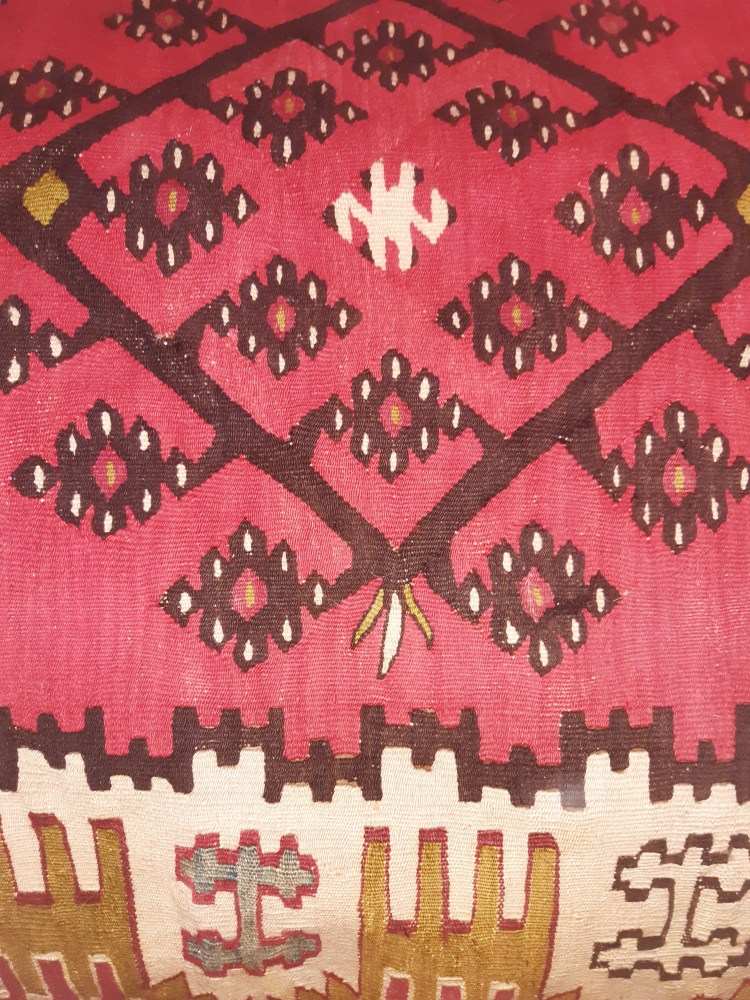
As he noticed our interest in other exquisite but expensive textiles, the owner began to unload a shelf holding small objects to reveal a slightly damaged but still beautiful Pirot wall hanging lying underneath. Now he began to bargain, suggesting a price for both the rug and the hanging. We could not resist agreeing to buy both so after all were able to purchase an attractive and sturdy rug and a fine example of Pirot weaving.
Though we were enjoying Belgrade and all it had to offer, we also kept track of the status of our case challenging the denial of long stay visas in Italy. The court date had been set for October 30, now not far away. Final communication with our lawyer in the last days before he pleaded our case assured us that all that could be done had been done. It was in the hands of the judges of the court to decide whether the Miami consulate had acted appropriately or not. Although our lawyer believed there had been a couple of significant failures, we could not assume the judges would agree.
Soon after our case was heard on the thirtieth, we received an email with the verdict. The Italian court upheld the denial of our visas and the lawyer told us to consider the case lost. Although it was not what we hoped to hear, the outcome was not a surprise. While there were some tenuous options left, pursuing them would be a lengthy process and unlikely to change our status. Moreover, our unpleasant experience with Italian bureaucracy left us with no enthusiasm to continue.
Looking for a positive in the verdict, I recognized that, had the finding been in our favor, that troublesome bureaucracy would have continued to tie knots in our lives. The next step would have been to secure the Permesso di Soggiorno giving us resident status. The process is not nearly as challenging as obtaining a visa, but still requires a series of steps to initiate and secure and has to be renewed every year. Once residents, we would be allowed to buy a car (residency is required) but in order to be legal drivers we would have to take an Italian course in driving and pass road and written tests. Residency provided greater privileges, but would also create problems of its own. I took some comfort in simply being a U S citizen, with the protections it gave us against the less pleasant aspects of Italian law.
Now that we knew that we could not return to Italy until mid-January, contingency plans and tentative reservations made for the next two months became a firm agenda and we began to modify our attitude to one of acceptance. Although simply flying to the states and spending the remaining two months there was an option, we never really considered doing that for a number of reasons and were committed to continuing our Balkan adventure.
 Lurching towards Italy