In considering where we would spend out first period of “exile” outside of Italy, in fact outside of any Schengen country, Northern Macedonia and Albania were both contenders. But when our lawyer mentioned that Serbia was an option, even though it was in the process of joining the EU, we quickly made the decision to go to Belgrade, or Beograd, (white city) as it is known in Serbia. I was somewhat familiar with Serbia, having worked on a dig there in the early nineties. In going to and coming from Ravna, site of the Roman fort we were excavating, I had a spent few days in Belgrade and knew it to be a city with much to offer. There were a number of good museums, a great park built around an ancient fort, and it occupied a strategic and scenic position on the confluence of the Danube and Sava Rivers. Belgrade and Serbia had experienced difficult times since I was last there, but those were now in the past and Belgrade was earning kudos as a great place to visit.
Our flight from Rome arrived just before noon and we took a taxi from Nikola Tesla airport to our apartment in the old part of Belgrade. The apartment we had booked there was in one of the many plain apartment blocks built along the Danube. Igor, the owner, greeted us and introduced us to the flat where we would spend the next month. With a few instructions for shopping, hiring a cab and sightseeing, he was off and we began to settle in.
In our apartment building, as in others nearby, small businesses occupied the ground level spaces. Below us was a tiny bar where neighborhood regulars gathered inside and out in the late afternoon, socializing to the beat of old American rock and roll standards. Across the way was a small store and fruit market, next door a beauty salon, and not far away tech shops, and a diving equipment business. While these businesses and the entrances to apartment buildings were neatly maintained, beyond them litter collected along streets and sidewalks, making the area look slightly tattered around the edges.
In the early evening of our first day we decided to eat out rather than cooking and set off to explore what our neighborhood had to offer. To reach the street beyond our building, we walked down a rocky slope then crossed several railroad tracks, along which sat an abandoned box car, sprayed with graffiti, and settled into place in the weedy landscape. Before our month was over this approach to the street would become as familiar to us as it was to the locals, all of us regularly choosing that route rather than climbing stairs to use the nearby overpass.
The closest street didn’t offer a full scale restaurant but we came upon a small bar where we hoped we would find some sort of food service. An all male crowd sitting at the few tables fell suddenly silent as we walked in, clearly strangers to the neighborhood. We were not certain whether food was served here, but after some initial confusion it seemed that a meal of sausage could be prepared, which satisfied Terry but held no appeal for me. In just a short time he was served a plateful of food holding two sausages, each the size of an American foot long hot dog, and generous sides of potatoes and sliced tomatoes. Although a much larger meal than Terry anticipated, good manners required that he dig in. Not very hungry myself, I slipped a tomato slice now and then from his plate, happy to call this dinner. Noticing what I was doing, one of the men, clearly a familiar in the bar, possibly the owner, brought me a plate and silverware. Then apparently deciding a few tomatoes did not constitute a meal, he retreated to the kitchen again and in a few minutes returned with a piece of meat he had cooked. He placed a portion on my plate, then sat down at the next table to enjoy his share. The first crusty bite tasted delicious; the second made me gag slightly and I realized then that the meat was liver, without a doubt my least favorite food. The remainder went, I hope discreetly, onto Terry’s plate. Now he had what remained of two large sausages plus the liver to eat and heroically downed it all.
Fortunately, Terry, true to his Slavic roots, thoroughly enjoyed his dinner and vigorously signaled his pleasure to the cook and everyone else in the bar. And with that, we were now all newly made friends. One of the men spoke good English, another was able to speak some, so communication, though a bit limited, was not only possible but enthusiastic, accompanied by a great deal of hand shaking and back patting. As we left, I said, “we’ll be back,” and one of the men responded “when?” flattering us with the idea that he looked forward to seeing the Americans return. Actually, we never ate there again and it was probably our loss.
The next morning Django and I headed for the nearby Danube, where he and I would walk every morning. This time, though, it was our first real walk without Grappelli. Once we reached the riverside, and I saw the number of dogs, some on leash, some not, I realized that had she been with us, the walk here would have been a challenge. Grappelli always reacted aggressively to the approach of another dog, lunging and barking whenever one came close. In these first days along the river, Django carried on in the same way, having learned the behavior from her, but in time he became more relaxed and even comfortable in the presence of other dogs.
No doubt any riverside walk is gratifying but this one offered even more than the usual pleasures. There was a bike trail, a pedestrian walk, playgrounds for children, exercise areas for adults and a number of sculptures, all adjacent to the river. Swans and other waterbirds floated by, occasionally turning tails into the air as they dived for fish. A number of houseboats parked at the river’s edge offered food and drink and sometimes, for the young and vigorous, a raucous evening of music and dance after dark. Across the river I could see thick forest, just beginning to show a change of color as fall approached. The great Serbian tennis player, Novak Djokovic, chose this spot to build his tennis center, a large compound of courts, restaurants and swimming pools. To see a bit of the area and Novak waving at you from the top of his building, go to:
http://www.youtube.com/watch?v=2jLD3QAgxq8
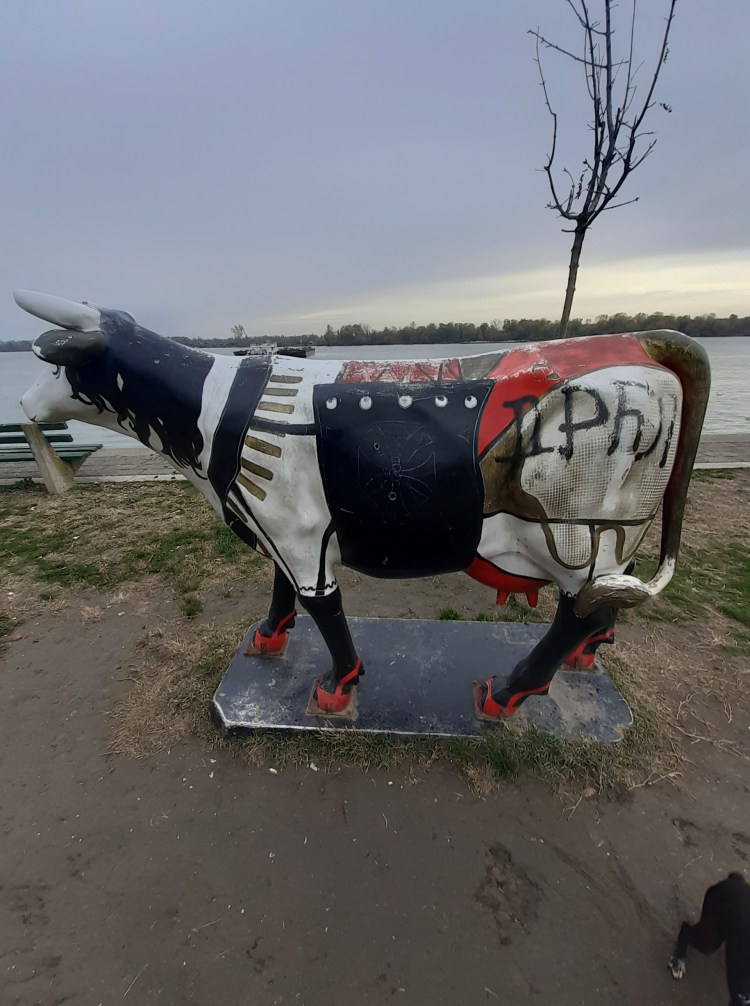
Our neighborhood was located on the edge of Dorcol, a district in Belgrade that is part of the original city, called Stari Grad or “old city.” The oldest house in Belgrade is there, a simple structure that would escape notice except for a sign identifying it. Dorcol is regarded as a highly desirable, vibrant area and its energy was evident as we walked deeper into the district. The stores, restaurants and services provided everything we would need during our month in the city and were only a short walk from our apartment. A restaurant there, the “Dorian Gray, became one of our favorites. Named for Oscar Wilde’s novel, it was an elegant pair of rooms on two open levels, decorated and furnished in the style of a late nineteenth century British dining room. We never really understood why its foreign literary theme was chosen, but returned several times to enjoy its outstanding food and ambiance.
Because central Belgrade was much more than a walk away, we learned to use the bus system, walking across the railroad tracks to the nearest stop. The tickets were inexpensive, and driving in Belgrade would have been a much greater challenge than we could manage. Besides the traffic and unfamiliarity with the city, all street signs were written in the Cyrillic alphabet so were unintelligible to us. The first order of business, and first bus ride after we arrived, was to get a SIM card in order to maintain telephone contact with friends and family. Being entirely ignorant of where to find SIM cards or even how to install one, we stopped at a mobile phone store to ask for help. Fortunately the young man there not only spoke English, but was happy to practice. He directed us to a nearby kiosk where we could buy a SIM card as well as a supply of minutes to use and offered to set us up with the service.
He not only did that, but spent quite a bit of time with us talking about Serbia’s history, its economy, whether it would be good to join the EU and generally helping us to understand more about the city and country we were in. Belgrade, he told us, had been leveled fifty-two times in its history and recovered each time to become the city it is today. He also talked about the plight of young adults and the difficult economy that kept them from advancing. Many were emigrating to Germany hoping to find work and establish a career there, possibly never to return. Like most other Serbians we came to know, he was completely opposed to joining the EU, citing the restrictions and costs, which he thought were onerous and primarily advantageous to the EU not Serbia. Much of what he said may be true, but we became aware during our time in the Balkans that these countries exist behind a barrier erected by European Union policy and are disadvantaged in a number of ways by the exclusion.
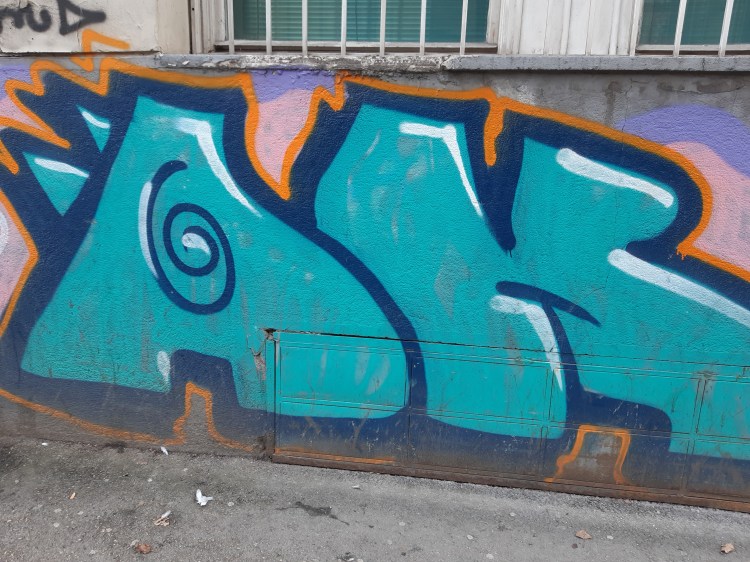
In our first days in Belgrade we were astonished by the graffiti found everywhere–on older and newer buildings and in almost every section of the city. I was captivated by this street art, but also wondered why it was tolerated. It is, after all, a form of vandalism. Still, much of it is beautiful and so skillfully executed that it rises to the level of art. The artist Jean-Michel Basquiat, as one example, first made his mark painting graffiti in the streets of New York before turning to canvas. In Belgrade, many of the works had a political message, though our inability to read Serbian made most of these obscure to us. We could, however, appreciate the skill of their execution and eventually came to recognize the works of specific individuals.
Our first week in Belgrade was spent exploring and getting comfortable with this new environment. We began to use a few basic words of Serbian–dobro dan (hello, good day), molim (please or excuse me), hvala (thank you), and found that ciao works as well in Serbia as in Italy. Since the Serbian currency was the RSD or dinars, we also needed to learn how to calculate costs against the Euro or dollar. We still had much to learn and do in the time remaining and as the week passed we looked forward to taking advantage of more that this great city offered.
 Lurching towards Italy